

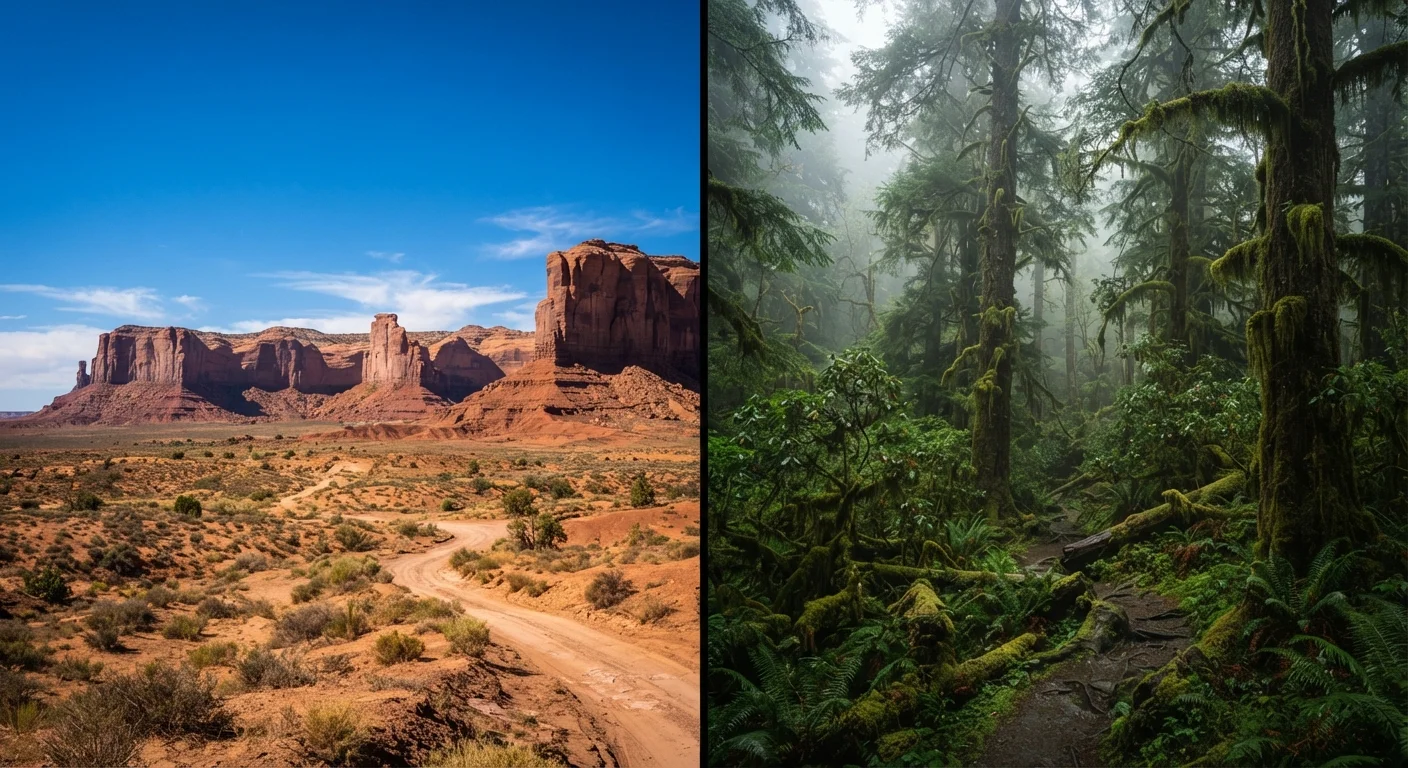
Option A
American Southwest Desert
The sun-baked, canyon-carved wilderness of ancient earth.
Best for: Travelers who crave wide-open skies, towering red rock formations, star-filled nights, and dry-heat adventure.
Option B
Pacific Northwest Rain Forest
The emerald, mist-wrapped world where giant trees reign.
Best for: Travelers drawn to lush, cool greenery, dramatic coastal scenery, and the hushed wonder of old-growth wilderness.
Two Worlds, One Country
Few contrasts in American geography are as striking as the one between the arid Southwest and the rain-soaked Pacific Northwest. One offers bone-dry canyons baked in relentless sun; the other shelters cathedral groves of Sitka spruce draped in moss so thick it muffles sound. Both are extraordinary — and choosing between them (or planning which to visit first) comes down to what kind of traveler you are.
The American Southwest Desert spans parts of Utah, Arizona, Nevada, and New Mexico. It's home to Zion, Bryce Canyon, Arches, Canyonlands, and the Grand Canyon — a cluster of national parks unmatched anywhere on Earth for sheer geological drama. Meanwhile, the Pacific Northwest Rain Forest reaches its purest expression in Washington's Olympic National Park, where the Hoh Rain Forest receives among the highest rainfall of any spot in the contiguous United States. For a broader look at how these regions fit into America's public lands system, see what makes each national park region distinct.
| Criterion | Southwest Desert | Pacific Northwest Rain Forest |
|---|---|---|
| Climate | Hot, dry; extreme summer heat | Cool, wet; mild summers |
| Annual Precipitation | Under 10 inches in most areas | Up to 140 inches (Hoh Valley) |
| Signature Landscapes | Red rock canyons, mesas, arches | Old-growth forest, sea stacks, coast |
| Key National Parks | Grand Canyon, Zion, Arches, Bryce | Olympic National Park |
| Wildlife | Condors, mule deer, bighorn sheep | Roosevelt elk, black bear, sea otters |
| Best Season to Visit | Spring and fall | July and August for least rain |
| Crowd Levels | Very high at peak parks in summer | Moderate; less congested than Southwest |
| Essential Gear | Sun protection, hydration, layers | Waterproof jacket, waterproof boots |
Climate, Conditions, and What to Pack
In the Southwest, summer temperatures routinely exceed 100°F in canyon bottoms and at lower elevations. Heat-related illness is a genuine hazard — rangers at Grand Canyon treat dozens of cases each season. That said, higher-elevation parks like Bryce Canyon (around 8,000 feet) stay dramatically cooler, and desert nights can turn surprisingly cold regardless of elevation. Elevation affects more than temperature — it changes how your body performs, how fast weather shifts, and even how food cooks.
The Pacific Northwest Rain Forest operates on entirely different logic. The Olympic Peninsula's western valleys receive roughly 12 feet of rainfall annually. Summers are relatively mild and occasionally sunny — July and August are the driest months — but waterproof layers and sturdy boots are never a mistake. Fog, drizzle, and mist are part of the atmosphere, not obstacles to it.
140"
Annual rainfall in the Hoh Rain Forest
The Hoh Valley on Washington's Olympic Peninsula is one of the wettest spots in the contiguous United States, according to National Park Service data.
5
Utah national parks within 6 hours of each other
Utah's 'Mighty Five' — Zion, Bryce, Capitol Reef, Canyonlands, and Arches — form one of the most concentrated clusters of national parks in North America.
6M+
Annual visitors to Grand Canyon National Park
Grand Canyon consistently ranks among the most-visited national parks in the US, making timing and planning especially important for visitors.
For either region, visiting in shoulder season — spring or fall — meaningfully reduces crowds, eases parking chaos, and in the desert's case, makes outdoor exertion genuinely pleasant.
Experiences, Wildlife, and What You'll Remember
Southwest desert travel is viscerally about scale. Standing at a canyon rim, watching shadows crawl across layered red and orange sandstone, produces a kind of geological awe that's hard to find elsewhere. Hiking slot canyons — narrow passages where walls glow amber in filtered light — is a singular experience. Stargazing in parks like Capitol Reef or Canyonlands, both designated International Dark Sky Parks, is among the best in North America.
The rain forest experience is subtler but no less profound. The Hoh Rain Forest trail system winds through old-growth Sitka spruce and western red cedar trees hundreds of years old, their roots tangled over mossy nurse logs, everything damp and alive. Roosevelt elk — the largest subspecies of elk in North America — roam the forest floor in herds that stop hikers in their tracks. The Olympic coast adds tide pools, sea stacks, and dramatic Pacific vistas to an already layered destination.
Planning a driving loop through either region? Our guide to road-tripping through the American West covers routes, pacing, and what to realistically expect from parks that draw millions of visitors.
Safety Considerations for Both Regions
In the Southwest, always carry more water than you think you need — the NPS recommends at least one liter per hour of strenuous hiking in heat. In the Pacific Northwest rain forest, be aware of rapidly changing coastal weather and trail conditions after heavy rain. Always check current park alerts and ranger advisories before heading out, and verify any entry requirements or permit systems with official National Park Service sources, as these change seasonally.
The content provided on our blog site traverses numerous categories, offering readers valuable and practical information. Readers can use the editorial team’s research and data to gain more insights into their topics of interest. However, they are requested not to treat the articles as conclusive. The website team cannot be held responsible for differences in data or inaccuracies found across other platforms. Please also note that the site might also miss out on various schemes and offers available that the readers may find more beneficial than the ones we cover.