

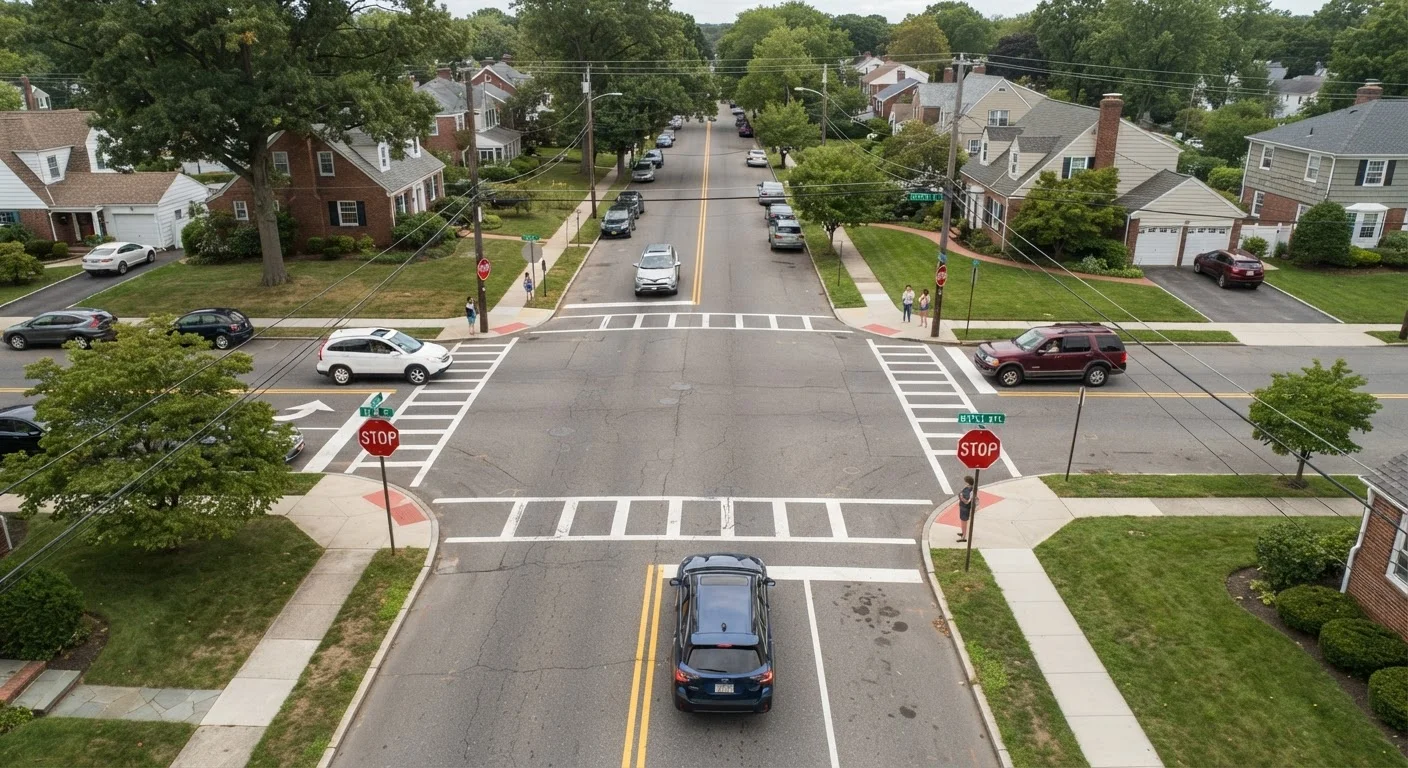
Why Right-of-Way Confusion Causes Crashes
Right-of-way rules are among the most frequently misapplied traffic laws in the United States. Misunderstandings at intersections, on-ramps, and crosswalks contribute to hundreds of thousands of crashes annually, many of which are entirely preventable. The problem isn't that drivers don't care - it's that many learned incorrect rules, or were never taught the nuances in the first place.
This article tackles the myths head-on, replacing them with what traffic law and driving standards actually say. For a broader look at how rules differ across the country, see our guide to traffic laws that vary by state.
Myth
At a four-way stop, you always yield to the car on your right - no matter when it arrived.
Fact
The first vehicle to come to a complete stop goes first. The yield-to-the-right rule only applies when two vehicles arrive at the same time.
The yield-to-the-right principle is a tiebreaker, not the primary rule. When two vehicles reach a four-way stop simultaneously, the driver on the left yields to the driver on the right. But if one car clearly arrived and stopped before another, that first car proceeds first - regardless of direction. Treating the right-side rule as universal creates unnecessary hesitation and can actually cause the stop-and-go standoffs many drivers have experienced.
Myth
When you're merging onto the highway, cars already on the highway must move over to let you in.
Fact
Merging drivers are legally required to yield to highway traffic. Highway drivers have no duty to change lanes, though courtesy often leads them to do so.
On-ramp acceleration lanes are designed to give merging drivers enough distance to match highway speeds and find a safe gap - not to force existing traffic to accommodate them. Most state vehicle codes place the full obligation on the merging driver. While many highway drivers will shift lanes when it's safe and practical, they are not legally required to do so. Assuming otherwise puts the merging driver at fault in a collision.
Myth
At a roundabout, whoever has been waiting the longest has the right of way to enter.
Fact
Any vehicle already circulating inside the roundabout has the right of way. Waiting time at the entry point is legally irrelevant.
Roundabouts operate on a yield-at-entry model: drivers entering must wait for a safe gap in the circulating flow before proceeding, regardless of how long they've waited at the yield line. This rule applies equally at single-lane and multi-lane roundabouts. The logic is that stopping circulating traffic to let entering vehicles in would defeat the roundabout's purpose of maintaining continuous flow and reducing conflict points.
Myth
A pedestrian only has the right of way if they're in a marked crosswalk with a walk signal.
Fact
Pedestrians have the right of way in both marked and unmarked crosswalks at intersections, with or without a signal, in most states.
Under the Uniform Vehicle Code - which forms the basis for most state traffic laws - a crosswalk exists at every intersection where sidewalks meet the roadway, whether or not lines are painted on the pavement. Once a pedestrian steps into that crossing, drivers are generally required to stop and remain stopped until the pedestrian has cleared the lane. Mid-block crossings without signals carry different rules, and specifics vary by state, so it's always worth knowing the pedestrian laws where you drive most.
Myth
If you're turning right on red, oncoming pedestrians must wait for you to complete your turn.
Fact
Pedestrians crossing with a walk signal have the right of way over vehicles turning right on red.
A right-on-red turn is a conditional privilege, not an automatic right. Before proceeding, the driver must come to a complete stop, yield to all cross traffic, and - critically - yield to pedestrians lawfully in the crosswalk. A pedestrian crossing on a walk signal in the path of a right-turn has the right of way. Failing to yield in this situation is both illegal and a common cause of pedestrian injuries at signalized intersections.
Merging, Roundabouts, and Pedestrians: Setting the Record Straight
Beyond four-way stops, three situations generate the most driver confusion: highway merges, roundabouts, and pedestrian crossings. Each has a clear legal framework - but common assumptions often contradict it.
~40%
Of U.S. crashes occur at intersections
According to the Federal Highway Administration, roughly 40 percent of all traffic crashes in the United States occur at or near intersections, many involving right-of-way errors.
3,000+
Roundabouts now operating in the U.S.
The Insurance Institute for Highway Safety notes that the U.S. has seen rapid roundabout growth, with research showing roundabouts reduce fatal crashes by roughly 90 percent compared to signalized intersections.
Roundabouts are a growing source of uncertainty for American drivers. The core rule is straightforward: traffic already circulating inside the roundabout has the right of way. Entering drivers must yield, regardless of how long they've been waiting. For a full walkthrough of roundabout navigation, see our roundabout guide for first-timers.
On highway on-ramps, many drivers believe the highway lane must accommodate them. It does not. The merging vehicle carries the legal burden to find a safe gap. That said, defensive driving - and courtesy - means highway drivers who can safely create space often do so. The legal obligation, however, rests with the entering driver. Learn more about what on-ramps are actually designed to do before your next highway entry.
Aggressive Right-of-Way Assumptions Carry Legal Risk
Insisting on your right of way when another driver has clearly not yielded - and proceeding anyway - can result in a collision for which you may share fault. Courts and insurers look at whether a driver took reasonable precautions, not just who had the technical right of way. If you see a driver about to run a stop sign or blow through a merge, yielding is the safer and legally defensible choice. For more on where the law draws the line on aggressive driving, see our guide to road rage and aggressive driving.
Pedestrian right-of-way is also widely misread. In most states, a pedestrian who has stepped into a marked or unmarked crosswalk at an intersection has the right of way - and drivers must stop, not merely slow. Failing to yield to a pedestrian in a crosswalk is a moving violation in every U.S. state. For a comprehensive overview of road rules across common situations, consult America's driving laws reference guide.
The content provided on our blog site traverses numerous categories, offering readers valuable and practical information. Readers can use the editorial team’s research and data to gain more insights into their topics of interest. However, they are requested not to treat the articles as conclusive. The website team cannot be held responsible for differences in data or inaccuracies found across other platforms. Please also note that the site might also miss out on various schemes and offers available that the readers may find more beneficial than the ones we cover.