

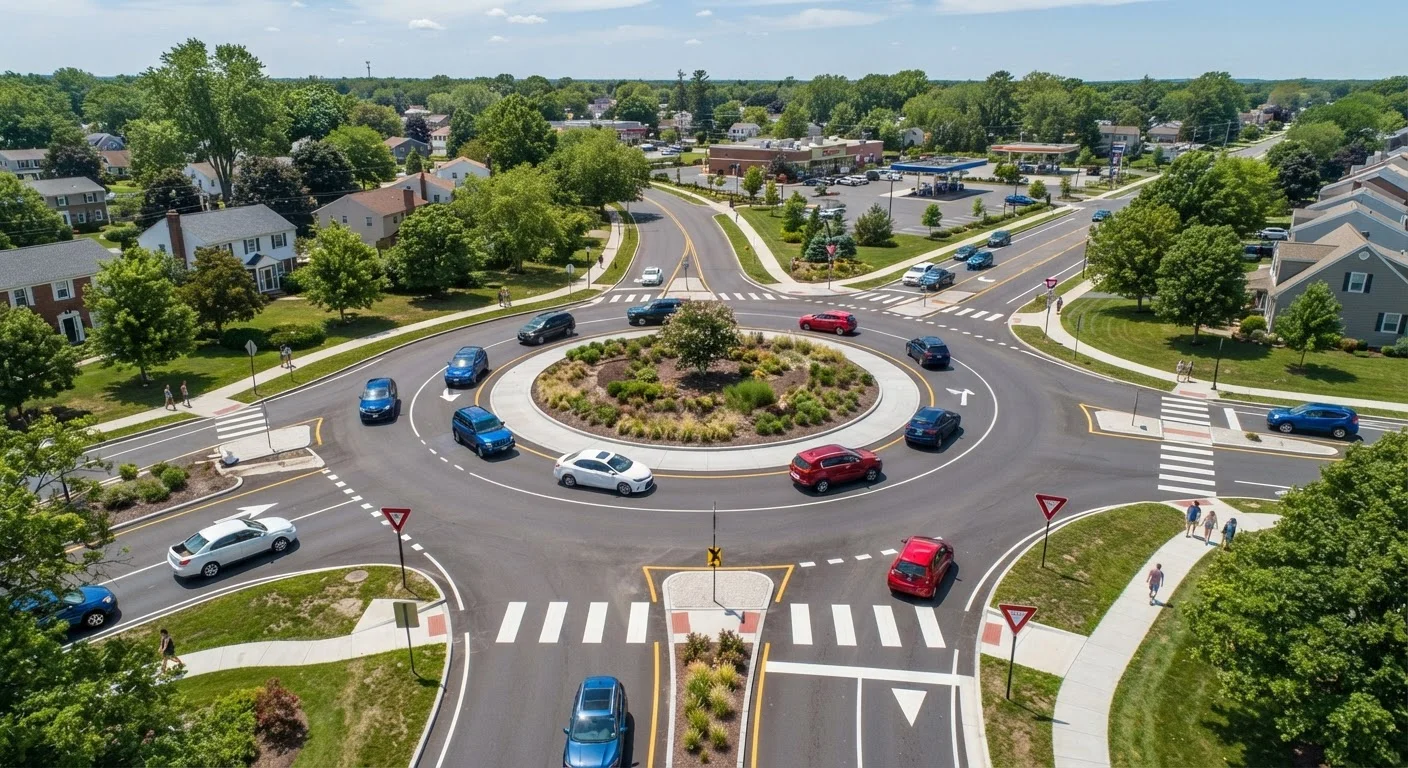
Why Roundabouts Work - and Why They Confuse American Drivers
Roundabouts have been a standard intersection design in Europe and Australia for decades, but they remained relatively rare in the United States until the late 1990s. Since then, state and local transportation departments have installed thousands of them - partly because research consistently shows they reduce fatal and injury-causing crashes compared with traditional signalized intersections, largely by eliminating high-speed right-angle collisions.
For many American drivers, confusion stems from one core misunderstanding: the roundabout is not a four-way stop, and it is not a free-for-all. It is a yield-on-entry system. Vehicles already traveling inside the circle have the right of way, and entering vehicles must wait for a safe gap before joining. Once that principle clicks, everything else follows logically. For a broader look at how right-of-way works across different intersection types, see our guide to right-of-way rules American drivers get wrong most often.
Plan Your Lane Before You Arrive
Multi-lane roundabouts post guide signs in advance showing which lane leads to which exit. Check those signs early - typically 200-300 feet before the entry - so you can position your vehicle without rushing. At single-lane roundabouts, lane choice is not an issue.
Before You Enter: What to Look For
Approach every roundabout expecting to slow down, not to stop. Scan for three things simultaneously:
- Directional signs: Posted well before the entry, these tell you which lane leads to which road or destination.
- Circulating vehicles: Traffic flows counterclockwise in the U.S. Look left for any vehicle already in the circle.
- Pedestrians and cyclists: Crosswalks sit just outside the entry and exit points. Yield to anyone in or entering a crosswalk.
Emergency vehicles are the one exception to normal roundabout flow. If you hear or see an emergency vehicle approaching, exit the roundabout if you can do so safely, then pull over. Do not stop inside the circle. This and other road-rule fundamentals are covered in our road rules reference for American drivers.
Yield Does Not Mean Stop
Many first-time roundabout drivers either stop unnecessarily - causing rear-end risk - or roll through without yielding at all. The rule is simple: slow down as you approach, check for vehicles already in the circle, and enter only when there is a safe gap. If traffic is clear, you do not need to stop.
Step-by-Step: How to Navigate a Roundabout
Follow these steps every time you encounter a roundabout, whether it is a compact single-lane circle or a larger multi-lane intersection.
Reduce your speed well before the roundabout
Begin slowing to roughly 15-20 mph as soon as you see the roundabout warning sign - typically a yellow diamond with a circular arrow. This gives you time to read any directional signs, identify your exit, and choose the correct entry lane on multi-lane roundabouts.
Choose the correct lane before entering
At single-lane roundabouts, there is nothing to decide. At multi-lane roundabouts, use the left lane for exits on the left side or for going straight past the midpoint, and the right lane for immediate right-turn exits. Road markings and overhead signs confirm the correct choice - follow them.
Yield to circulating traffic at the entry line
The dashed yield line at the entry is your decision point. Look left (in the U.S., traffic flows counterclockwise) and check for vehicles already in the circle. If the gap is clear and safe, proceed smoothly. If vehicles are close, wait until a comfortable gap opens.
Enter and maintain a steady, moderate speed
Once inside, keep pace with the natural flow - typically 15-20 mph. Avoid braking sharply or accelerating aggressively. Stay in your lane, keep a safe following distance from the vehicle ahead, and watch for pedestrians at the crosswalks positioned just outside each entry and exit.
Signal right as you approach your exit
Activate your right-turn signal when you pass the exit before the one you want. This alerts other drivers and cyclists that you are about to leave the circle. Do not signal before entering - it can mislead waiting drivers into thinking you will turn before reaching the circle.
Exit the roundabout and cancel your signal
Steer smoothly into your exit lane, check for pedestrians on the crosswalk ahead, and accelerate to match the speed of the road you are joining. Cancel your turn signal once you have exited. If you missed your exit, continue around the circle and try again - do not brake sharply or reverse.
Common Mistakes and How to Avoid Them
Even experienced drivers can develop bad habits at roundabouts. The most frequent errors include:
- Stopping unnecessarily at the entry
- A clear circle means you should enter without stopping. Hesitating too long backs up traffic and creates rear-end risk.
- Failing to signal the exit
- Signaling is legally required in most states and practically essential - it prevents other drivers from entering directly into your path as you exit.
- Changing lanes inside the circle
- This is one of the leading causes of roundabout collisions. Commit to your lane before entering.
- Entering too fast
- High entry speed reduces reaction time and makes the tight curve uncomfortable to navigate. Slow down before the yield line, not after.
New and returning drivers will find additional context in The New Driver's Complete Guide to American Roads, which covers roundabouts alongside other essential intersection types.
Never Stop or Reverse Inside the Circle
Stopping mid-roundabout or attempting to reverse creates an immediate collision risk. If you miss your exit, stay in the circle and go around again - it is completely legal and far safer than any sudden maneuver.
The content provided on our blog site traverses numerous categories, offering readers valuable and practical information. Readers can use the editorial team’s research and data to gain more insights into their topics of interest. However, they are requested not to treat the articles as conclusive. The website team cannot be held responsible for differences in data or inaccuracies found across other platforms. Please also note that the site might also miss out on various schemes and offers available that the readers may find more beneficial than the ones we cover.