

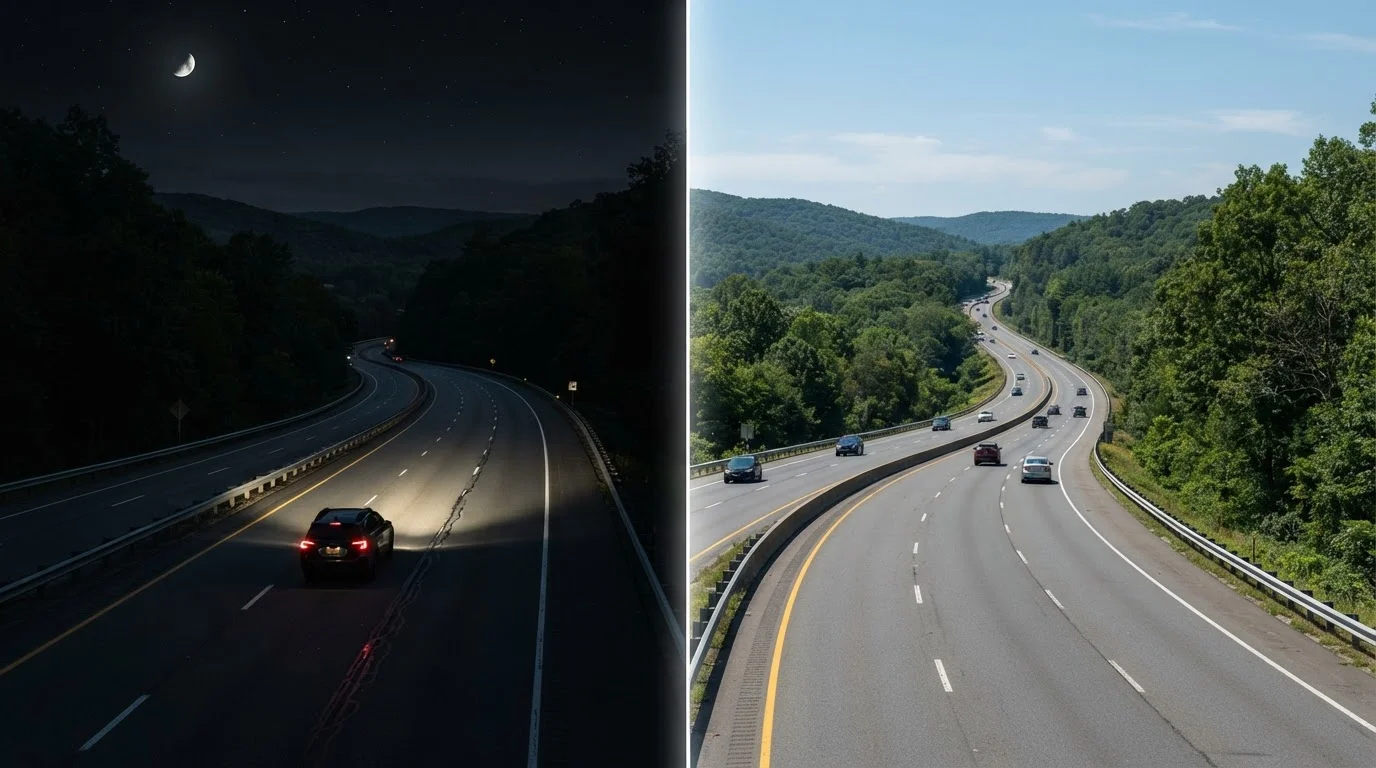
Our Verdict
Daytime driving offers superior visibility, faster hazard recognition, and lower fatigue risk - making it objectively safer for most drivers in most conditions. Nighttime driving, while unavoidable for many Americans, demands a distinct set of habits: reduced speed, greater following distance, clean headlights, and honest awareness of fatigue. Understanding what actually changes after dark - not just lighting, but perception and reaction - is the foundation of driving safely around the clock.
| Best for | Recommended |
|---|---|
| Drivers who can choose their departure time | Daytime driving |
| Essential travel or work requiring nighttime operation | Night driving with deliberate adjustments |
| Long highway road trips spanning multiple hours | Daytime driving with planned rest stops |
| Urban commuters in well-lit areas after dark | Night driving with heightened pedestrian awareness |
The Real Statistics Behind Night Driving Risk
Most drivers instinctively understand that nighttime is more dangerous, but the numbers make the gap concrete. According to the National Highway Traffic Safety Administration (NHTSA), fatal crash rates per mile driven are significantly higher at night than during the day - despite substantially lower traffic volumes after dark. Fewer cars on the road means less congestion, yet the risk per trip rises sharply.
The reasons go well beyond the obvious absence of sunlight. Impaired and intoxicated drivers are disproportionately active between 10 p.m. and 2 a.m. Pedestrians and cyclists are harder to detect. Road hazards - debris, animals, unmarked construction zones - appear with far less warning. And crucially, many drivers underestimate how much their own fatigue is affecting their reaction time and judgment.
~50%
Fatal crashes that occur at night
According to NHTSA data, approximately half of all fatal traffic crashes occur during nighttime hours, despite far lower traffic volume than daytime.
3x
Higher nighttime fatality rate per mile
NHTSA research indicates the fatality rate per mile driven at night is roughly three times higher than during daylight hours.
0.08% BAC equivalent
Impairment level after 20+ hours without sleep
The AAA Foundation for Traffic Safety found that 20+ hours of wakefulness produces impairment comparable to the U.S. legal drunk-driving limit.
Understanding these dynamics is the first step. For a broader foundation on safe driving habits, see our guide to defensive driving.
Visibility, Perception, and Reaction Time: What Actually Changes
Human eyes are not equally effective in all lighting conditions. At night, vision shifts from cone-dominated (color, detail) to rod-dominated (motion, low contrast), reducing the sharpness of your peripheral field and making it harder to judge the speed and distance of oncoming vehicles. This is why depth perception degrades noticeably after dark - a fact most drivers haven't fully considered.
Standard low-beam headlights illuminate roughly 160 feet ahead. At 60 mph, your vehicle covers that distance in under two seconds. If a stopped car, deer, or debris appears at the edge of your headlight range, you may not have enough time to stop - a phenomenon safety researchers sometimes call "overdriving your headlights." High beams extend that range to around 350-400 feet, but they must be dimmed for oncoming traffic.
| Factor | Daytime Driving | Nighttime Driving | |
|---|---|---|---|
| Visibility range | Full natural light, wide field | Limited to headlight range (~160-400 ft) | |
| Depth perception | Normal, cone-based vision | Reduced; rods dominate, detail lost | |
| Fatigue risk | Lower; circadian rhythms support alertness | Higher; especially midnight-6 a.m. | |
| Impaired driver prevalence | Lower overall | Significantly higher late at night | |
| Pedestrian/wildlife risk | Easier to spot with full visibility | Harder to detect; shorter reaction time | |
| Recommended following distance | 3-second minimum | 4+ seconds recommended |
Headlight condition also matters enormously. Yellowed or foggy headlight lenses can reduce light output by more than 50%, dramatically shrinking your usable visibility. Keeping lenses clean and lenses replaced on schedule is a maintenance task that directly affects night-driving safety. For a broader vehicle readiness review, our road trip safety checklist covers headlights alongside tires, fluids, and documentation.
Fatigue: The Hidden Night Driving Risk
Driver fatigue is most severe in the early morning hours, typically between midnight and 6 a.m., aligning with the human body's natural circadian low point. Research from the AAA Foundation for Traffic Safety has found that going without sleep for 20 or more hours produces impairment comparable to a blood alcohol concentration of 0.08% - the legal limit in every U.S. state.
Unlike alcohol impairment, fatigue is often invisible to the driver experiencing it. Many people believe they can "push through" tiredness with caffeine or loud music, but these are temporary measures that mask - rather than reverse - declining reaction time and decision-making. Microsleep episodes (brief, involuntary sleep events lasting just a few seconds) can occur without the driver's awareness and are particularly deadly at highway speeds.
Plan Rest Stops Before You Need Them
Do not wait until you feel dangerously tired to stop driving. By the time microsleep episodes begin, your judgment about your own alertness is already compromised. On any drive lasting more than two hours at night, identify rest areas or safe stops in advance and use them proactively. A 20-minute nap at a rest area is far safer than pushing through fatigue.
If you drive long distances at night, planning rest stops is not optional - it is a safety requirement. Our complete guide for new drivers addresses fatigue management alongside other essential road skills.
Practical Adjustments for Safer Night Driving
Knowing the risks is only useful if it changes behavior. Several adjustments can meaningfully reduce night driving hazards:
- Reduce speed: Lower speed extends the time available to react when hazards appear at the edge of headlight range.
- Increase following distance: The standard three-second gap recommended during the day should be extended at night to account for slower hazard detection.
- Use high beams deliberately: Switch to high beams on unlit rural roads when no oncoming traffic is present; return to low beams promptly when approaching other vehicles.
- Keep windshield and lenses clean: Interior windshield grime creates glare from oncoming headlights; dirty headlight lenses reduce your output significantly.
- Watch for wildlife and pedestrians: Both appear with much shorter warning at night. Scanning the road edges - not just the center - catches hazards earlier.
- Be honest about fatigue: Pull over and rest if you experience heavy eyelids, drifting lanes, or difficulty remembering recent miles driven.
Some of these adjustments also intersect with state-specific legal requirements. Headlight use laws, speed limits on rural roads, and rules about when high beams must be dimmed vary by jurisdiction. See our overview of traffic laws that vary by state for context on what the rules look like where you drive.
Tire condition also affects night driving performance - particularly during emergency braking. Proper tire pressure ensures maximum contact patch and shorter stopping distances, both of which matter more when reaction time is already compressed.
The content provided on our blog site traverses numerous categories, offering readers valuable and practical information. Readers can use the editorial team’s research and data to gain more insights into their topics of interest. However, they are requested not to treat the articles as conclusive. The website team cannot be held responsible for differences in data or inaccuracies found across other platforms. Please also note that the site might also miss out on various schemes and offers available that the readers may find more beneficial than the ones we cover.