

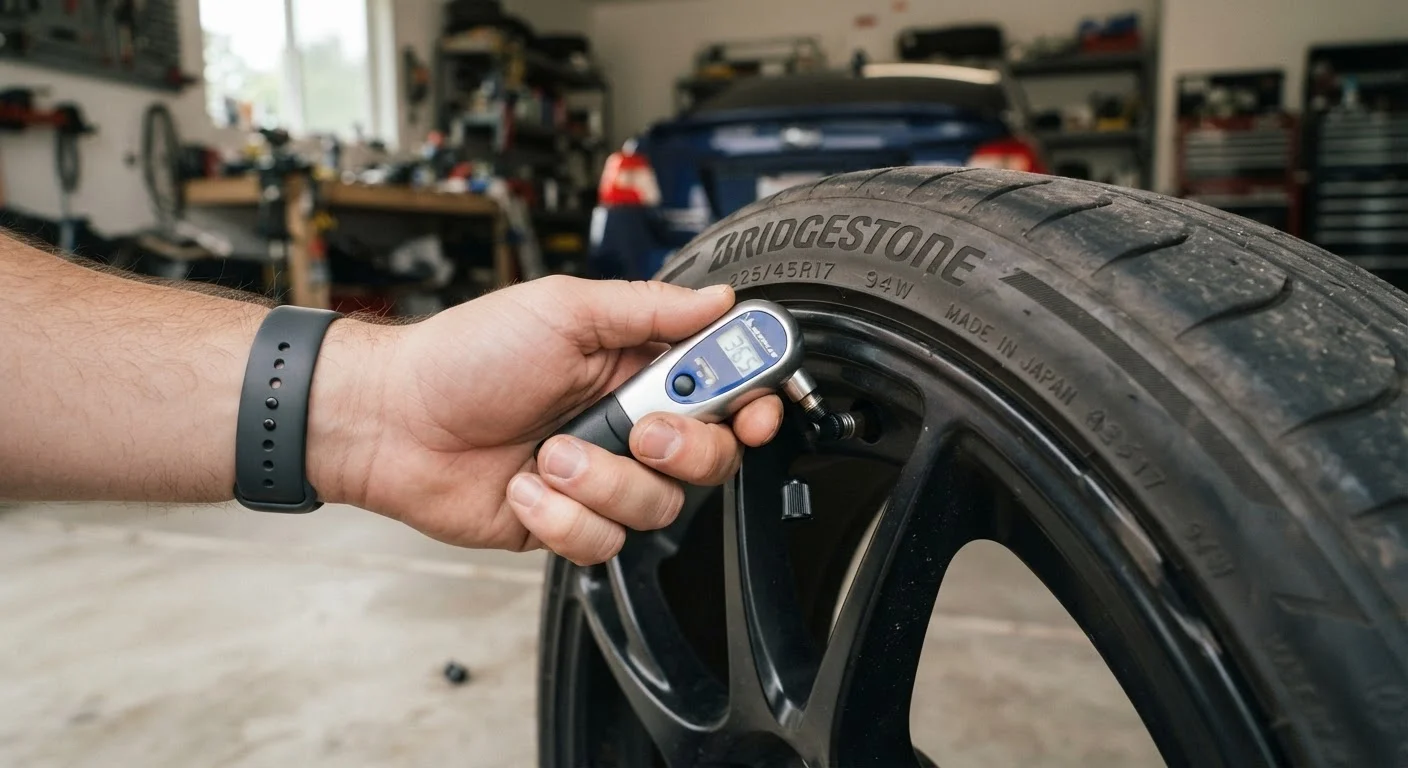
Why Tire Pressure Is More Important Than It Sounds
Tire pressure sits on the short list of maintenance tasks that most drivers know about but many skip. It requires no appointment, no special tools beyond a basic gauge, and takes about three minutes - yet its consequences when neglected reach well beyond a slightly bumpy ride.
Each tire on your vehicle is the only point of contact between a few thousand pounds of moving metal and the road surface. Whether your car can brake quickly, handle a sudden lane change, or resist a blowout at highway speed depends in part on whether the air inside those tires is at the right level. Under-inflation is the more common issue, and it's also the more hazardous one: a tire carrying too little pressure flexes excessively as it rolls, generating heat that can lead to tread separation or blowout - particularly at sustained highway speeds.
Over-inflation carries its own risks. A tire inflated beyond the vehicle manufacturer's recommendation contacts the road only through a narrow center strip, reducing grip and making the vehicle more reactive to bumps and imperfections. Neither extreme is harmless.
Your TPMS Light Is a Late Warning
Most vehicles manufactured after 2008 are required to include a Tire Pressure Monitoring System (TPMS). However, the warning light typically activates only when pressure has dropped about 25% below the recommended level - a point at which handling and fuel economy are already measurably affected. Regular manual checks with a gauge remain the more reliable approach. See your car's warning lights decoded for more on what dashboard alerts actually mean.
Reading the Right Number in the Right Place
One of the most persistent sources of confusion is where to find the correct PSI for your vehicle. The sidewall of every tire displays a maximum PSI figure - but that number describes the structural limit of the tire casing, not the pressure your vehicle's engineer intended for daily driving. Using it as a target routinely leads to over-inflation.
The number that actually matters is on the placard inside your driver's door jamb (sometimes also in the owner's manual). That figure accounts for your vehicle's weight, suspension geometry, and intended handling characteristics. Many vehicles also specify different pressures for front and rear tires, so it's worth checking both.
For vehicles that tow trailers or carry heavy loads regularly, the recommended pressure may be higher - check your owner's manual for load-specific guidance, or ask a qualified mechanic if you're uncertain. Checking tire pressure is one of the straightforward tasks covered in our guide to DIY car maintenance.
~1 PSI
Pressure lost per 10°F temperature drop
Cited by the U.S. Department of Energy as a standard guideline for how ambient temperature affects tire inflation.
Up to 3%
Fuel economy improvement with correct pressure
Estimated by the U.S. Department of Energy based on the effect of proper tire inflation on rolling resistance.
25%
Below-recommended pressure that triggers TPMS alert
The federal minimum threshold at which TPMS systems are required to warn the driver, per U.S. NHTSA regulations.
Temperature, Seasons, and the 1-PSI Rule
Tire pressure isn't static - it changes with temperature. As a general rule, tires lose approximately 1 PSI for every 10°F drop in ambient temperature. A tire correctly inflated on a warm October afternoon may be meaningfully low by a cold November morning, even without any slow leak.
This makes fall and winter the seasons when pressure checks matter most. Drivers who ignore pressure through the colder months may unknowingly be running under-inflated tires for weeks at a time - paying the cost in fuel, tread life, and handling without realizing it.
For this same reason, always check tire pressure when tires are cold - meaning the vehicle has been parked for at least three hours or driven fewer than a mile. Heat from driving temporarily raises pressure readings, which can give a falsely reassuring result.
Tire pressure is also a key item on any pre-trip inspection. Our long road trip safety checklist walks through what to verify before leaving home.
Check Pressure When Tires Are Cold
For the most accurate reading, check tire pressure in the morning before driving, or after the car has been parked for at least three hours. Driving heats the air inside the tires and temporarily increases pressure - which can make a slightly low tire appear fine. A quality analog or digital tire gauge is inexpensive and available at any auto parts store.
The Fuel Economy Connection
Beyond safety, there's a direct and measurable relationship between tire pressure and fuel consumption. Under-inflated tires increase rolling resistance - the friction the tire generates as it deforms against the road surface. Your engine compensates by burning more fuel to maintain speed.
The U.S. Department of Energy has noted that properly inflated tires can improve fuel efficiency by up to 3%. That may sound modest, but compounded across thousands of miles, it represents real money. For a vehicle averaging 30 mpg and driven 15,000 miles per year, even a 2% efficiency loss from low pressure translates to roughly an extra tank or two of gas annually.
Tire pressure also interacts with tire wear. Under-inflated tires wear heavily on their outer edges; over-inflated tires wear down the center. Uneven wear shortens tire life and can subtly affect handling in ways that build gradually and go unnoticed until the tires are badly degraded. For a broader look at how tires are maintained over time, see our explainer on tire rotation, balancing, and alignment.
Keeping tires properly inflated is also one of the simplest ways to manage annual vehicle costs without sacrificing safety. Our guide to keeping annual car costs under control covers related habits worth building.
Frequently Asked Questions
Most automotive safety organizations recommend checking tire pressure at least once a month and before any long trip. Temperature swings - especially in fall and winter - can drop pressure quickly, so more frequent checks during those seasons make sense.
Follow the recommended PSI listed on the sticker inside your driver's door jamb, not the maximum PSI printed on the tire sidewall. That sidewall number is the tire's structural limit, not the recommended operating pressure for your specific vehicle.
Yes. Over-inflation causes the tire's center tread to bear most of the contact load, leading to faster center wear and a harsher ride. It also reduces the tire's ability to absorb road impacts, which can contribute to damage from potholes.
It does. The U.S. Department of Energy estimates that properly inflated tires can improve gas mileage by up to 3%. Under-inflated tires increase rolling resistance, meaning your engine works harder to move the vehicle the same distance.
Air contracts in cold temperatures, reducing pressure inside the tire. A drop of about 10°F typically causes a loss of roughly 1 PSI. If enough pressure is lost, the TPMS threshold is triggered. Adding air on a cold morning usually resolves it.
Not for long. The TPMS warning activates when pressure is already significantly below the recommended level. You should check and correct tire pressure as soon as safely possible. See <a href="/cars-driving/car-maintenance/your-cars-warning-lights-decoded">what your dashboard warning lights mean</a> for more detail.
The content provided on our blog site traverses numerous categories, offering readers valuable and practical information. Readers can use the editorial team’s research and data to gain more insights into their topics of interest. However, they are requested not to treat the articles as conclusive. The website team cannot be held responsible for differences in data or inaccuracies found across other platforms. Please also note that the site might also miss out on various schemes and offers available that the readers may find more beneficial than the ones we cover.