

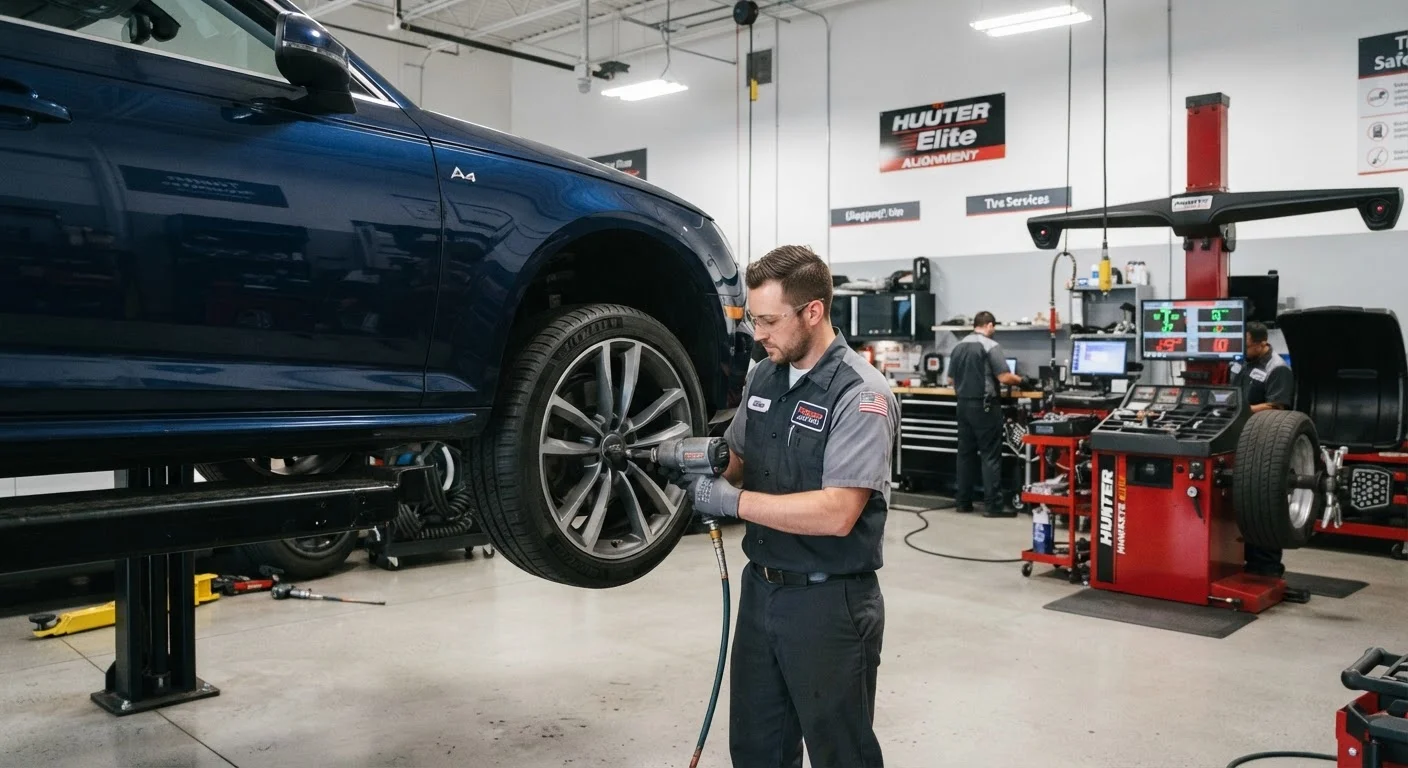
Three Services, Three Different Jobs
Tire rotation, wheel balancing, and wheel alignment are routinely grouped together in conversations about tire care - and just as routinely confused with one another. They are not interchangeable. Each one addresses a fundamentally different mechanical issue, and each has its own recommended schedule. Understanding what separates them helps you have more informed conversations with your mechanic and make smarter decisions about your car's upkeep.
For a broader view of how these services fit into overall vehicle ownership, see our maintenance overview for first-time drivers.
~$200
Typical cost of one set of replacement tires (per tire)
Premature tire replacement from skipped maintenance can cost drivers hundreds more than keeping up with rotation, balancing, and alignment services.
5,000-7,500 mi
Standard tire rotation interval
Most vehicle manufacturers and tire producers recommend rotation within this mileage range to ensure even tread wear across all four tires.
10%
Potential fuel economy reduction from misalignment
The U.S. Department of Energy notes that improper wheel alignment can increase rolling resistance and reduce fuel efficiency measurably over time.
Tire Rotation: Evening Out the Wear
Your car's weight is not evenly distributed across all four tires, and front tires - especially on front-wheel-drive vehicles - handle both steering and power delivery. That combination causes them to wear faster than rear tires. Rotation is the practice of periodically moving tires to different positions on the vehicle so that wear distributes more evenly across all four.
Common rotation patterns include front-to-rear, cross-rotation, or side-to-side depending on whether your vehicle is front-, rear-, or all-wheel drive. The standard recommendation is every 5,000 to 7,500 miles, often scheduled alongside oil changes. Skipping rotation means your front tires may need replacing thousands of miles before your rears - an unnecessary and avoidable cost.
Sync Rotation With Your Oil Changes
Many rotation intervals overlap conveniently with oil change schedules. Asking your shop to rotate tires at every oil change is an easy way to stay on schedule without tracking a separate service interval. Confirm the right interval for your specific vehicle in your owner's manual.
Wheel Balancing: Eliminating the Wobble
A tire and wheel assembly is rarely perfectly uniform in weight. Even tiny imbalances - sometimes just a few grams - can cause the wheel to wobble or vibrate as it spins, particularly at higher speeds. Wheel balancing corrects this by mounting the assembly on a balancing machine, identifying heavy spots, and attaching small counterweights to the rim to compensate.
The telltale sign of an imbalance is vibration felt through the steering wheel or floorboard, usually becoming noticeable around highway speeds. Balancing is typically performed when new tires are installed, but wheels can fall out of balance over time as counterweights shift or tires wear unevenly. Many shops recommend checking balance every 12,000 to 15,000 miles or whenever you notice vibration.
Wheel Alignment: Keeping Your Car Pointed Straight
Alignment refers to the angles at which your wheels meet the road and relate to each other. When these angles drift out of specification - from a pothole, curb impact, or gradual suspension wear - your car may pull to one side, your steering wheel may sit crooked even when driving straight, or your tires may show unusual wear patterns along one edge.
An alignment service uses specialized equipment to measure and adjust three key angles: toe (whether tires point inward or outward when viewed from above), camber (whether tires tilt inward or outward when viewed from the front), and caster (the steering axis angle). Most manufacturers recommend checking alignment annually or after any significant suspension impact. Misaligned wheels are one of the fastest ways to destroy a set of tires prematurely.
Keeping up with alignment is also part of controlling the long-term cost of car ownership. Our guide on keeping annual car costs under control covers how routine maintenance decisions like this one add up over time.
“Tires are the only part of your car that actually touches the road. Every other system - brakes, steering, suspension - ultimately depends on those four contact patches being in good condition.”
— National Highway Traffic Safety Administration, U.S. Federal Vehicle Safety Agency
Why Neglecting Any One of Them Costs You
Each of these services protects your tires from a different type of damage. Skipping rotation shortens tire lifespan through uneven wear. Ignoring balancing leads to vibration that stresses suspension components and accelerates wear at certain points on the tire. Putting off alignment eats away at tire edges and forces your engine to work harder against the drag of misaligned wheels - reducing fuel efficiency in the process.
Together, they form a straightforward maintenance rhythm that preserves your tires, your suspension, and your fuel economy. Well-maintained tires also directly support vehicle safety - particularly in emergency handling and braking situations. For more on how tire condition connects to overall vehicle safety, see our article on tire pressure and its impact on safety and fuel economy.
If you're unsure which of these services your vehicle currently needs, a qualified technician can inspect your tires and advise based on your specific mileage, wear patterns, and driving conditions. These are not services that should be deferred indefinitely - the cost of a new set of tires far exceeds the combined cost of keeping up with rotation, balancing, and alignment on schedule.
When to See a Professional
Rotation, balancing, and alignment all require shop equipment that isn't available for DIY use. Balancing machines and alignment racks are precision instruments that must be calibrated regularly. These services are best left to a qualified technician - they're affordable, quick, and not something to attempt at home. See our guide on which maintenance tasks to leave to a pro for more context on where to draw the line.
Frequently Asked Questions
Yes, and it's often efficient to do so. Many shops perform rotation, balancing, and alignment together, especially when you're having new tires installed. Bundling them can save time and may reduce labor costs, though each service addresses a different issue and has its own interval.
Most manufacturers recommend rotation every 5,000 to 7,500 miles, which often aligns with oil change intervals. Check your owner's manual for the recommendation specific to your vehicle and tire type.
Common causes include hitting potholes, striking curbs, or general road impact over time. Suspension wear and minor accidents can also shift alignment. Even normal driving gradually moves angles out of specification.
Yes. Misaligned wheels cause uneven and accelerated tire wear, often producing a feathered or one-sided wear pattern. Tires that should last 50,000 miles or more can wear out significantly sooner when alignment is neglected.
The terms are used interchangeably in most shops. The service balances the combined assembly of the tire mounted on the wheel rim to eliminate vibration-causing weight imbalances.
Vibration - especially felt through the steering wheel or seat at highway speeds - typically signals a balancing issue. Pulling consistently to one side, or a steering wheel that sits off-center, usually points to an alignment problem.
The content provided on our blog site traverses numerous categories, offering readers valuable and practical information. Readers can use the editorial team’s research and data to gain more insights into their topics of interest. However, they are requested not to treat the articles as conclusive. The website team cannot be held responsible for differences in data or inaccuracies found across other platforms. Please also note that the site might also miss out on various schemes and offers available that the readers may find more beneficial than the ones we cover.