

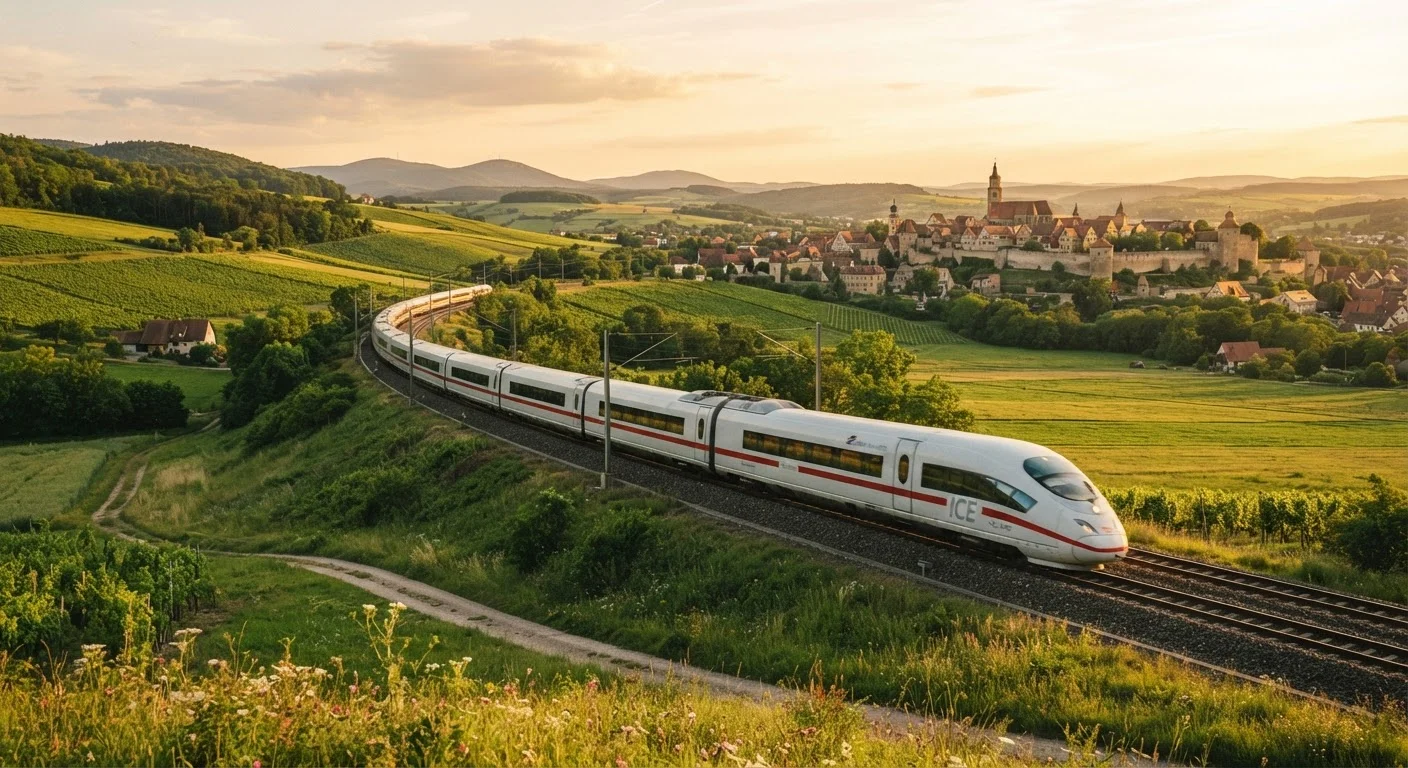
Option A
Europe by Train
The scenic, city-center-to-city-center classic.
Best for: Travelers who value flexibility, comfort, luggage freedom, and immersive scenery over raw speed.
Option B
Domestic/Intra-European Flights
The fast but friction-heavy option.
Best for: Travelers covering long distances quickly — say, London to Athens — where rail journey times are impractical.
The Hidden Math Behind Each Option
Americans planning a European trip often default to searching for flights out of habit — it's what we do at home. But Europe's geography rewards a different mindset. Most major cities sit within 2–4 hours of each other by rail, and when you factor in the full airport experience, a two-hour flight can easily consume five or six hours of your day.
Consider a Paris-to-Amsterdam run. The Thalys/Intercity Direct train takes roughly three and a half hours, station to station — both of which sit in the heart of their respective cities. A flight covers the same route in about an hour of airtime, but add 90 minutes at Charles de Gaulle, a 45-minute journey to Schiphol, and immigration queues, and the real-world difference evaporates. Meanwhile, the train costs comparable or less, especially when you avoid checked bag fees.
| Criterion | Europe by Train | Intra-European Flight |
|---|---|---|
| City-center access | Station to station, central locations | Often secondary airports, 30–90 min from center |
| Luggage policy | No weight limits or fees | Strict limits; fees for bags beyond personal item |
| Booking flexibility | Walk-up tickets widely available | Last-minute fares often very high |
| Best for distances | Under 600 miles / 5–6 hour routes | 700+ miles where no practical rail exists |
| Environmental impact | Significantly lower carbon per journey | Higher carbon footprint per passenger |
| Security/boarding process | Minimal — board minutes before departure | Full security; arrive 90+ minutes early |
| Overnight travel option | Yes — sleeper trains on many routes | No equivalent accommodation option |
The calculus shifts on longer routes. London to Athens, for instance, is genuinely impractical by train in a modern leisure itinerary. That's where intra-European flights earn their keep — and budget carriers have made those connections affordable for travelers who book intelligently. See our complete international trip planning framework for how to sequence these decisions early in your planning.
Understanding Rail Passes vs. Point-to-Point Tickets
The Eurail Global Pass is one of the most recognized names in European travel, but it's frequently misused. A pass makes financial sense when you're taking five or more long-distance train journeys across multiple countries within a compressed timeframe. For a traveler doing Paris → Lyon → Barcelona → Madrid over ten days, individual point-to-point tickets — booked in advance through national rail operators — will almost always cost less.
National operators like SNCF (France), Deutsche Bahn (Germany), Renfe (Spain), and Trenitalia (Italy) release discounted advance fares that can be dramatically cheaper than the pass's per-journey equivalent. The trade-off is rigidity: advance tickets lock you to specific trains, so spontaneity costs you.
32,000+
Miles of high-speed rail across Europe
Europe's high-speed network is the most extensive in the world, according to the International Union of Railways (UIC), connecting dozens of major cities at speeds of 150–200 mph.
~3x
Carbon emissions: flight vs. equivalent train journey
Research from organizations including the European Environment Agency consistently shows rail travel generates roughly a third or less of the CO₂ per passenger-kilometer compared to short-haul flying.
€30–€60
Typical budget airline bag fee, each way
Checked bag fees vary by carrier and route but routinely add €30–€60 per direction on carriers like Ryanair and easyJet, significantly eroding headline fares.
One underappreciated advantage of the pass: reservation fees. High-speed trains across Europe typically require a seat reservation even with a pass — these run €10–€40 per leg depending on the route, and they add up. Budget accordingly. If you're planning a trip focused primarily on Western Europe, our Western Europe vs. Southeast Asia comparison can help you weigh the overall destination choice first.
What Budget Airlines Actually Cost
Carriers like Ryanair, easyJet, and Wizz Air have genuinely democratized European travel — but the advertised fare is rarely the final fare. A €19 headline price can easily become €70–€90 once you add a cabin bag (carry-on beyond a personal item often costs extra), a reserved seat, and a credit card fee. If you check a bag, add another €30–€60 each way.
Then there's the airport problem. Budget carriers frequently use secondary airports well outside city centers. London's Stansted is an hour from central London by train; Milan Bergamo is further from the Duomo than Milan Malpensa. A €60 roundtrip to "Rome" from Amsterdam sounds thrilling until you realize Ciampino airport is 40 minutes from the city core — and the bus back at 10 p.m. costs €7 and runs infrequently.
Secondary Airports: Check the Map First
Before booking any budget flight in Europe, look up the airport's actual location relative to your destination city center. Many carriers list routes using the nearest major city's name while operating from airports 30–80 miles away. Always check ground transport options and their costs and schedules — late arrivals can mean limited or expensive transfer options back to your hotel.
None of this makes budget airlines a bad option — it makes them a conditional option. They win when you book early, travel carry-on only, and factor transfers honestly. For packing light strategies that make budget airlines more viable, a thoughtful carry-on approach is the single biggest lever you have.
Comfort, Culture, and the Overlooked Benefits of Trains
There's something the spreadsheet doesn't capture: the journey itself. Watching the Swiss Alps glide past your window, rolling through Tuscan vineyards, or emerging from the Channel Tunnel into the French countryside — these are experiences, not just transit. Europe's trains are generally spacious, quiet, and equipped with café cars and reliable Wi-Fi on major routes.
From a logistical standpoint, trains offer luggage freedom that airlines simply don't. No weight limits, no liquids restrictions, no removing your shoes. You board 5–10 minutes before departure, stow your bag overhead, and arrive in the city center ready to explore. For families, older travelers, or anyone carrying more than a minimalist kit, this matters enormously.
First-time international travelers especially benefit from the lower-stress boarding process. If you're still getting comfortable with the rhythms of overseas travel, our first-timer's international travel primer is worth a read before you finalize your in-country transport strategy. And if you're going it alone, solo travel trade-offs for Americans covers how transport choices affect safety and independence on the road.
The content provided on our blog site traverses numerous categories, offering readers valuable and practical information. Readers can use the editorial team’s research and data to gain more insights into their topics of interest. However, they are requested not to treat the articles as conclusive. The website team cannot be held responsible for differences in data or inaccuracies found across other platforms. Please also note that the site might also miss out on various schemes and offers available that the readers may find more beneficial than the ones we cover.