

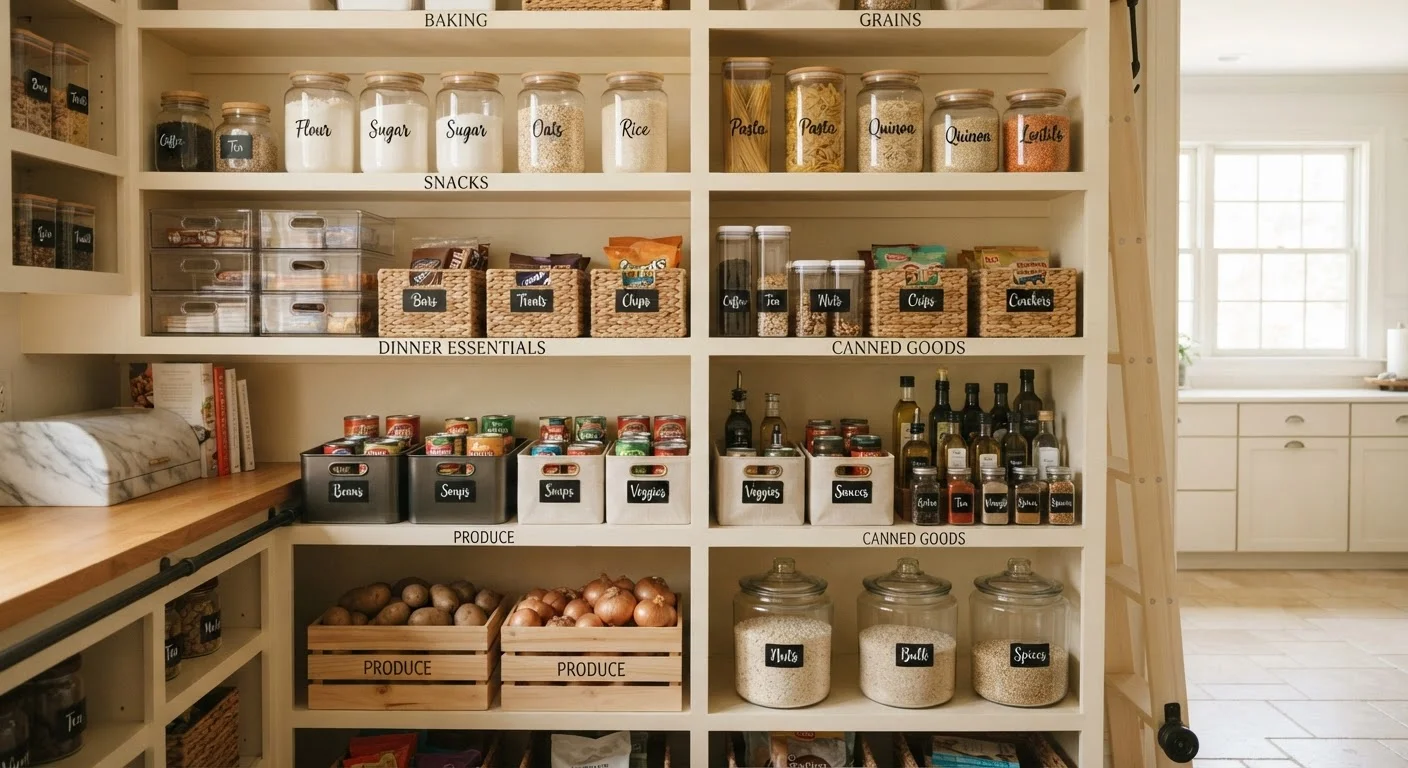
Why Most Storage Problems Are Actually System Problems
Most households don't have a clutter problem - they have a system problem. Items pile up not because people are careless, but because no clear structure tells objects where to go when they're not in use. Without a system, every tidying session resets to zero within days.
The good news: professional organizers rely on a remarkably simple framework that works in every room. It has three parts - zones, labels, and containers - and once you understand the logic behind each, you can apply it anywhere. If you're ready to tackle the full house, the room-by-room organization playbook builds on exactly these principles.
The System Should Fit Real Life
The most common reason organized spaces revert to clutter is that the system was built around ideal behavior rather than actual behavior. If you never fold clothes immediately after laundry, a system requiring immediate folding will fail. Design zones and container placements around what you genuinely do, not what you intend to do. Adjusting the system to fit habits is not a failure - it's good design.
Zones: Organizing by Use, Not by Category
A zone is a dedicated area where items serving the same purpose or used in the same activity are stored together. The key distinction is organizing by use, not just by type. A 'homework zone' at the kitchen table might hold pens, scissors, tape, and a charger - different categories, but all used together in one spot.
To create effective zones, trace how you actually move through a space during the day. Where do you open mail? That's your mail zone. Where do you grab your keys and bag on the way out? That's your launch pad zone. Zones built around real behavior require almost no willpower to maintain because returning items feels natural.
80%
Of household clutter attributed to disorganization
According to the National Association of Productivity and Organizing Professionals (NAPO), the vast majority of household clutter stems from a lack of organizational systems rather than simply owning too many items.
~30 min
Time per week spent searching for lost items
Research cited by organization and time-management educators suggests the average American adult spends roughly 30 minutes per week looking for misplaced household items.
In shared households, zones become even more important - they give every person a shared mental map of the space. The guide to organizing shared living spaces covers how to align zones when household members have different habits.
Labels: Making the System Legible for Everyone
A zone without a label is a system only the organizer can navigate. Labels transform a personal setup into a shared one - they tell every household member (and future-you after a busy week) exactly what goes where without guessing.
Effective labels describe the contents, not just the category. 'Snacks' is a label. 'Grab-and-go snacks' is a better one. The more specific the label, the less mental work is required at the moment of putting something away - which is exactly when most systems break down.
Write Labels for the Least-Informed User
When deciding how specific a label should be, imagine the person in the household least familiar with where things go. If that person could find and return the item using only the label, it's specific enough. Vague labels like 'misc' or 'stuff' defeat the purpose entirely - if everything could fit there, nothing has a home.
Label placement matters too. Labels on the front face of containers, at eye or hand level, are used. Labels on the back, top, or inside of lids often go unread. For pantry shelving, consider labeling both the container and the shelf below it - this way, an empty space still communicates where something belongs. The pantry labeling reference guide goes deeper on conventions that work well in kitchen storage.
Containers: Creating Boundaries That Hold the System Together
Containers are the physical infrastructure of any storage system. Their job isn't aesthetic - it's functional. A container creates a hard limit on how much of any category can accumulate. When a bin is full, that's a signal to edit, not to expand.
This 'one-in, one-out' logic only works if containers are appropriately sized. Oversized bins invite overfilling and make items hard to retrieve. Undersized bins create constant overflow. The right container fits the volume of items you actually use regularly - not everything you own in that category.
Clear containers serve spaces where you need to see contents quickly, such as pantries, medicine cabinets, and craft supplies. Opaque bins work well in closets and under-bed storage where visual uniformity matters more. Matching containers in a zone also provide a subtle visual cue: a full bin signals the boundary of that zone. For rooms where floor space is tight, containers can also help you make use of vertical storage - a topic explored in the guide to vertical and hidden storage.
Putting All Three Together: A Simple Example
Consider a cluttered bathroom cabinet. Without a system, everything is jumbled - cotton swabs next to cold medicine next to hair clips. Applying the framework looks like this:
- Define zones: First aid, daily skincare, hair tools, and medications each become distinct zones - either on separate shelves or in separate sections of a single shelf.
- Add containers: Each zone gets a container or tray that physically bounds it. The first aid items go into a small bin; daily skincare items go into a narrow tray at eye level.
- Label everything: Each container or shelf section gets a label. Anyone opening that cabinet can immediately locate what they need and return it correctly.
The result isn't just tidier - it's a system that maintains itself because every decision about where something belongs has already been made. For anyone who finds the whole process daunting, the low-friction organizing framework offers a gentler starting point with minimal setup effort.
Frequently Asked Questions
A zone is a designated area where items of a related purpose or category are kept together. For example, a 'coffee zone' on the kitchen counter holds the coffee maker, mugs, filters, and beans in one spot. Zones reduce searching time and make it easier to return items after use.
Not necessarily - labels matter most for shared spaces, less-used storage areas, and any category where multiple people need to put things back correctly. In a personal closet you use daily, labels may be optional. In a pantry or utility room shared by a household, they're highly effective.
The best container is one that fits the space, suits the category it holds, and is easy to open and close. Clear containers work well for pantries and medicine cabinets because contents are visible. Opaque bins work for items where visual uniformity matters more than at-a-glance access.
The most common reason systems fail is that returning items is harder than grabbing them. Simplify by removing lids from frequently accessed bins, keeping containers at eye level, and ensuring zones match actual habits rather than aspirational ones. Regular light resets - not full re-organizations - keep systems functioning.
Yes - zones, labels, and containers scale to any space. In small rooms, zones may be as small as a single drawer section, and containers may simply be small trays or dividers. The logic is the same regardless of square footage.
The content provided on our blog site traverses numerous categories, offering readers valuable and practical information. Readers can use the editorial team’s research and data to gain more insights into their topics of interest. However, they are requested not to treat the articles as conclusive. The website team cannot be held responsible for differences in data or inaccuracies found across other platforms. Please also note that the site might also miss out on various schemes and offers available that the readers may find more beneficial than the ones we cover.