

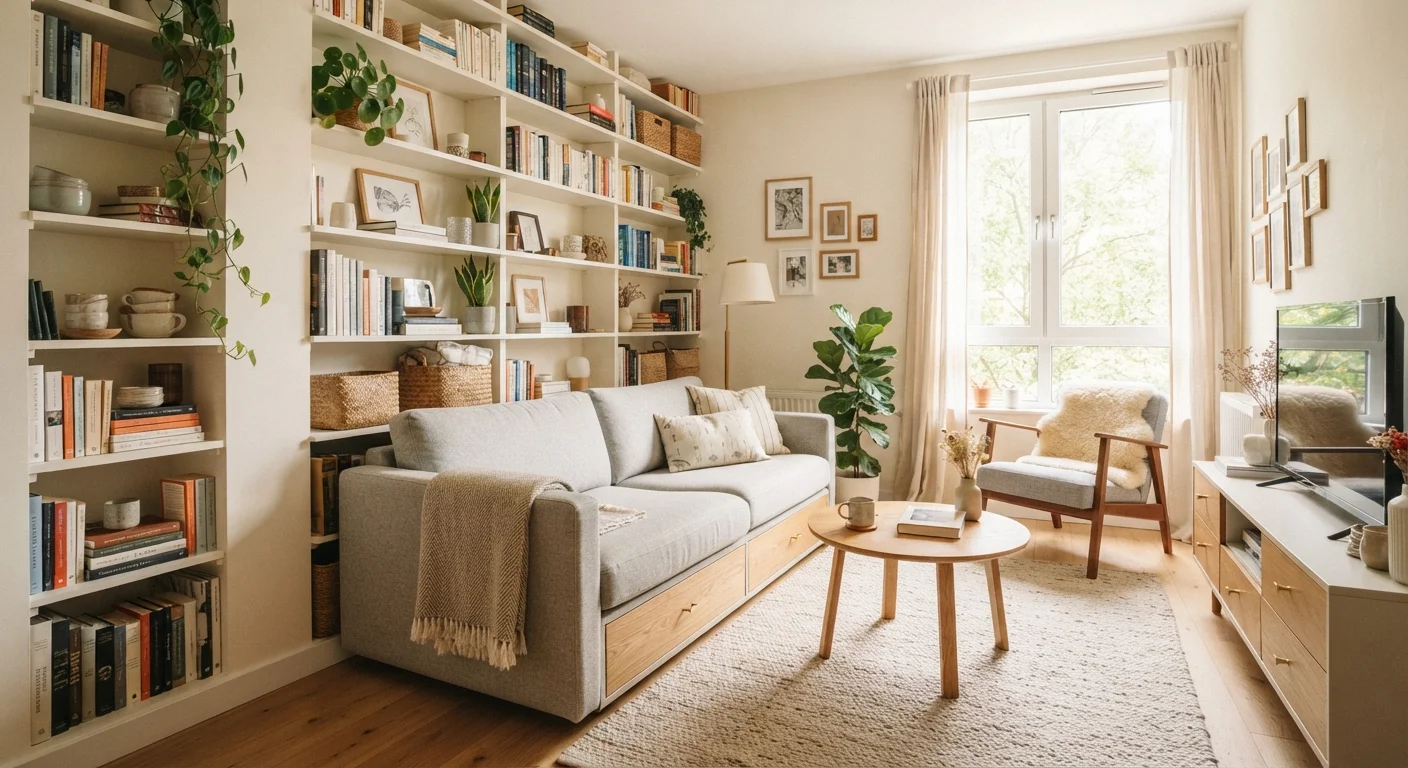
Why Small Rooms Feel More Cluttered Than They Are
A small room doesn't always mean a storage shortage - it usually means storage is distributed poorly. Items pile up on flat surfaces, floors, and the fronts of closets while entire walls, corners, and the undersides of furniture sit unused. The result isn't a space problem; it's a strategy problem.
The good news: most of these fixes don't require renovation. Whether you own your home or rent, the approaches below work across room types and tight budgets. For a broader framework on how to structure what goes where, the core logic behind functional storage is a useful foundation before diving into specific tactics.
Go vertical from floor to ceiling
Most people install shelving at eye level and leave the space above it empty. That upper zone - typically from six feet to the ceiling - is legitimate storage real estate. Deep baskets on high shelves can hold seasonal items, extra linens, or rarely accessed gear. In a home office or living room, tall bookcases that run close to the ceiling dramatically increase capacity without expanding your footprint at all.
The key is to organize upper shelves by access frequency: daily-use items stay at reachable height; infrequently used items go up top. A small step stool stored nearby makes those upper shelves practical rather than decorative.
Upper wall space from six feet to the ceiling is legitimate storage that most people simply ignore.
Reclaim dead corners
Corners are the most neglected zones in any room. Standard rectangular furniture doesn't reach into them, so they become dust collectors. A few targeted solutions change this entirely:
- Corner shelving units - freestanding or wall-mounted triangular or L-shaped shelves fit precisely into 90-degree corners and provide tiered storage without blocking traffic flow.
- Lazy Susans - particularly effective inside kitchen or bathroom cabinets with corner configurations, they bring rear items forward with a simple spin.
- Corner desks or benches - in bedrooms or offices, a corner-specific piece turns dead space into a functional work or seating zone.
Before dismissing a corner as awkward, measure it. You may find it fits a freestanding unit you hadn't considered.
A well-chosen corner unit can turn the most ignored spot in a room into its most efficient storage zone.
Choose furniture that stores as it functions
In a small room, every piece of furniture should ideally serve two purposes. Ottomans with removable lids, beds with under-mattress drawers, benches with hinged seats, and coffee tables with lower shelves or drawers all provide storage without requiring a single extra square foot of floor space.
When selecting new pieces - or evaluating what you already own - ask whether each item is doing double duty. A standard bench by the front door that offers no storage is a missed opportunity; the same footprint with a lift-top seat solves the shoe and accessory problem in entryways.
Every piece of furniture in a small room should ideally serve a storage function as well as its primary use.
Use the backs of doors
The back of a door is a flat, vertical surface that rarely gets used. Over-door organizers - whether shallow-pocket fabric panels, narrow wire racks, or hook rails - can hold cleaning supplies, pantry overflow, shoes, jewelry, office supplies, and more depending on the room.
This strategy works especially well in bathrooms and small closets where floor and wall space is already tight. A well-organized door back can eliminate the need for an entire freestanding unit elsewhere in the room. For renters, most over-door organizers hang without hardware and leave no trace on walls or doors.
The back of a door is a flat vertical surface that can replace an entire freestanding storage unit.
Make open and closed storage work together
In small rooms, the instinct is often to hide everything behind closed doors - but a mix of open and closed storage tends to work better. Open shelving keeps frequently used items visible and accessible, while closed cabinets or bins conceal the visual clutter of irregular or unattractive objects.
The decision of what to display openly versus hide away depends on your habits as much as your aesthetic. The trade-offs between open shelving and closed cabinets explores this decision in detail - including which approach tends to stay tidier over time depending on how you naturally move through your space.
Pairing open shelving with closed storage lets you balance accessibility with visual calm in a tight space.
Audit what's actually in the room
No storage strategy works if the room holds things that don't belong there. Before adding organizers or shelving, do a quick category audit: identify items that live in the room by default but could logically be stored elsewhere. A bedroom cluttered with hobby supplies might simply need those items relocated to a closet or dedicated storage area.
Reducing the volume of items - not just reorganizing them - is often the single highest-impact move in a small room. The full home organization playbook offers a room-by-room approach to this kind of audit across the entire home.
Relocating items that don't belong in a room often does more than any organizer or storage unit ever could.
Putting It All Together
The most effective small-room systems combine at least two or three of these strategies rather than relying on just one. Stack vertical storage with under-furniture capacity, then tuck a corner unit into that overlooked alcove - and suddenly a room that felt cramped has real breathing room.
Start with one wall or corner
Tackling an entire small room at once is overwhelming and often leads to stalled projects. Pick one underused zone - a single wall, a corner, or one piece of furniture - and optimize it fully before moving on. Small, completed changes build momentum and make the overall system easier to maintain.
If you share your space with others, storage systems only work when everyone can use them intuitively. The guide to organizing with multiple people covers how to design systems that hold under different habits and schedules.
For renters specifically, nearly all of these strategies - floating shelves with adhesive anchors, freestanding corner units, furniture-integrated storage - fall well within typical lease restrictions. See what's possible in the renter-friendly organizing guide for a full breakdown.
Small rooms reward intentional thinking. Once you stop treating floor space as the only storage surface, the room you have tends to be more than enough.
The content provided on our blog site traverses numerous categories, offering readers valuable and practical information. Readers can use the editorial team’s research and data to gain more insights into their topics of interest. However, they are requested not to treat the articles as conclusive. The website team cannot be held responsible for differences in data or inaccuracies found across other platforms. Please also note that the site might also miss out on various schemes and offers available that the readers may find more beneficial than the ones we cover.