

Organizing a Rental Without Losing Your Deposit
Renters face a genuine constraint that homeowners don't: the lease. Most rental agreements prohibit nailing, drilling, or otherwise damaging walls and surfaces - which can feel like a barrier to building a truly organized home. But in practice, the vast majority of effective organization strategies don't rely on permanent fixtures at all.
The key shift is thinking in terms of freestanding, stackable, and reversible systems. Once you stop designing around walls, an entirely different toolkit opens up - one that travels with you when you move and causes zero conflict at inspection. For a full room-by-room framework, see the full home organization playbook.
Before diving into specific strategies, one rule applies everywhere: declutter first. No storage system compensates for excess stuff. Donate, recycle, or discard anything you haven't used in a year. After that, the following approaches can transform almost any rental space.
Use damage-free adhesive strips and hooks strategically
Modern adhesive mounting strips and hooks have come a long way. Many are rated to hold several pounds per strip, making them suitable for lightweight shelves, kitchen utensil rails, bathroom caddies, and coat hooks near the entryway. The key to making them work is surface prep: wipe the wall with isopropyl alcohol and let it dry before applying, and always follow the weight guidelines on the packaging.
These work best on smooth, painted drywall and tile. They're less reliable on textured walls, wallpaper, or surfaces that have been repainted many times with thick coats. When removal time comes, pull the tab slowly and parallel to the wall - not outward - to avoid paint damage.
Surface prep is the single most important factor in adhesive strip performance.
Invest in freestanding shelving units
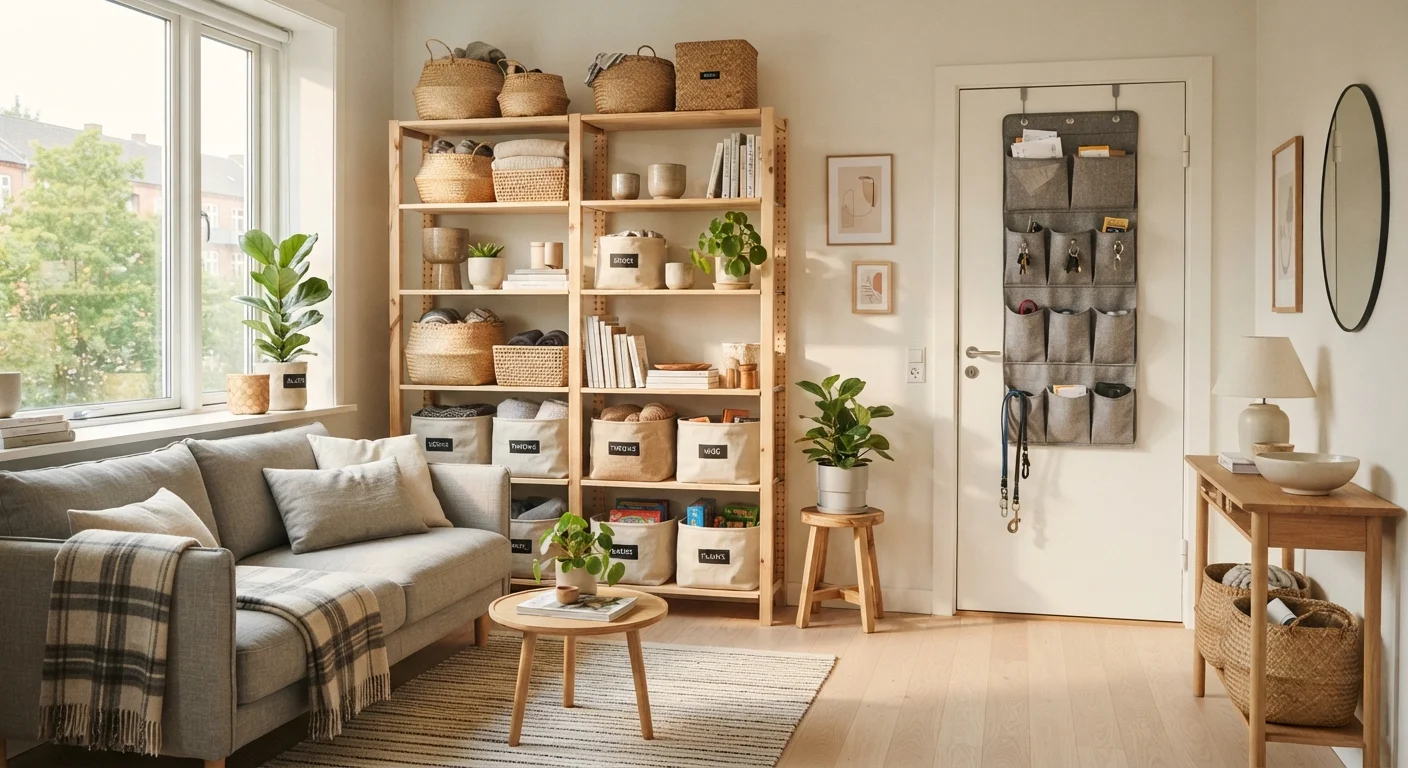
A sturdy freestanding bookshelf or wire shelving unit is one of the highest-value investments a renter can make. It adds vertical storage, defines space in open-plan layouts, and moves with you to the next apartment. In living rooms, it holds books, decor, and media. In bedrooms, it replaces closet overflow. In kitchens, it handles pantry items when cabinet space runs short.
If stability is a concern - especially in households with children or pets - consider anti-tip furniture straps that loop around the unit and attach to a wall stud using a small, easily patched hole. Check your lease first, but a single small hole is far less likely to trigger a deposit dispute than multiple large anchor points. For thoughts on open versus closed shelving trade-offs, the article on open shelving vs. closed cabinets is worth a read.
A freestanding shelf is the single most versatile storage tool a renter can own.
Maximize over-door space in every room
The back of almost every door in your home is usable storage - and over-door organizers require zero tools to install. In the bathroom, an over-door pocket organizer holds toiletries and first-aid supplies. In the kitchen, it corrals foil, wrap, and small snacks. In a bedroom or closet, it manages shoes, accessories, or folded items.
Look for organizers with adjustable hooks that sit flush on the door without scratching or stressing the door frame. If your doors are hollow-core and light, heavier organizers may cause them to warp slightly over time - check the total loaded weight and distribute it across multiple hooks when possible.
Every door in your home holds untapped, entirely reversible storage potential.
Put tension rods to work beyond the shower
Tension rods are a criminally underused renter's tool. Installed horizontally inside a cabinet, they create a divider for baking sheets and cutting boards. Placed vertically in a deep cabinet, they separate platters and trays. Suspended under a sink, they hold a second tier of cleaning spray bottles. Run low in a closet, they provide an extra hanging rod for shorter garments.
The mechanism is simple: spring pressure holds the rod in place with no hardware required. Choose rods rated for the intended load and avoid over-tightening, which can bow cabinet walls or scratch the interior finish. Rubber or silicone end caps protect surfaces and improve grip.
A tension rod under the kitchen sink instantly doubles your cleaning supply storage.
Use rolling carts as flexible, room-to-room storage
A rolling cart - whether a multi-tier wire design or a slim utility cart - is one of the most adaptable pieces in a renter's organizational toolkit. Park it in the kitchen as a prep station and pantry overflow. Move it to a home office as a mobile supply station. Wheel it into a craft area or bathroom as needed. Because it's not fixed, it adapts to your changing needs and travels easily when you move.
For renters with especially small spaces, the same logic applies to other furniture choices: ottomans with interior storage, bed frames with built-in drawers, and nesting tables all add function without footprint. If you find organizing systems generally feel like a lot of effort, the low-friction organizing guide offers realistic starting points.
Rolling carts move with your needs - they're not tied to one room or one purpose.
Corral clutter with baskets, bins, and drawer organizers
Containers are the backbone of any organized space, and they require no installation whatsoever. Baskets on open shelves group loose items visually and make retrieval intuitive. Drawer dividers keep utensils, office supplies, and bathroom items from becoming jumbled. Labeled bins in a closet turn a chaotic pile into a searchable system.
The organizing principle here is category grouping: everything of one type lives together in one container. When you run out of something, the empty container signals what to replenish. When the container is full, it signals what to edit. Containers also make room-by-room systems easier to maintain because each category has a defined home.
Containers make categories visible - and visible categories are far easier to maintain.
Making It Work Long-Term
Renter-friendly organization isn't a compromise - it's a discipline that tends to produce more thoughtful systems than permanent installations. Because everything must earn its place without anchoring to a wall, you're forced to prioritize what genuinely matters.
Review Your Lease Before You Start
Before installing anything - even adhesive strips - skim your lease for language about alterations. Some leases prohibit any wall contact at all; others only restrict structural changes. Knowing your specific terms helps you make confident choices and avoid surprises at move-out. When in doubt, a quick message to your landlord asking for clarification is always worth the few minutes it takes.
If you share your rental with others, consider involving them in system decisions early. Shared spaces need buy-in from everyone who uses them - for guidance on that challenge, see organizing a home with multiple people.
Renters who want to explore storage in underused areas of their home - corners, vertical wall space, and nooks - will find practical direction in making small rooms work. The strategies there pair naturally with the no-drill approach described here.
The content provided on our blog site traverses numerous categories, offering readers valuable and practical information. Readers can use the editorial team’s research and data to gain more insights into their topics of interest. However, they are requested not to treat the articles as conclusive. The website team cannot be held responsible for differences in data or inaccuracies found across other platforms. Please also note that the site might also miss out on various schemes and offers available that the readers may find more beneficial than the ones we cover.