

Start here
Why Traditional Organizing Advice Fails So Many People
Core concept
The One Rule That Makes Organization Stick
Apply it
Low-Friction Systems for Every Room
Build the habit
How to Maintain Order Without Daily Effort
Go further
When to Ask for Help
Why Traditional Organizing Advice Fails So Many People
Most organization content assumes you enjoy the process - that sorting bins and labeling drawers feels satisfying rather than draining. For a lot of people, it simply doesn't. That's not a character flaw; it's a mismatch between advice designed for enthusiasts and the reality of everyday life.
The deeper problem is that popular systems are often built around idealized outcomes: color-coded pantries, matching containers, perfectly folded towels. These are aesthetically appealing but practically fragile. The moment life gets busy, a system that requires sustained effort collapses - and the clutter comes back, often worse.
If previous attempts at organizing haven't held, the issue is almost certainly the system, not your motivation. The goal here isn't a magazine-worthy home. It's a home that's easy enough to keep in order that you don't have to think about it much.
Designated home
The one specific place an object is stored when not in use. Without a designated home, items default to whatever surface is nearest.
Friction
Any small obstacle that makes a behavior harder - an extra step, a hard-to-open lid, or a storage spot that's inconvenient. Reducing friction makes good habits easier to maintain.
Clutter
Items that have accumulated in a space without a clear system or designated location. Clutter is usually a symptom of a missing system, not a lack of effort.
Reset routine
A short, repeatable tidying practice - like a 5-minute evening sweep - that returns items to their homes before disorder builds up.
One-in, one-out rule
A simple policy where every new item brought into the home means one existing item leaves. It prevents gradual accumulation without requiring a major purge.
The One Rule That Makes Organization Stick
Every object in your home needs a designated home - one specific place it lives when not in use. This sounds obvious, but most clutter accumulates precisely because items don't have one. Things pile on counters and chairs not out of laziness, but because there's genuinely nowhere obvious to put them.
Before adding a single bin or shelf, walk through your space and identify what doesn't have a home. These are your highest-priority items. Assign them a location based on where you naturally set them down - not where you think they should go. If keys keep landing on the kitchen counter, put a hook or small dish on the kitchen counter. Work with your existing behavior rather than against it.
Test your system before committing
Before buying containers or rearranging furniture, live with a proposed system for a week using what you already own. If it works, invest in making it permanent. If it doesn't, adjust before spending money. Most failed organizing projects involve purchasing supplies for a system that was never tested first.
This principle - matching your system to your habits rather than retraining yourself - is the foundation of any low-friction approach. It also means that what works for one household won't work for another. Resist copying systems wholesale from social media; treat them as inspiration, not blueprints.
Low-Friction Systems for Every Room
A few reliable patterns work across most rooms and most households:
- Entryway: A hook for bags and coats, a tray or bowl for keys and small items, and a shoe rack or mat. Nothing more is needed. The goal is to stop objects from migrating deeper into the home.
- Kitchen: Group items by task - coffee-making supplies together, baking supplies together - rather than by type. This reduces the number of decisions you make each time. For pantry-specific approaches, see our pantry organization reference guide.
- Bedroom: A single catch-all tray on the dresser beats no system at all. Laundry hampers with lids reduce visual noise. Limit surfaces where things can accumulate.
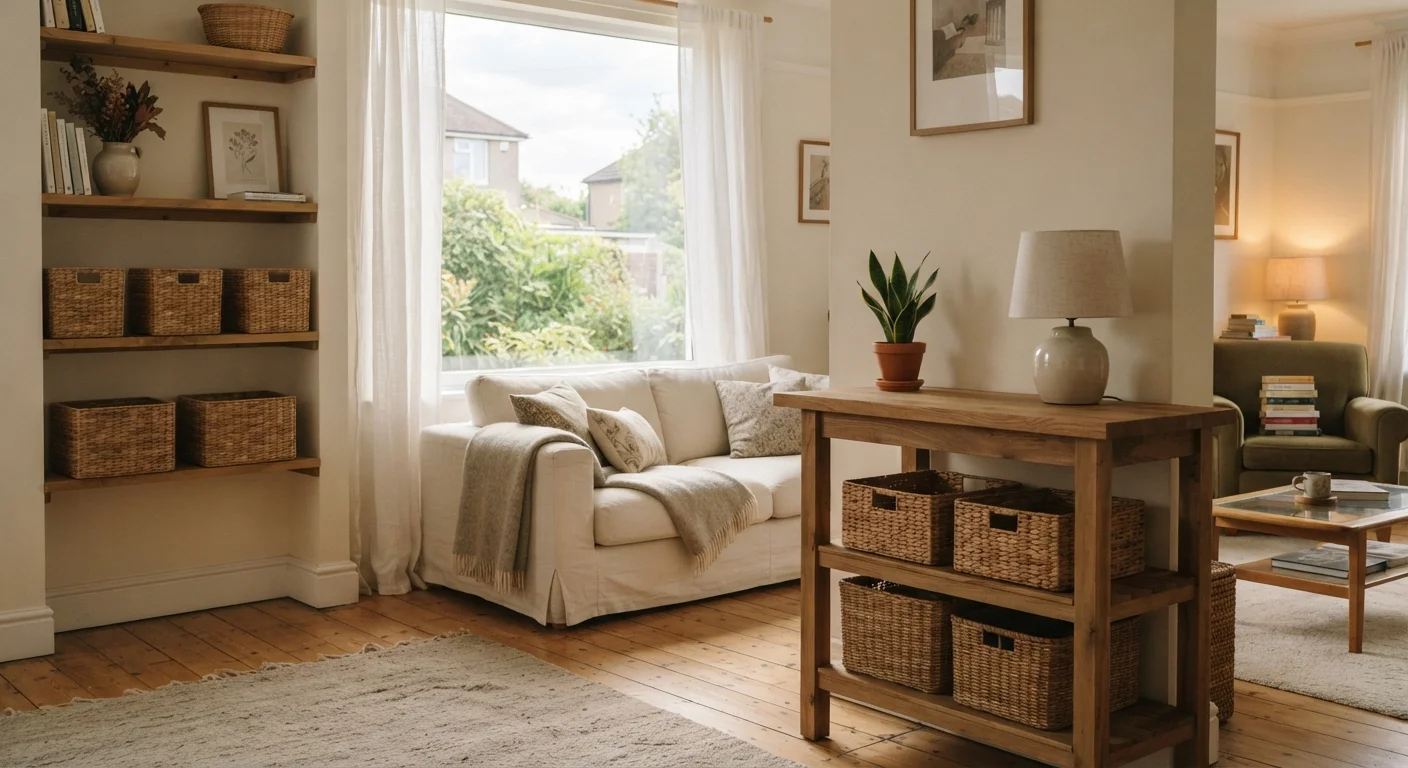
- Living areas: One basket per surface category - remote controls, books, kids' items - keeps spaces scannable without demanding precision.
- Paperwork: Paper clutter is particularly persistent. A simple inbox-to-file pipeline with two or three categories handles most household documents. For more detail, see our guide on why paper clutter accumulates.
For a full room-by-room breakdown, our full home organization playbook goes deeper on each space.
Avoid organizing before decluttering
Buying bins and containers before reducing your belongings is one of the most common - and costly - organizing mistakes. You'll likely buy the wrong sizes, run out of space anyway, and end up with neatly organized clutter. Always sort and remove first; then measure and contain.
How to Maintain Order Without Daily Effort
Maintenance is where most organization attempts break down. The fix is to make resets so short and obvious that they require almost no willpower.
A 5-minute evening reset - returning items to their designated homes before bed - prevents the gradual drift that turns into overwhelming clutter over weeks. The key is that it works only if those designated homes exist and are easy to reach. A lid that requires two hands to open is enough friction to break the habit.
For deeper reading on whether one-time purges or small daily habits work better, see our article on decluttering once vs. maintaining order daily. The short answer: daily habits tend to be more durable, but they have to be genuinely easy.
Two additional principles that reduce long-term effort:
- One-in, one-out: When something new enters the home, something old leaves. This stops accumulation at the source.
- Quarterly reassessment: Spend 20 minutes every few months checking whether your systems still match your habits. Life changes; your organization should adapt with it.
When to Ask for Help
Some homes - particularly those with chronic clutter built up over years, or households navigating major life transitions - benefit from outside perspective. A professional organizer can identify patterns you've stopped seeing and set up systems faster than you could alone.
That said, professional organizing isn't the right fit for everyone. Our balanced look at hiring a professional organizer covers when it makes sense and when it doesn't.
If your household includes multiple people with different tidiness standards, the challenge is as much social as spatial. See our guide on organizing shared spaces with different habits for practical frameworks that don't require everyone to have the same standards.
Finally, if spending feels like part of the problem - buying organizing supplies that don't get used, or clutter connected to shopping habits - general saving and debt guidance can complement the physical work of getting organized.
Organizing looks different for renters
If you rent, many traditional organization upgrades - wall-mounted shelving, permanent hooks, cabinet modifications - may not be permitted under your lease. The good news is that most effective systems don't require any drilling or permanent changes. Our article on organizing without drilling covers what actually works within lease constraints.
Frequently Asked Questions
Pick one small area - a single drawer, a countertop, or an entryway hook - and get it working well before expanding. Early wins build momentum and help you learn what systems actually fit your habits. A <a href="/home-garden/home-organization/tackling-a-chronically-cluttered-home-room-by-room">room-by-room sequence</a> can help you prioritize after that.
No - buying containers before you've sorted and reduced your belongings often leads to buying the wrong sizes or too many. Decide what you're keeping first, then measure the space. This avoids the common trap of organizing clutter rather than eliminating it.
Shared systems need buy-in from everyone in the household to hold long-term. Focus on shared zones first, keep rules simple, and negotiate rather than impose. Our guide on <a href="/home-garden/home-organization/shared-spaces-different-habits-organizing-a-home-with-multiple-people">organizing with multiple people</a> covers practical strategies.
Yes. Freestanding shelves, over-door organizers, tension rods, and adhesive hooks rated for smooth surfaces can all add storage without permanent damage. For a full overview, see our article on <a href="/home-garden/home-organization/renting-and-organizing-what-you-can-do-without-drilling-a-single-hole">renting and organizing without drilling</a>.
Decluttering means removing things you no longer need; organizing means giving what remains a logical, consistent home. Both matter, but organizing without first decluttering often just rearranges the problem. Think of decluttering as preparation and organizing as the structure that follows.
Maintenance failure usually signals the system is too complicated, not that you lack discipline. Simplify: fewer categories, more obvious homes for items, and shorter reset routines. Read more on <a href="/home-garden/home-organization/decluttering-once-vs-maintaining-order-daily-which-approach-sticks">which approach actually sticks</a> for a deeper look.
The content provided on our blog site traverses numerous categories, offering readers valuable and practical information. Readers can use the editorial team’s research and data to gain more insights into their topics of interest. However, they are requested not to treat the articles as conclusive. The website team cannot be held responsible for differences in data or inaccuracies found across other platforms. Please also note that the site might also miss out on various schemes and offers available that the readers may find more beneficial than the ones we cover.