

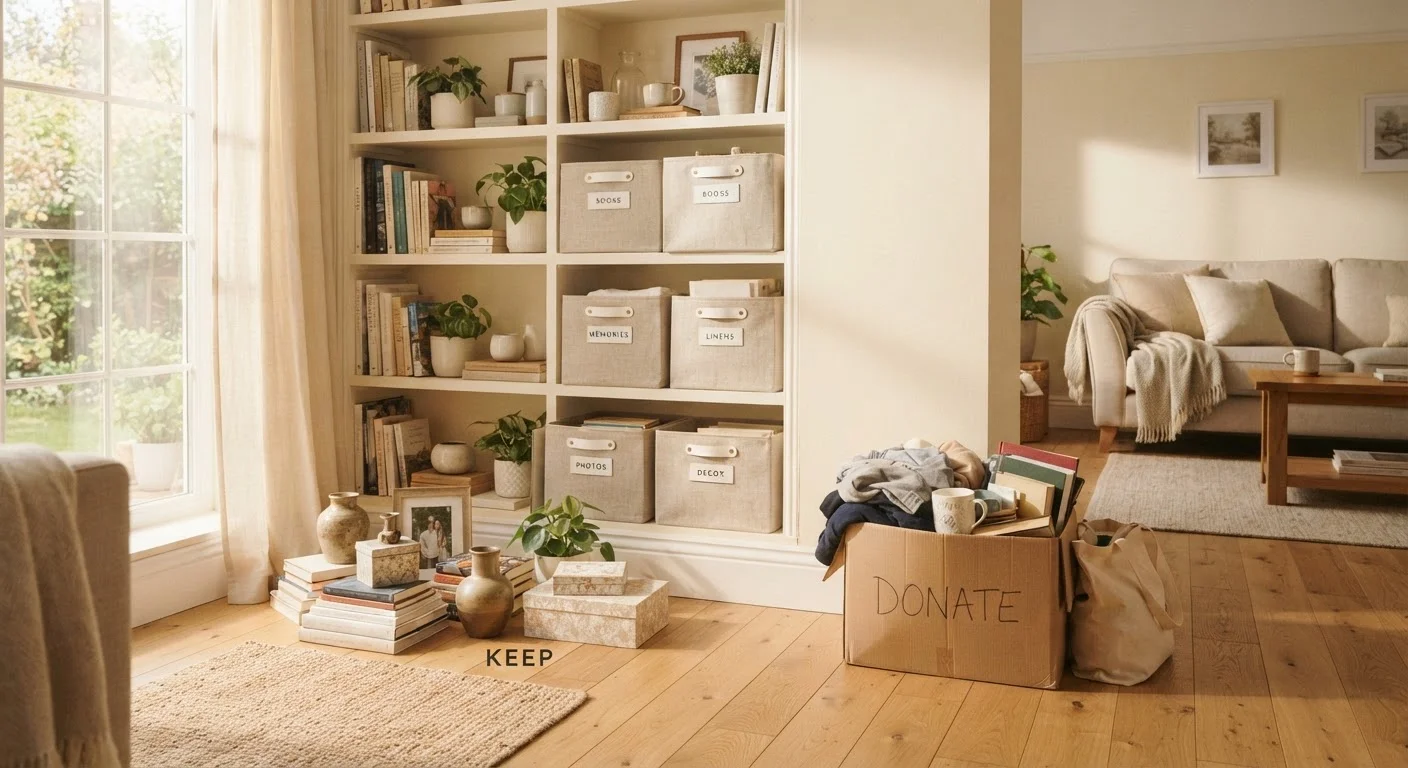
Summary
28 items · 2-4 hours (spread across multiple sessions recommended)
Why an Annual Audit Beats Constant Tidying
Daily tidying keeps surfaces clear, but it rarely addresses the slower accumulation happening inside drawers, closets, and cabinets. Objects quietly multiply - duplicates appear, items outlive their usefulness, and things migrate from their proper places. A dedicated annual audit interrupts that cycle by forcing a deliberate look at everything you own, room by room.
Unlike a full-scale reorganisation project, this checklist is designed around realistic time blocks. You don't need to transform your home in a single weekend. Working through one area at a time - and following a consistent sorting system - produces results that last. If you want a deeper look at how to build lasting systems for each space, see our full home organization playbook for room-specific strategies.
The checklist below covers every major area of a home, from the entryway to the garage. Use it as a guided walkthrough, checking off items as you go and noting anything that needs follow-up attention.
What You'll Need Before You Begin
Preparation is what separates a productive audit from an exhausting one. Before you touch a single shelf, assemble your supplies and set realistic expectations for how long this will take.
Sorting Bins or Bags
Used to physically separate items into Keep, Donate, Discard, and Relocate categories as you work through each room.
Permanent Marker & Labels
Used to label storage boxes clearly once decluttering is complete, so contents are easy to find year-round.
Notepad or Notes App
Used to record items that need repair, replacement, or follow-up action discovered during the audit.
Heavy-Duty Trash Bags
Used for collecting items destined for discard, particularly from storage areas and garages.
File Folders or a Filing Box
Used to organise paper documents that are worth keeping after the paper sort in living areas and home offices.
Document Shredder
Used to securely destroy sensitive paper documents such as old financial statements or medical records.
Plan to work in focused sessions of one to two hours rather than attempting the entire home at once. Fatigue leads to poor decisions - you'll either keep things you should let go or discard things impulsively. Pace yourself, and the process will feel far more manageable.
Room-by-Room Declutter Checklist
Work through each area of your home systematically. For every item you handle, make a clear decision: Keep, Donate, Discard, or Relocate. Avoid the habit of setting things aside to decide later - deferred decisions are how clutter survives annual purges.
Before You Start
Entryway & Hallways
Kitchen & Pantry
Living Areas & Home Office
Bedrooms & Closets
Bathrooms
Garage, Basement & Storage Spaces
Wrap-Up & Follow-Through
Dispose of Medications and Hazardous Items Safely
Never put old medications down the drain or in household trash, as this can harm water supplies and wildlife. Many pharmacies and local governments run take-back programs for expired medications. Similarly, paints, solvents, and chemicals must go through your municipality's household hazardous waste (HHW) program - check your local government website for drop-off locations and accepted materials.
Paper deserves special attention during the living area and home office pass. It's one of the fastest-accumulating categories in any home. For strategies on getting paper under long-term control, see our guide on why paper clutter accumulates and how filing systems help.
Don't Let Donated Items Linger Indoors
One of the most common decluttering pitfalls is filling bags for donation and then letting them sit in a hallway or garage for weeks. Items left in limbo often find their way back into circulation. Move donation bags to your vehicle or arrange a pickup within 48 hours of sorting to ensure they actually leave your home.
Avoid Making Decisions Alone on Shared Items
If you share your home with a partner, roommate, or family members, avoid sorting their belongings without their input. Discarding someone else's possessions - even with good intentions - can damage trust and create conflict. Involve all household members in decisions about shared or communally used items.
Making the Results Stick Year After Year
Completing a declutter audit is satisfying - but the bigger challenge is preventing the same accumulation from returning within a few months. A few habits help significantly. First, apply a simple one-in, one-out rule: when something new enters the home, something comparable leaves. Second, designate a single spot near the door or in a closet as your ongoing donation staging area, so items you naturally outgrow have somewhere to go between annual audits.
If you're dealing with a home where clutter feels genuinely overwhelming rather than just routine, our article on tackling a chronically cluttered home room by room walks through a sequenced approach for more difficult situations. And if you're curious about methodology - specifically, structured category-based approaches to deciding what to keep - how the KonMari method actually works is worth a read.
Finally, note that this checklist focuses on decluttering, not maintenance. For the structural and mechanical tasks your home needs each year - gutters, filters, weatherproofing - see our seasonal home maintenance checklist to keep both lists working together.
The content provided on our blog site traverses numerous categories, offering readers valuable and practical information. Readers can use the editorial team’s research and data to gain more insights into their topics of interest. However, they are requested not to treat the articles as conclusive. The website team cannot be held responsible for differences in data or inaccuracies found across other platforms. Please also note that the site might also miss out on various schemes and offers available that the readers may find more beneficial than the ones we cover.