

Why 'Spark Joy' Is Just the Beginning
Most people have heard the phrase 'Does it spark joy?' - but that single question has overshadowed the rest of the KonMari Method, which is a structured, step-by-step system with specific rules about sequence, technique, and mindset. If you've only heard the tagline, you've only heard a fraction of what the method actually involves.
At its core, KonMari challenges you to make a deliberate decision about every item you own - not just the obviously unwanted clutter, but the neutral, forgotten, and kept-out-of-obligation items too. That's a meaningfully different ask than a typical weekend tidying session.
“The question of what you want to own is actually the question of how you want to live your life.”
— Marie Kondo, Professional organizing consultant and author of 'The Life-Changing Magic of Tidying Up'
The Five Categories, In Order
The defining structural feature of KonMari is that you sort by category, not by room. This is one of the most misunderstood aspects of the method. Here's the required sequence:
- Clothing - Gather every garment in your home into one pile before evaluating anything.
- Books - This includes all books, not just the ones on your nightstand.
- Papers - Documents, mail, manuals, and paperwork of all kinds.
- Komono (miscellaneous) - Kitchen, bathroom, garage, hobby supplies, and more.
- Sentimental items - Photos, gifts, keepsakes, and inherited objects.
The sequence matters. Clothing is emotionally straightforward, which helps you practice the decision-making process before you reach harder categories. Sentimental items require the most emotional clarity, so they come last - after you've sharpened your instincts. Jumping ahead, say, straight to photos, commonly leads to decision fatigue and abandoned efforts.
5
Required categories in the KonMari sequence
The method specifies clothing, books, papers, komono, and sentimental items - worked through in that exact order to build emotional decision-making capacity progressively.
2011
Year KonMari was first published
Marie Kondo's foundational book 'The Life-Changing Magic of Tidying Up' was first published in Japan in 2011 and became an international bestseller after translation in 2014.
1 time
How often KonMari is designed to be done
Unlike daily or seasonal tidying routines, the KonMari method is explicitly designed as a single intensive event - the argument being that thoroughness once prevents the cycle of re-cluttering.
What Gathering and Holding Actually Looks Like
Before evaluating anything in a category, Kondo instructs you to gather every item in that category into one place - typically on the floor or bed. This step alone is revealing. Most people discover they own far more than they realized once it's all in one pile.
Then, you pick up each item individually. The physical act of holding something is intentional: it prompts a bodily response rather than a purely intellectual one. You're not asking 'Is this in good condition?' or 'Might I need this someday?' - questions that tend to justify keeping almost everything. You're asking whether this item has an active, positive role in your life going forward.
Set a Timer to Avoid Stalling
When holding items for evaluation, it's easy to overthink. If you find yourself deliberating for more than a minute or two on a single item, set a 60-second limit and trust your initial response. Indecision often signals the item isn't truly essential - but a time boundary helps prevent the session from stalling entirely.
Items that don't make the cut are thanked before they're released. This practice, rooted in Kondo's philosophy, is about closing a chapter mindfully rather than treating discarded things as failures or waste.
Storage Is a Skill, Not an Afterthought
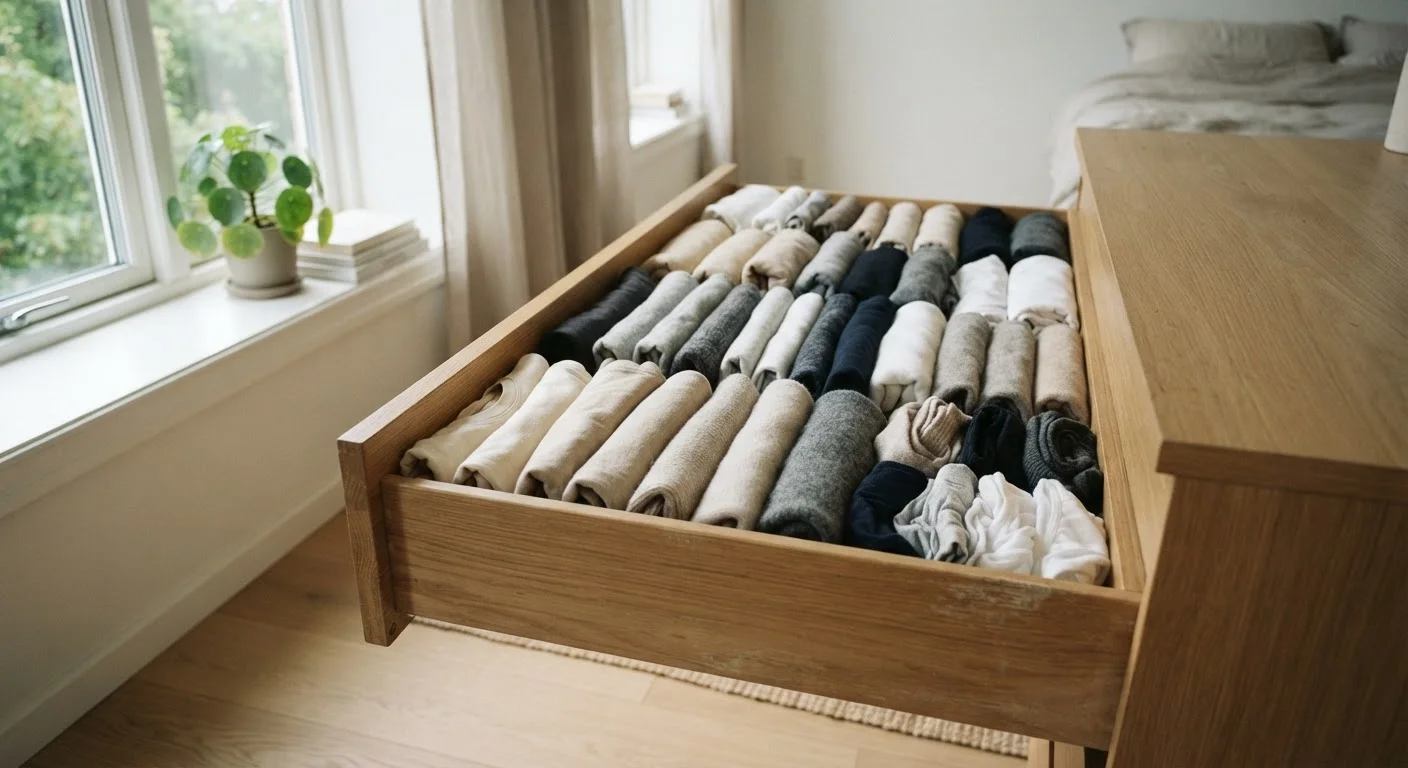
What happens after the evaluation is equally important in KonMari. Kondo is specific about how items should be stored, not just which ones to keep. The most well-known technique is vertical folding for clothing: garments are folded into compact rectangles and stood upright in drawers, rather than stacked in piles. This lets you see everything at a glance and prevents the common problem of bottom-of-pile items going unused for years.
The broader principle is that every item should have a designated home - a single, specific place it returns to after use. This is what allows a tidied space to stay tidy. Without assigned homes, items migrate and pile up again regardless of how thoroughly you initially sorted them.
This storage-first thinking distinguishes KonMari from approaches that focus purely on reducing quantity. For a complementary take on building habits around a tidy home, see our guide on decluttering once vs. maintaining order daily.
What KonMari Asks of You - Honestly
The method is not a quick fix. It's designed as a single, intensive undertaking - sometimes called a 'tidying festival' - rather than a routine maintenance system. Kondo's argument is that doing it thoroughly once, rather than repeatedly in small bursts, creates a more durable shift in how you live with your belongings.
That said, it's a significant time and emotional commitment. Sentimental categories in particular can be unexpectedly draining. If a full KonMari undertaking feels like too much at once, a lower-friction starting framework might be a better entry point - or consider a room-by-room approach to build momentum first.
KonMari Isn't the Only Valid Approach
The KonMari Method works well for people who prefer a comprehensive, philosophy-driven process. But it's not the only effective system. Some households benefit more from room-specific organization strategies or a structured annual declutter checklist. The best system is the one you'll actually follow through on.
For those who complete the process, many find the lasting benefit isn't just a tidy home - it's having made hundreds of intentional choices about what they want their space to reflect. That shift in relationship to possessions is what Kondo considers the real outcome of the method.
Frequently Asked Questions
Sparking joy is the emotional checkpoint Kondo uses to decide whether an item stays or goes. You hold the object and notice your physical and emotional response - does it feel right to keep it? It's not just about happiness; it also includes items that serve a clear, valued purpose in your life.
Kondo recommends completing the full tidying process in one concentrated period rather than spreading it over months or years. For most households, this realistically means multiple sessions over several weeks. Rushing or doing it piecemeal tends to undermine lasting results.
Yes - the sequence is intentional. Clothing is the easiest category emotionally, which builds your decision-making confidence. Sentimental items come last because they require the most emotional discernment. Skipping ahead often makes the process harder and less effective.
It can work for families, though it takes more coordination. Kondo advises focusing on your own belongings first rather than attempting to declutter other people's things. Children can be gradually involved in the process in age-appropriate ways.
Komono is a Japanese word meaning miscellaneous items. In KonMari, it's the fourth category and covers everything from kitchen tools and bathroom products to hobby supplies and electronics. It's typically the largest and most varied category.
Most decluttering approaches focus on removing obvious junk or organizing room by room. KonMari asks you to evaluate every item you own - even things that seem fine - and make an active choice about each one. It also emphasizes where and how you store what stays.
The content provided on our blog site traverses numerous categories, offering readers valuable and practical information. Readers can use the editorial team’s research and data to gain more insights into their topics of interest. However, they are requested not to treat the articles as conclusive. The website team cannot be held responsible for differences in data or inaccuracies found across other platforms. Please also note that the site might also miss out on various schemes and offers available that the readers may find more beneficial than the ones we cover.