

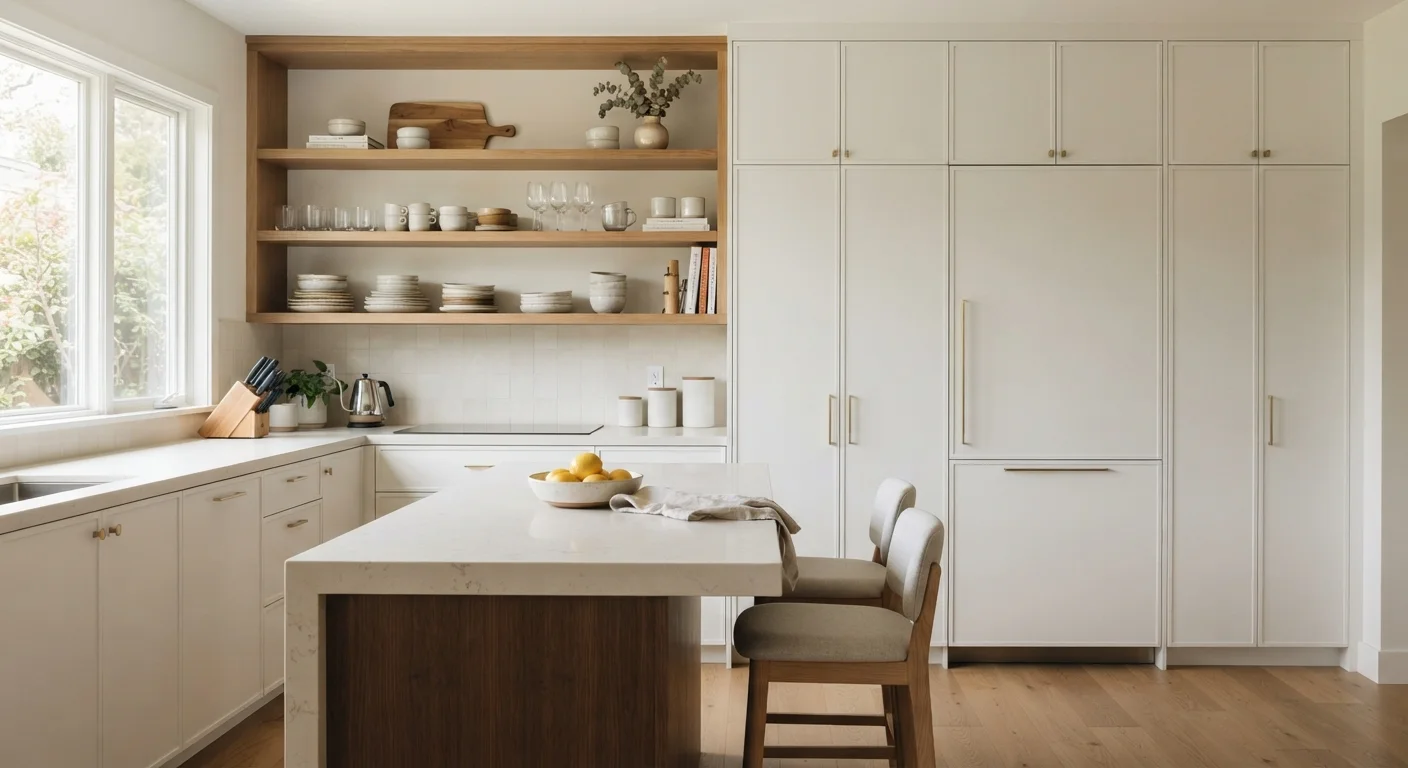
Option A
Open Shelving
The visible, accessible, display-forward option.
Best for: Households with consistent tidiness habits who want quick access and a curated, airy aesthetic.
Option B
Closed Cabinets
The contained, clutter-hiding, low-maintenance solution.
Best for: Busy households, shared spaces, or anyone who prefers organized-looking rooms without daily upkeep.
What Each Storage Type Actually Asks of You
Open shelving and closed cabinets aren't just aesthetic choices - they impose different behavioral demands. Open shelving puts everything in view, which means every item stored there is effectively on permanent display. Attractive, consistently arranged items look great; a single week of loose mail, random bottles, or mixed-height containers can make an entire wall feel chaotic.
Closed cabinets, by contrast, hide their contents behind doors. This lowers the visual maintenance bar considerably - you can push mismatched containers or half-used products inside and close the door. The catch is that closed storage can mask disorganization rather than cure it. Without intentional internal systems (labeled zones, bins, shelf dividers), closed cabinets tend to accumulate clutter that's invisible until a drawer won't close or you can't find anything quickly.
The honest question isn't "which looks better" - it's "which system matches how I actually behave." For a deeper look at building room-by-room systems that account for real-life habits, see the full home organization playbook.
| Criterion | Open Shelving | Closed Cabinets |
|---|---|---|
| Visual maintenance required | High - everything is always visible | Low - contents hidden behind doors |
| Dust and grease accumulation | Significant, especially in kitchens | Minimal on stored items |
| Accessibility | Excellent - items visible at a glance | Depends on cabinet depth and layout |
| Renter suitability | Good - freestanding units available | Limited if built-in units aren't present |
| Hides disorganization | No - clutter is always on display | Yes - but doesn't solve root clutter |
| Best room fit | Living rooms, offices, low-dust kitchens | Bathrooms, laundry rooms, shared spaces |
Where Each Option Works Best - and Where It Struggles
Open shelving performs well in spaces where items are used frequently and stored consistently. Kitchen shelves holding everyday dishes, glasses, and a few attractive pantry jars work because those items are grabbed and returned regularly - turnover keeps things tidy. In a home office or bedroom, open shelving for books or folded textiles can feel intentional and uncluttered if maintained.
It struggles, however, in high-grease or high-dust environments. Kitchen shelves near a stove accumulate grease and grime on everything stored nearby - including the items themselves. In dusty utility spaces or garages, open shelving means everything needs regular wiping. For pantry storage specifically, a hybrid approach - open shelving for frequently rotated items, closed for bulk stock - often works best. The kitchen pantry organization reference guide outlines practical zone strategies for exactly this kind of setup.
Closed cabinets excel in bathrooms (where products vary by person and privacy helps), laundry rooms (cleaning supplies benefit from containment), and any shared household space. When multiple people with different tidiness habits use the same room, closed storage reduces friction. The guide to organizing shared spaces covers how storage type affects multi-person household harmony in more detail.
A Note on Hybrid Approaches
Many kitchen and living room designs successfully combine both types - lower closed cabinets for bulk or private storage, upper open shelves for display items or daily-use essentials. This approach lets you tailor each zone to what's stored there rather than committing the entire room to one solution. If you're renovating or selecting new furniture, look for pieces specifically designed with this mixed format in mind.
Making a Practical Decision for Your Space
Start by auditing what you plan to store, not how you'd like the room to look. Items that are attractive, uniform in size, and used daily are good open-shelf candidates. Items that are mismatched, rarely used, or private belong behind doors.
Next, honestly assess maintenance tolerance. If keeping surfaces tidy requires conscious effort for you, open shelving will create ongoing stress. There's no shame in choosing closed storage - it's simply a better behavioral match for most busy households.
For renters, open shelving has a practical advantage: freestanding units require no permanent installation. The renter-friendly organization guide covers no-drill options worth exploring before committing to any fixed storage. And if your biggest challenge is extracting storage from a room that seems to have none, vertical space and hidden storage strategies can help you see the room differently before you decide on a storage type at all.
~60%
Homeowners preferring mixed storage
Design surveys from home improvement publications consistently show that a majority of homeowners prefer combining open and closed storage rather than choosing one type exclusively.
1-2×/week
Dusting frequency for open kitchen shelves
Home cleaning guides generally recommend dusting open kitchen shelves at least once or twice a week, compared to monthly cleaning for closed cabinet interiors.
Most functional homes use a mix of both. The key is deliberate placement: open shelving where visibility and access are assets, closed cabinets where containment and concealment serve you better. Neither is inherently superior - the right choice is the one that reduces friction in your daily routine.
The content provided on our blog site traverses numerous categories, offering readers valuable and practical information. Readers can use the editorial team’s research and data to gain more insights into their topics of interest. However, they are requested not to treat the articles as conclusive. The website team cannot be held responsible for differences in data or inaccuracies found across other platforms. Please also note that the site might also miss out on various schemes and offers available that the readers may find more beneficial than the ones we cover.