

What Are Vitamins and Minerals?
Unlike proteins, carbohydrates, and fats, vitamins and minerals are micronutrients - compounds your body needs in small amounts but cannot manufacture in sufficient quantities on its own. They don't provide energy directly, but they make nearly every biological process possible: turning food into fuel, building bone, transmitting nerve signals, and defending against infection.
Vitamins are organic compounds, meaning they come from living sources and can be broken down by heat, air, or acid. Minerals are inorganic elements - think calcium, iron, and zinc - that hold their structure through cooking and digestion. Both categories are essential, and a shortfall in any one of them can gradually affect how you feel and function.
This reference covers the most nutritionally significant micronutrients, what each one does, and where to find it in food. For a complementary look at how macronutrients fit into the picture, see how protein, carbs, and fat work in your body.
Micronutrient
A vitamin or mineral needed by the body in small quantities to support essential biological functions. Unlike macronutrients, micronutrients do not provide calories but are critical for health.
Fat-soluble vitamin
A vitamin that dissolves in fat and is stored in body tissues (liver and fatty tissue). Vitamins A, D, E, and K are fat-soluble, meaning excess intake can accumulate to potentially harmful levels.
Water-soluble vitamin
A vitamin that dissolves in water and is not stored in significant amounts. Excess is generally excreted in urine, so these vitamins require regular intake through food. Vitamin C and all B vitamins fall into this category.
Trace mineral
A mineral the body needs in very small (microgram to milligram) quantities. Despite the tiny amounts needed, trace minerals like iron, zinc, and iodine are essential for health.
Bioavailability
The proportion of a nutrient that the body actually absorbs and uses after ingestion. Factors such as food form, other foods eaten together, and individual health status can all affect bioavailability.
Daily Value (DV)
A reference amount set by the FDA representing how much of a nutrient a typical adult needs per day. Nutrition labels express nutrients as a percentage of the DV to help consumers compare foods at a glance.
Key Vitamins at a Glance
Vitamins are divided into two groups based on how the body stores and uses them:
- Fat-soluble vitamins (A, D, E, K) dissolve in fat and are stored in body tissues. Because they accumulate, excessive supplementation carries risk.
- Water-soluble vitamins (C and the eight B vitamins) dissolve in water, are not stored in large amounts, and need regular replenishment through food.
| Number of essential vitamins | 13 (National Institutes of Health (NIH)) |
| Number of essential minerals | At least 16 (NIH Office of Dietary Supplements) |
| Most common nutrient deficiency globally | Iron deficiency (World Health Organization (WHO)) |
| Vitamin D synthesis | Triggered by UVB sunlight on skin (NIH Office of Dietary Supplements) |
| B12 in plant foods | Negligible - supplementation often needed (Academy of Nutrition and Dietetics) |
| Vitamin C + iron pairing | Enhances non-heme iron absorption (NIH Office of Dietary Supplements) |
Fat-Soluble Vitamins
- Vitamin A
- Supports vision (especially in low light), immune function, and skin cell renewal. Found in liver, dairy, eggs, and as beta-carotene in orange and dark green vegetables.
- Vitamin D
- Regulates calcium absorption and bone mineralization; also plays a role in immune response. Synthesized by skin after sun exposure; dietary sources include fatty fish, fortified milk, and egg yolks.
- Vitamin E
- Acts as an antioxidant, protecting cells from oxidative damage. Concentrated in nuts, seeds, and vegetable oils.
- Vitamin K
- Essential for blood clotting and bone metabolism. Leafy greens - kale, spinach, broccoli - are the richest sources.
Water-Soluble Vitamins
- Vitamin C
- Supports collagen synthesis, immune defense, and iron absorption. Citrus fruits, bell peppers, strawberries, and broccoli are excellent sources.
- B Vitamins (collective)
- The eight B vitamins - including B1 (thiamine), B2 (riboflavin), B3 (niacin), B6, B9 (folate), and B12 - collectively support energy metabolism, nerve function, and red blood cell production. Whole grains, legumes, meat, fish, eggs, and dairy cover most of these. Folate is critical during early pregnancy; B12 is found almost exclusively in animal products, making it a key consideration for plant-based eaters. See what plant-based eaters need to plan for for more detail.
Key Minerals at a Glance
Minerals are split into macrominerals (needed in larger amounts, such as calcium and magnesium) and trace minerals (needed in tiny amounts, such as iron and zinc). Both are equally essential.
Absorption Matters as Much as Intake
Eating a food that contains a mineral doesn't guarantee your body absorbs all of it. Compounds called phytates (in grains and legumes) and oxalates (in spinach and beets) can bind to minerals like iron, calcium, and zinc and reduce how much is absorbed. Cooking, soaking, or fermenting these foods can help improve mineral bioavailability. Pairing iron-rich plant foods with a source of vitamin C is one of the best-documented ways to boost absorption.
- Calcium
- The most abundant mineral in the body, critical for bone and tooth structure, muscle contraction, and nerve signaling. Dairy products, fortified plant milks, tofu made with calcium sulfate, and leafy greens are reliable sources.
- Iron
- Central to hemoglobin - the protein that carries oxygen in red blood cells. Comes in two forms: heme iron (meat, poultry, seafood - absorbed efficiently) and non-heme iron (legumes, fortified cereals, spinach - absorbed less efficiently but enhanced by pairing with vitamin C).
- Magnesium
- Involved in more than 300 enzymatic reactions, including energy production, protein synthesis, and blood glucose regulation. Found in nuts, seeds, whole grains, leafy greens, and legumes.
- Potassium
- Helps maintain fluid balance and supports healthy blood pressure. Bananas, potatoes, beans, and dairy are good sources.
- Zinc
- Supports immune function, wound healing, and DNA synthesis. Found in meat, shellfish, legumes, nuts, and seeds.
- Iodine
- Required for thyroid hormone production, which regulates metabolism. Iodized table salt and seafood are the primary sources in the American diet.
Understanding how these nutrients appear on food packaging can help you make more informed choices. Learn what the nutrition label is actually telling you, including how to read % Daily Values for key micronutrients.
Getting What You Need Through Food
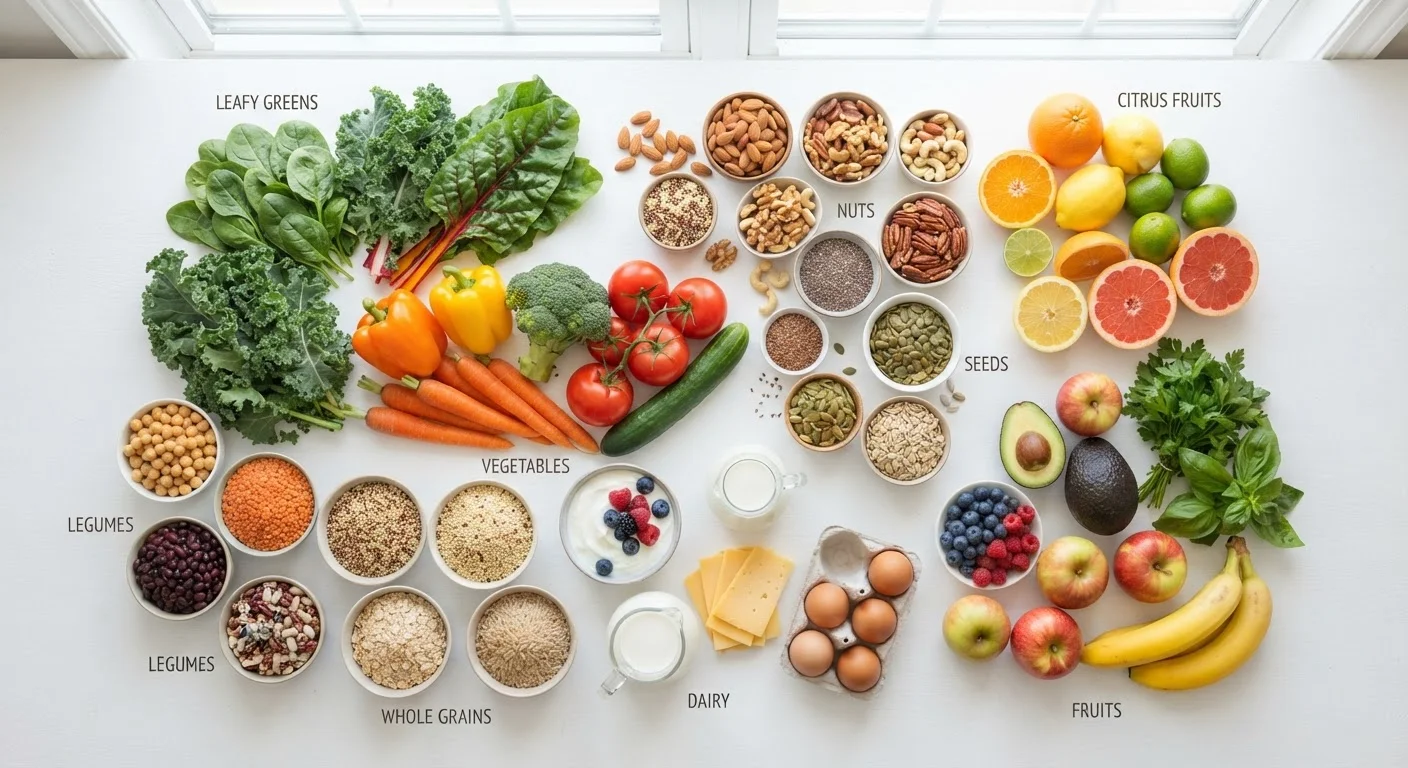
For most healthy adults, a varied diet that includes vegetables, fruits, whole grains, legumes, protein sources, and dairy (or fortified alternatives) will cover the majority of micronutrient needs without supplementation. No single food supplies everything - dietary variety is the most practical strategy.
~31%
U.S. adults at risk for at least one vitamin deficiency or anemia
According to CDC nutritional surveillance data based on NHANES findings.
42%
U.S. adults estimated to be vitamin D insufficient
Based on NHANES data analyzed by researchers and cited in NIH fact sheets.
1 in 6
Women of childbearing age with low iron stores
Reported in CDC Iron Deficiency surveillance summaries.
Certain groups may have increased needs or absorption challenges: older adults often absorb B12 and vitamin D less efficiently; people who are pregnant need more folate and iron; those following a fully plant-based diet should pay deliberate attention to B12, vitamin D, calcium, iron, zinc, and iodine. If you're building weekly meals with nutritional balance in mind, this practical starting point for meal planning can help structure your approach.
Supplements can fill specific gaps, but they are not a substitute for a nutritious diet and should be chosen based on individual need - ideally guided by a healthcare provider or registered dietitian. A periodic self-check on your eating patterns can be useful; this weekly nutrition self-check offers a practical, pressure-free way to do that.
This article is for general informational and educational purposes only and is not a substitute for professional medical or nutritional advice. Consult a qualified healthcare provider or registered dietitian for guidance tailored to your individual health needs.
The content provided on our blog site traverses numerous categories, offering readers valuable and practical information. Readers can use the editorial team’s research and data to gain more insights into their topics of interest. However, they are requested not to treat the articles as conclusive. The website team cannot be held responsible for differences in data or inaccuracies found across other platforms. Please also note that the site might also miss out on various schemes and offers available that the readers may find more beneficial than the ones we cover.