

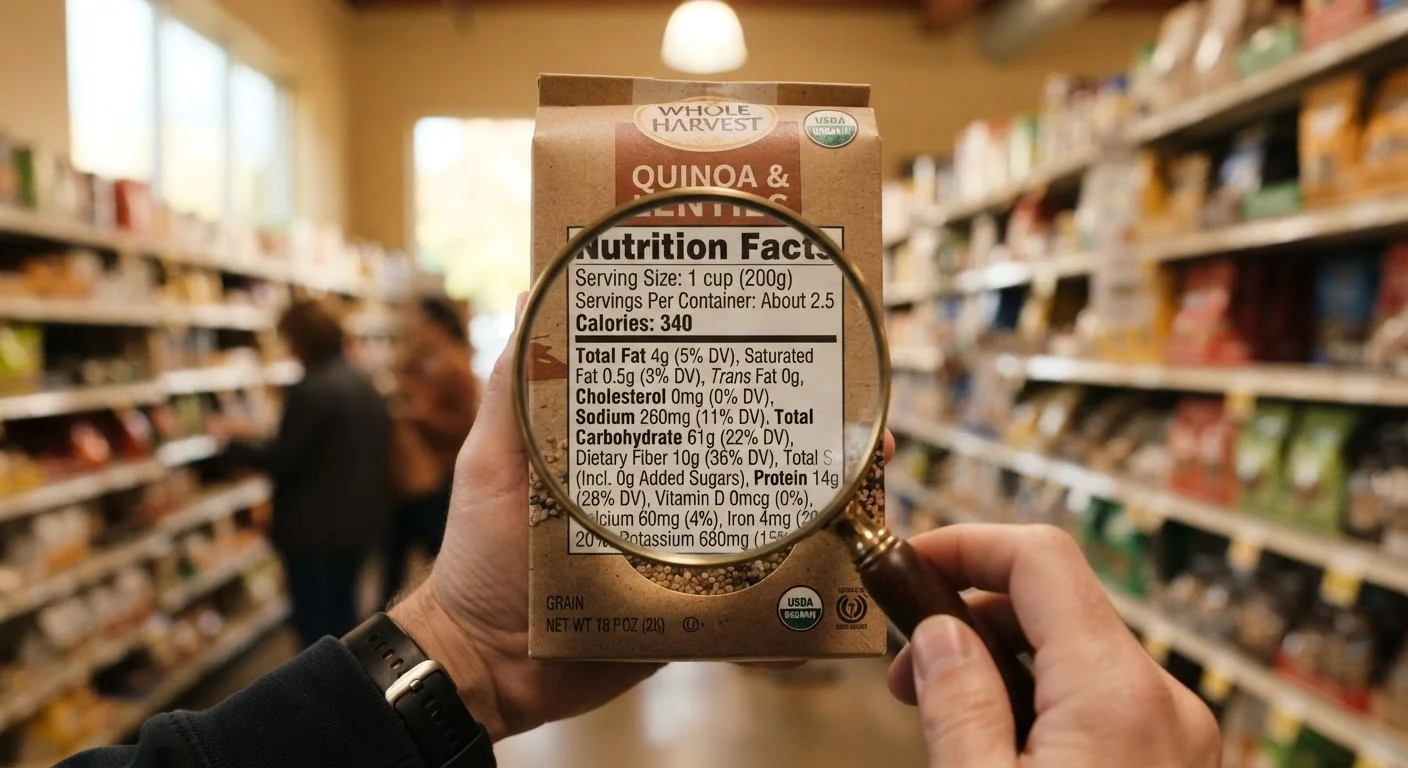
Start Here: Serving Size Is the Whole Foundation
The single most important line on any nutrition label is serving size, and it's deliberately placed at the top. Every calorie count, gram of fat, and milligram of sodium listed below it applies only to that measured amount - not necessarily what you'd pour into a bowl or drink in one sitting.
Manufacturers set serving sizes based on FDA reference amounts that reflect how much people typically consume, not how much they should consume. A bag of chips might list 1 oz (about 15 chips) as a serving, but if you eat 2 oz, every number on the label doubles. This is where many people underestimate their intake without realizing it.
Check the servings per container line too. A bottled drink that appears to be a single portion may contain 2.5 servings according to the label - meaning the calorie count listed applies only to a fraction of the bottle.
Quick Serving-Size Check at the Store
Before comparing two similar products, make sure their serving sizes are the same - otherwise you're comparing different amounts. Look at the grams listed next to the serving size, not just the household measure (like "1 cup"), since cup volumes can vary by food density.
Calories and Macronutrients: What the Big Numbers Mean
Calories measure the total energy a food provides. The label then breaks down where those calories come from across three macronutrients:
- Total Fat - includes saturated fat and trans fat as sub-categories. Saturated fat is linked to cardiovascular risk when consumed in excess; trans fat (from partially hydrogenated oils) has been largely removed from the U.S. food supply but can still appear in trace amounts.
- Total Carbohydrates - includes dietary fiber, total sugars, and the separately listed added sugars. Fiber is a nutrient most Americans under-consume and is associated with digestive and cardiovascular health.
- Protein - listed in grams, without a % Daily Value for most adults, because protein needs vary widely by body weight and health status.
For a deeper look at one of the most misunderstood entries on this list, see our guide on added sugars and where they hide.
70%
Americans who eat too much sodium
According to the CDC, the vast majority of U.S. adults consume more sodium than the recommended 2,300 mg per day, largely from packaged and processed foods.
17 tsp
Average daily added sugar intake in the U.S.
The American Heart Association reports that average American adults consume roughly 17 teaspoons of added sugar per day - more than double the recommended limit for women.
<5%
Adults meeting daily fiber recommendations
Research published in the American Journal of Lifestyle Medicine found that fewer than 5% of Americans meet the recommended daily fiber intake of 25-38 grams.
Understanding % Daily Value
The % Daily Value (% DV) column is one of the most useful - and most ignored - parts of the label. It answers a simple question: how much does this serving contribute to your total daily intake of a nutrient, based on a 2,000-calorie reference diet?
The FDA's shorthand rule is practical: 5% DV or less is low; 20% DV or more is high. This helps you decide quickly whether a food is a meaningful source of fiber or calcium, or whether it's pushing your sodium or saturated fat budget uncomfortably high.
Nutrients to aim for higher % DV include: dietary fiber, vitamin D, calcium, iron, and potassium - all nutrients that are commonly under-consumed in American diets. Nutrients to keep lower include: saturated fat, sodium, and added sugars.
The 2,000-Calorie Reference Is a Benchmark, Not a Target
The % Daily Values on every label are calculated against a 2,000-calorie daily diet - a standardized figure chosen to make labels uniform across all products. Your actual calorie needs depend on factors including age, sex, height, weight, and physical activity level. Use % DV as a relative comparison tool, not a precise personal prescription.
If you're monitoring your diet for specific micronutrients, our no-jargon vitamins and minerals reference explains what each one does and where to find it in food.
Common Label Pitfalls and How to Avoid Them
Even label-aware shoppers can be tripped up by a few recurring issues:
- Liquid calories are easy to overlook. Many beverages - from juiced drinks to coffee preparations - have nutritional profiles that surprise people. Our article on how liquid calories fit into daily nutrition walks through what those labels actually show.
- "Per serving" vs. "per container" confusion. When a product lists its best-looking numbers per serving, always do the math for what you'll actually consume.
- Front-of-package claims don't substitute for the label. Words like "natural," "multigrain," or "light" are marketing terms, not nutritional guarantees. The Nutrition Facts panel is the authoritative source.
- Ingredient lists matter too. Ingredients are listed by weight from greatest to least. If a form of added sugar appears among the first three ingredients, it's a significant component of the food - regardless of what the front label implies.
This article is for general informational and educational purposes only and is not a substitute for advice from a registered dietitian, physician, or other qualified health professional. Always consult a qualified healthcare provider before making significant changes to your diet.
Frequently Asked Questions
% Daily Value (% DV) tells you how much a nutrient in one serving contributes to a typical 2,000-calorie daily diet. A general rule: 5% DV or less is considered low, and 20% DV or more is considered high. Use it to quickly gauge whether a food is a significant source of a nutrient.
The FDA chose 2,000 calories as a standardized benchmark to make labels consistent and comparable across all products. It does not represent a universal recommendation - individual calorie needs vary based on age, sex, body size, and activity level.
Total sugars include both naturally occurring sugars (like those in fruit or milk) and sugars added during processing. Added sugars are only those introduced during manufacturing. Because natural and added sugars behave differently in health terms, the FDA now requires them to be listed separately.
Use the % Daily Value as your guide: 20% DV or above per serving signals a high-sodium food. The Dietary Guidelines for Americans recommend limiting sodium to 2,300 mg per day for most adults, and many processed foods can consume a large portion of that in a single serving.
Calorically, a calorie from fat equals a calorie from carbohydrate or protein. However, different macronutrients affect satiety, blood sugar, and overall health differently. The calorie count alone doesn't tell the full nutritional story of a food.
Most packaged foods sold in the U.S. are required to carry a Nutrition Facts label, but there are exemptions - including very small businesses, certain raw produce, and plain meats and poultry, which fall under USDA rather than FDA jurisdiction.
The content provided on our blog site traverses numerous categories, offering readers valuable and practical information. Readers can use the editorial team’s research and data to gain more insights into their topics of interest. However, they are requested not to treat the articles as conclusive. The website team cannot be held responsible for differences in data or inaccuracies found across other platforms. Please also note that the site might also miss out on various schemes and offers available that the readers may find more beneficial than the ones we cover.