

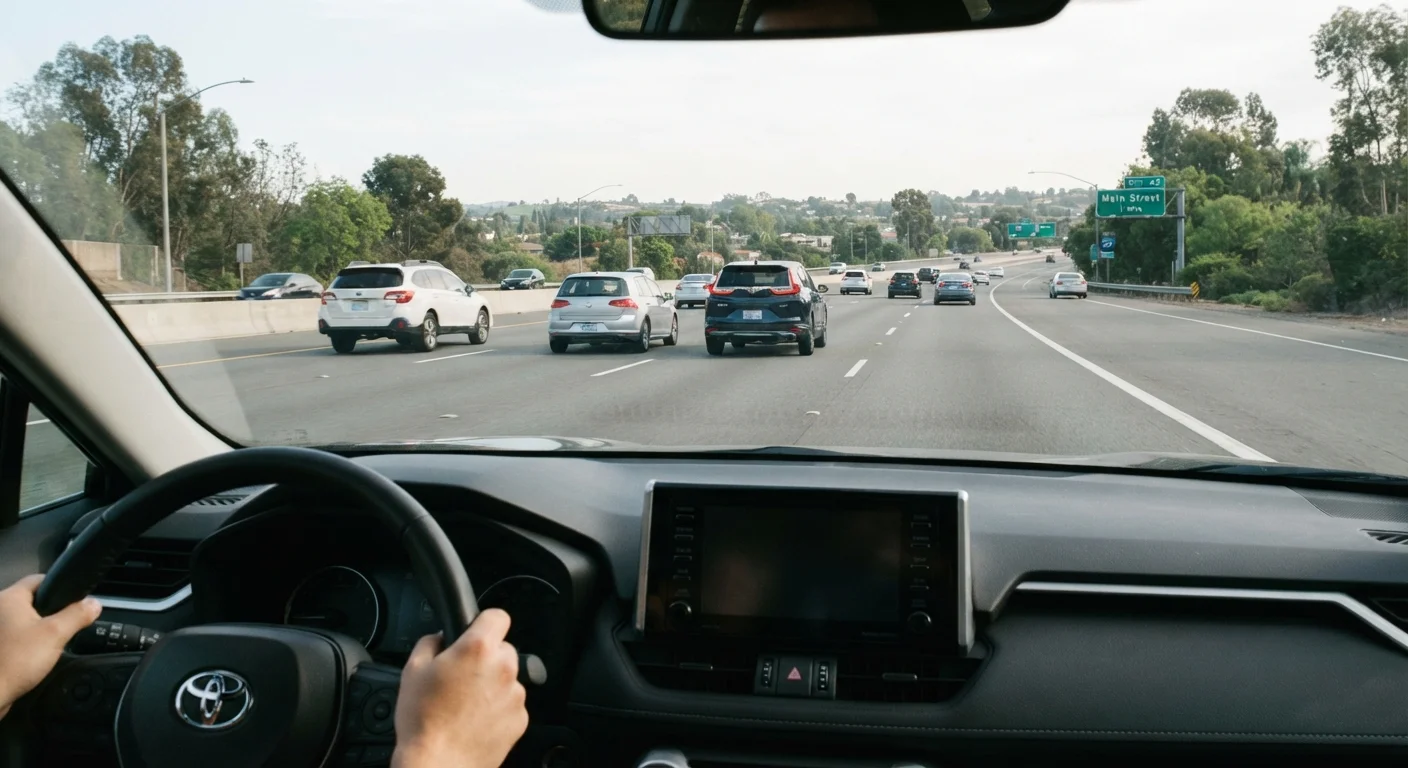
Why the Gap You're Leaving Probably Isn't Enough
Rear-end collisions are among the most preventable crashes on American roads - and insufficient following distance is a primary cause. According to the National Highway Traffic Safety Administration (NHTSA), rear-end crashes account for roughly 29% of all reported collisions. Most happen not because drivers are distracted (though that compounds the problem), but because they simply don't leave enough space to react and stop in time.
The standard advice most drivers remember from driver's ed is the two-second rule: watch the vehicle ahead pass a fixed point, then count two seconds before your own vehicle reaches that same point. That gap gives you a rough baseline at lower speeds in good conditions. But it's a minimum - not a margin of comfort - and most drivers don't even achieve that.
Research from driving safety organizations suggests that in real-world traffic, many drivers follow at intervals closer to one second. At 60 mph, one second equals 88 feet. A typical passenger car traveling at that speed needs roughly 240-300 feet to stop completely, accounting for reaction time and braking distance combined. The math simply doesn't work in your favor.
~29%
Share of all crashes that are rear-end collisions
According to NHTSA data, rear-end crashes are one of the most common and preventable collision types on American roads.
240-300 ft
Stopping distance at 60 mph for a typical passenger car
This figure includes approximately 1.5 seconds of reaction time plus braking distance on dry pavement - far more than most drivers allow.
Best Practices for Maintaining a Safe Following Distance
The right gap depends on your speed, vehicle, road conditions, and visibility. These practices translate the general principle into specific, usable habits.
Use the three-second rule as your everyday baseline, not the two-second rule.
Two seconds is the floor recommended for ideal conditions at moderate speeds. Adding one more second builds in a buffer for reaction lag, worn brakes, or slight distractions - all of which are part of normal driving. Safety engineers and defensive driving instructors increasingly recommend three seconds as the practical standard.
Double your gap in wet or adverse weather conditions.
Water on the road significantly reduces friction between tires and pavement, extending the distance needed to stop. Hydroplaning risk increases with speed, and wet brake components can respond more slowly. Four seconds or more is the common recommendation from highway safety authorities in rain.
Increase your following distance when driving a larger or loaded vehicle.
Heavier vehicles take longer to stop due to greater momentum. A full-size pickup towing a boat, or an SUV loaded for a road trip, behaves very differently than the same vehicle empty. Drivers often underestimate this effect, particularly those transitioning from smaller cars.
Identify and maintain the gap using fixed landmarks, not just a gut feeling.
Most drivers overestimate how much space they're leaving. Using a fixed roadside object - a sign, a lane marker, a bridge - to count seconds removes guesswork and makes the habit measurable and consistent.
Re-establish your gap after being cut off rather than closing in on the intruding vehicle.
When another driver merges closely in front of you, the instinct is often frustration - and some drivers unconsciously close the gap in response. This is dangerous. The correct response is to ease off the accelerator and restore your following distance, regardless of how unnecessary the other driver's move felt.
When Conditions Demand More Space
Many drivers set a mental gap and keep it regardless of conditions. That's a mistake. Following distance isn't a fixed number - it's a dynamic judgment based on your environment.
The Conditions Test: Ask Before You Drive
Before settling into your following distance on any trip, quickly assess: Is it raining, foggy, or icy? Am I carrying extra weight? Is visibility reduced? If the answer to any of these is yes, your gap should be longer - often significantly so. Treating following distance as a fixed habit rather than a dynamic choice is one of the most common errors experienced drivers make.
Rain reduces tire traction and lengthens stopping distances significantly. On wet roads, doubling the two-second rule to a minimum of four seconds is widely recommended by safety authorities. On ice or packed snow, stopping distances can be ten times longer than on dry pavement, making six to eight seconds or more appropriate depending on speed.
Reduced visibility - from fog, heavy rain, glare, or night driving - compounds the problem. If you can't see the road clearly 100 feet ahead, you can't safely drive at speeds that require more than 100 feet to stop. Slow down and extend your gap. For more on how speed misjudgment affects safety in specific zones, see why drivers misjudge speed in school and work zones.
Towing a trailer or driving a loaded pickup further extends your stopping distance. Heavier vehicles carry more momentum, and that extra weight doesn't stop as quickly as an empty car. Always account for your vehicle's actual load.
Quick Actions to Improve Your Following Distance Today
You don't need a new car or a refresher course to improve your following distance habits. Small, deliberate adjustments made consistently are all it takes.
Following distance is one component of a broader set of road habits that keep you legal and safe. For a full overview of foundational driving laws, see America's driving laws reference guide. And because following distance intersects with right-of-way decisions - especially in merging and intersection scenarios - it's worth reviewing right-of-way rules American drivers get wrong as well.
The content provided on our blog site traverses numerous categories, offering readers valuable and practical information. Readers can use the editorial team’s research and data to gain more insights into their topics of interest. However, they are requested not to treat the articles as conclusive. The website team cannot be held responsible for differences in data or inaccuracies found across other platforms. Please also note that the site might also miss out on various schemes and offers available that the readers may find more beneficial than the ones we cover.