

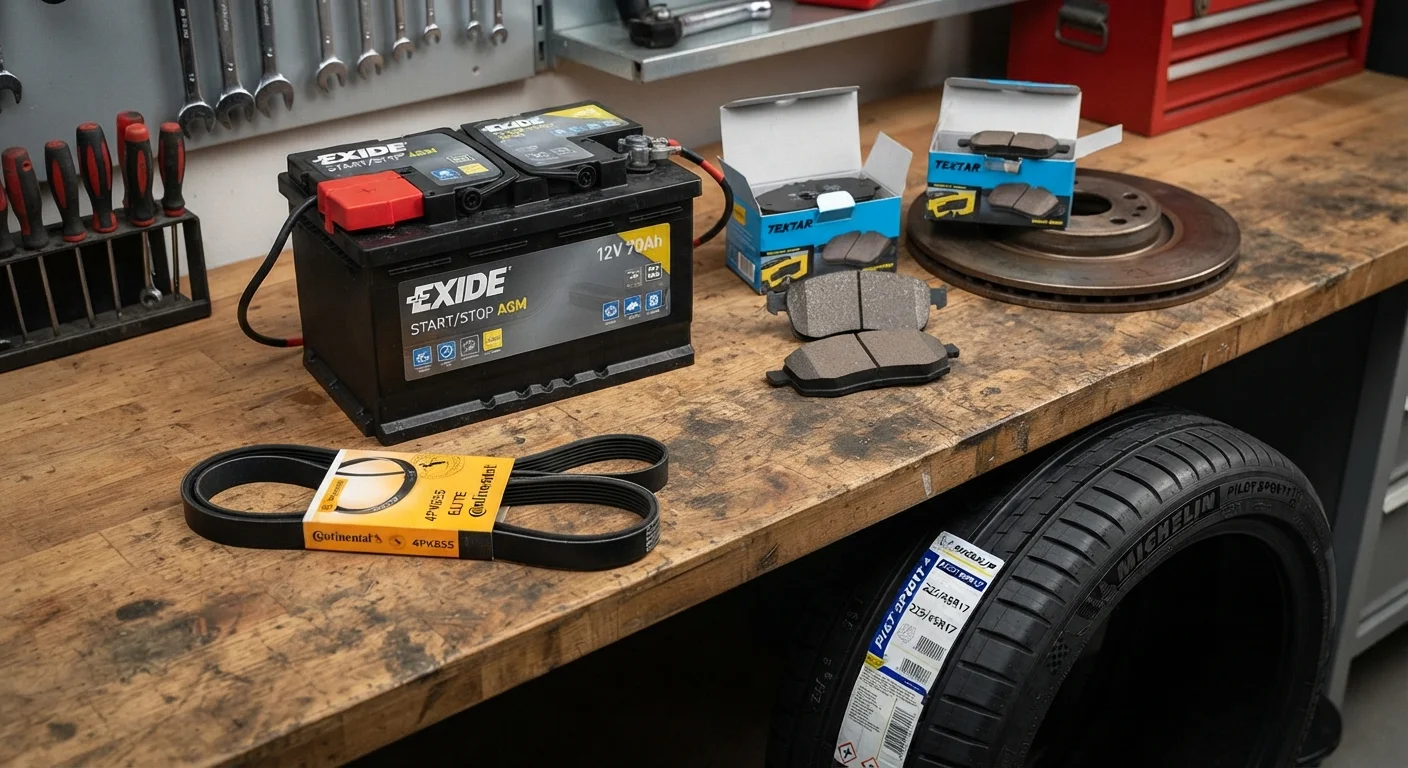
Why Replacement Timelines Matter
Every part on your car has a finite lifespan. Some wear out gradually; others can fail without warning if neglected past their limits. Knowing general replacement windows helps you plan ahead, budget for service, and catch problems before they strand you roadside or compromise safety.
Keep in mind that the timelines below are industry-wide estimates. Your actual intervals depend on driving habits, climate, vehicle type, and how well the car has been maintained. For the most authoritative guidance, check your owner's manual - it contains the manufacturer-specific schedule for your exact vehicle.
| Battery lifespan | 3-5 years (General industry consensus) |
| Tire replacement (tread) | 25,000-50,000 miles (Varies by tire type and driving conditions) |
| Brake pad lifespan | 25,000-65,000 miles (Shorter with city/stop-and-go driving) |
| Serpentine belt | 60,000-100,000 miles (General industry estimate) |
| Timing belt | 60,000-105,000 miles (Confirm with manufacturer schedule) |
| Spark plugs (iridium/platinum) | 60,000-100,000 miles (Standard copper plugs: ~30,000 miles) |
Component-by-Component Lifespan Reference
Battery
Most conventional lead-acid car batteries last 3-5 years. Extreme heat accelerates corrosion; extreme cold reduces cranking power. If your battery is older than three years, have it load-tested annually. Learn the warning signs of a failing battery before you're stranded.
Tires
Tread depth is the primary metric - most tires should be replaced when tread wears to 2/32 of an inch, which typically occurs between 25,000 and 50,000 miles depending on tire type and driving conditions. Regardless of tread depth, many manufacturers recommend replacing tires after 6-10 years due to rubber degradation.
Brake Pads
Brake pads generally last 25,000-65,000 miles. City driving with frequent stops wears them faster than highway driving. Most modern pads include a wear indicator that emits a high-pitched squeal when replacement is due - don't ignore it.
Serpentine Belt
The serpentine belt drives your alternator, power steering pump, and air conditioning compressor. Expect replacement between 60,000 and 100,000 miles. Cracking, fraying, or squealing are signs it's nearing the end. A snapped belt can leave you stranded immediately.
Timing Belt
Not all vehicles have a timing belt (some use a chain), but where present, manufacturers typically recommend replacement every 60,000-105,000 miles. This is a critical interval - a failed timing belt can cause severe engine damage. Consult your owner's manual for the exact mileage for your vehicle.
Spark Plugs
Standard copper plugs need replacement around every 30,000 miles. Iridium or platinum plugs can last 60,000-100,000 miles. Worn plugs reduce fuel efficiency and can cause rough idling or misfires.
Air Filter (Engine)
A clogged engine air filter restricts airflow and reduces performance. Most manufacturers recommend replacement every 15,000-30,000 miles, but dusty environments accelerate this interval considerably.
Coolant
Engine coolant (antifreeze) degrades over time. Depending on the formulation, it may need flushing every 2-5 years or 30,000-50,000 miles. Old coolant loses its anti-corrosion properties and can damage hoses and the radiator.
Mileage vs. Time: Both Count
Some parts degrade based on mileage; others degrade with time regardless of how much you drive. Rubber components like belts and hoses age from heat and ozone exposure even in a low-mileage vehicle. Always factor in the age of the car alongside the odometer reading when assessing whether a part is due for replacement.
Getting the Most from Every Part
Proper maintenance habits extend the life of nearly every component. Gentle acceleration and braking, keeping tires properly inflated, and addressing small issues before they escalate all add miles to part lifespans. Some tasks are well within reach for a motivated home mechanic, while others - like timing belt replacement or brake hydraulics - should always be handled by a qualified technician.
If you're new to vehicle ownership, this maintenance overview for first-time drivers is a practical starting point. And if you've been following conventional wisdom like oil changes every 3,000 miles, it may be worth reviewing which car maintenance beliefs are actually outdated.
Serpentine belt
A single, continuous belt that drives multiple engine accessories - including the alternator, air conditioning compressor, and power steering pump. If it breaks, those systems stop working immediately.
Timing belt
A rubber belt that synchronizes the rotation of the crankshaft and camshaft(s), ensuring valves open and close at the right moment. Failure can cause significant engine damage in many vehicles.
Tread depth
The measurement from the top of a tire's rubber to the bottom of its grooves. Low tread depth reduces traction, especially on wet roads; 2/32 of an inch is the legal minimum in most U.S. states.
Load test (battery)
A diagnostic check that applies a simulated electrical load to a battery to measure its actual capacity and ability to hold a charge under demand, rather than just measuring voltage at rest.
The content provided on our blog site traverses numerous categories, offering readers valuable and practical information. Readers can use the editorial team’s research and data to gain more insights into their topics of interest. However, they are requested not to treat the articles as conclusive. The website team cannot be held responsible for differences in data or inaccuracies found across other platforms. Please also note that the site might also miss out on various schemes and offers available that the readers may find more beneficial than the ones we cover.