

Why Your Battery Sends Warnings Before It Quits
A car battery rarely fails without warning. In most cases, it sends a series of increasingly obvious signals over days or weeks before leaving you stranded in a parking lot or driveway. Knowing how to read those signals gives you time to act on your own schedule - not the battery's.
The six signs below cover the most common indicators that a battery is nearing the end of its useful life. Some are subtle enough to dismiss once; few should be ignored twice.
Slow or labored engine cranking
When you turn the key or press the start button and the engine hesitates, groans, or turns over sluggishly before catching, that's the battery struggling to deliver the burst of current the starter motor needs. A healthy battery provides that energy almost instantaneously. A weakened one takes noticeably longer - and the gap between those experiences grows wider as the battery continues to decline.
Don't dismiss a single slow start as a fluke, especially if it happens more than once in a week. This symptom worsens in cold weather, when battery chemistry naturally slows down and engine oil thickens.
A sluggish crank is the battery's clearest early distress signal - don't ignore it.
Dimming headlights and interior lights
Your car's lighting system draws power directly from the battery whenever the engine isn't running fast enough for the alternator to fully take over. If you notice your headlights appear noticeably dimmer than usual - especially at idle - the battery may no longer be holding sufficient voltage. Interior dome lights that seem faint or flicker under load are another clue.
This symptom is particularly telling at night or in a garage where you can easily compare brightness against what you're used to seeing.
Dim lights at idle often mean the battery is no longer holding adequate voltage.
Frequent need for jump-starts
Needing an occasional jump-start after accidentally leaving your lights on is normal. Needing one repeatedly without an obvious cause is not. If your car won't start on its own more than once in a short span, the battery has likely lost its ability to hold a meaningful charge - even after being driven and theoretically recharged by the alternator.
Each jump-start puts additional strain on surrounding electrical components, so repeated reliance on this workaround isn't just inconvenient - it can create downstream problems.
Repeated jump-starts without a clear cause signal a battery that can no longer hold a charge.
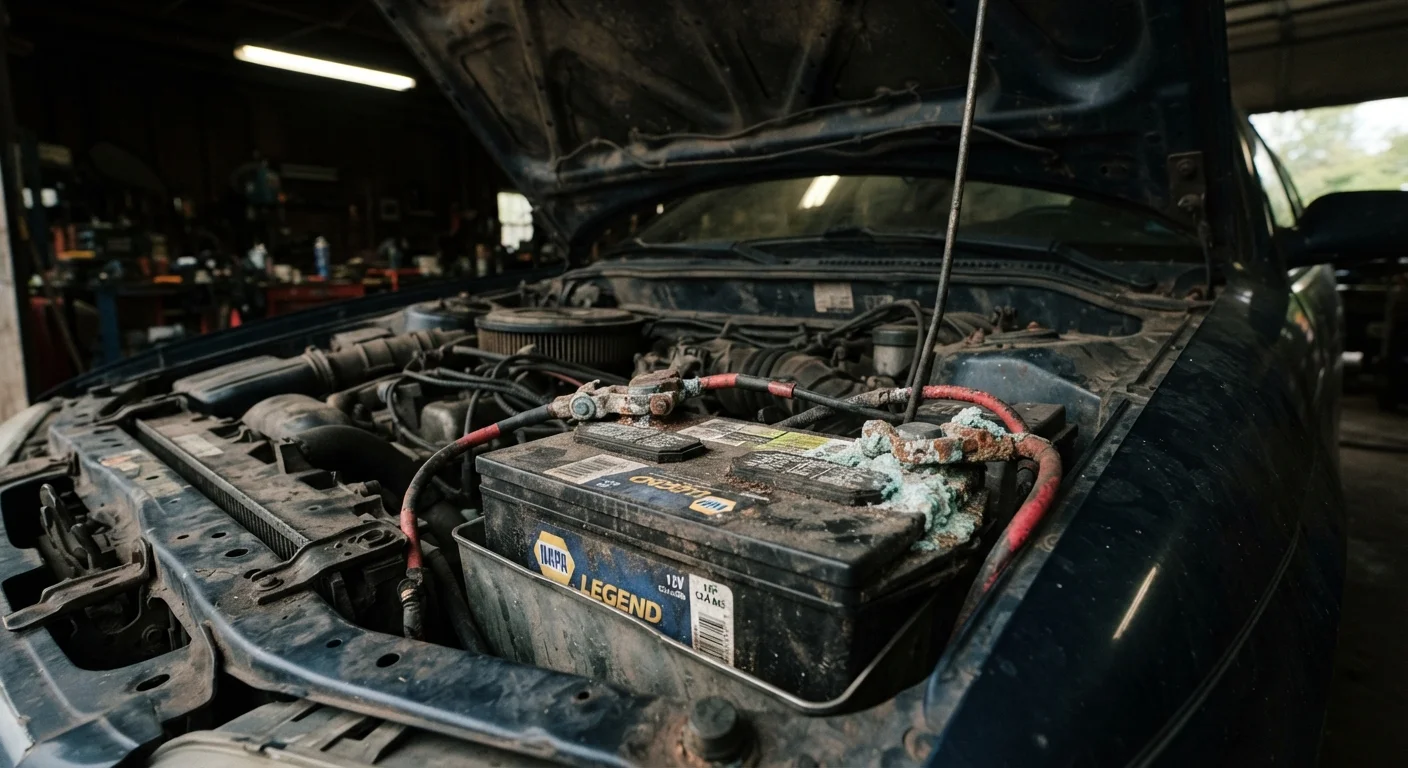
Visible corrosion on battery terminals
A white or bluish-green powdery buildup around the battery's positive and negative terminals is a sign of corrosion caused by escaping battery gases reacting with metal. While some minor terminal buildup can be cleaned, heavy corrosion restricts current flow between the battery and the vehicle's electrical system - meaning even a battery with remaining capacity may behave as if it's dead.
If you notice terminal corrosion, have a qualified mechanic inspect the battery and cables. Corrosion may also indicate the battery is venting excessively, which can point to overcharging or internal damage.
Heavy terminal corrosion restricts current flow and can mask a battery's true condition.
Electrical components acting erratically
Modern vehicles rely on consistent battery voltage to keep everything from power windows and seat memory to infotainment systems and backup cameras functioning correctly. When voltage drops or fluctuates, these systems can glitch - windows moving slowly, radio resetting, dashboard displays flickering, or power locks responding inconsistently.
If multiple electrical features start misbehaving at the same time without any other explanation, the battery is a logical first thing to check. Dashboard warning lights may also appear - the battery warning light and other dashboard indicators are worth understanding so you can act quickly when they illuminate.
Simultaneous electrical glitches across multiple systems often trace back to a weak battery.
The battery is three to five years old
Age alone is a reliable predictor. Most automotive batteries are rated for three to five years of service life under typical driving conditions, though extreme climates - both very hot and very cold - can shorten that window. Heat, in particular, accelerates internal battery degradation even when the car is parked.
If you don't know your battery's age, a mechanic or auto parts store can often test it for you with a load tester. Proactive replacement before symptoms appear - particularly heading into winter - is far less disruptive than an unexpected no-start. See our guide to seasonal vehicle preparation for a full checklist of what to inspect before cold weather hits.
A battery older than four years deserves proactive testing, even without obvious symptoms.
Battery Testing Is Quick and Often Free
Many auto parts retailers and repair shops offer complimentary battery load testing, which measures whether the battery can hold voltage under real-world demand. A load test gives a far more accurate picture than a simple voltage reading with a multimeter. If your battery is borderline, get it tested before relying on it for a long trip or heading into winter.
What to Do When You Spot These Signs
If you recognize one or more of these symptoms, the next step is a professional battery test rather than waiting to see how things develop. A failing battery places extra strain on the alternator and starter motor, so delaying replacement can lead to more expensive repairs down the road.
Check Your Battery Before Winter Arrives
Cold temperatures reduce a battery's cranking power by a significant margin - a battery that barely functions in fall may fail entirely once temperatures drop. Schedule a battery inspection in late summer or early autumn so you have time to address any issues before cold weather makes starting problems more frequent and more dangerous.
Keep in mind that battery symptoms can sometimes overlap with alternator or starter problems. A qualified mechanic can distinguish between them with appropriate testing equipment. If dashboard warning lights appear alongside any of these symptoms, our guide on decoding your car's warning lights can help you interpret what the vehicle is trying to tell you.
Staying ahead of battery wear is a straightforward part of routine car ownership - and one of the most reliable ways to avoid an inconvenient, preventable breakdown.
The content provided on our blog site traverses numerous categories, offering readers valuable and practical information. Readers can use the editorial team’s research and data to gain more insights into their topics of interest. However, they are requested not to treat the articles as conclusive. The website team cannot be held responsible for differences in data or inaccuracies found across other platforms. Please also note that the site might also miss out on various schemes and offers available that the readers may find more beneficial than the ones we cover.