

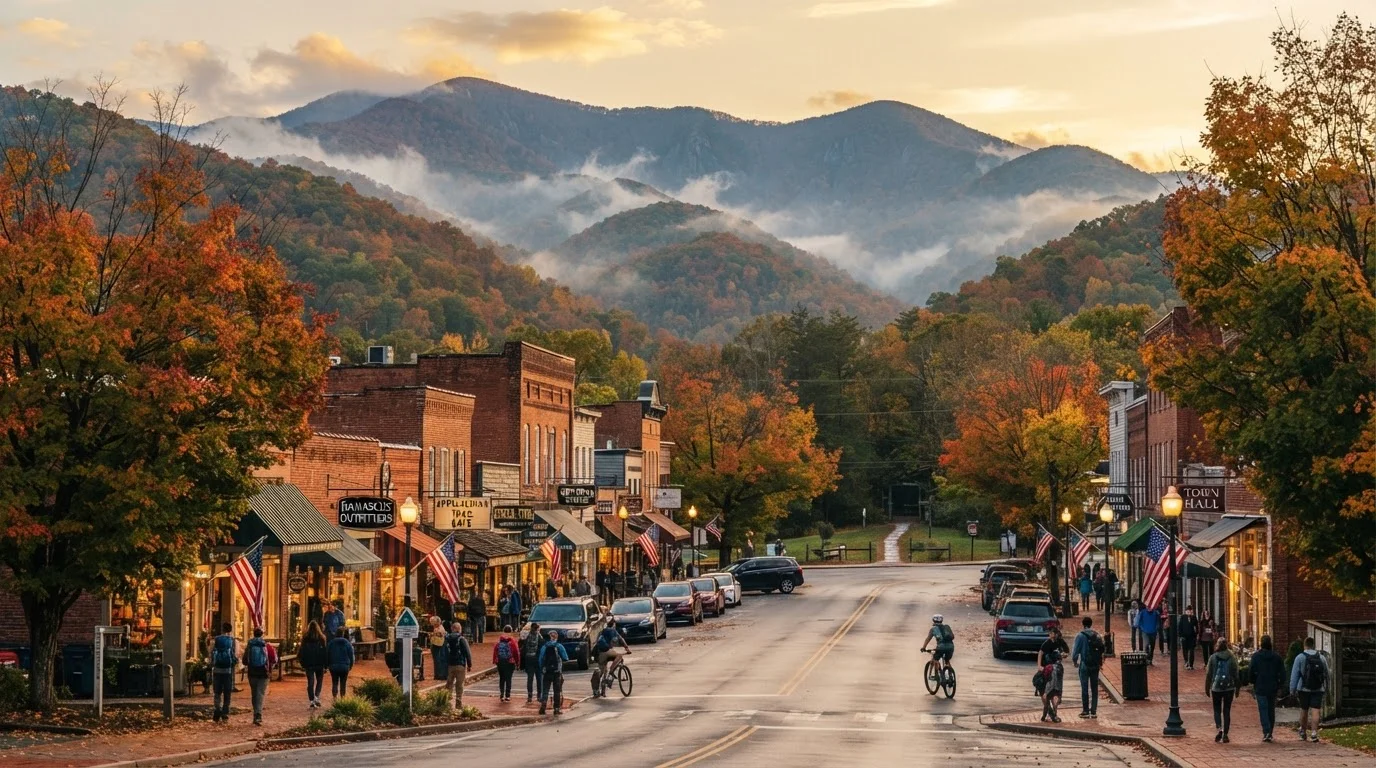
More Than a Resupply Stop
The Appalachian Trail stretches roughly 2,190 miles through 14 states, threading through some of the most dramatic terrain in the eastern United States. Most people know about the trail itself — the ridge walks, the shelters, the thru-hikers with weathered packs — but fewer pause to appreciate the towns that have grown up alongside it.
These gateway communities aren't incidental to the AT experience. Many have shaped trail culture for generations, offering hikers a place to rest and recharge while quietly building their own identities as destinations. For travelers who've never laced up a hiking boot, that's actually great news: you can roll into an AT trail town for the food, the history, or the scenery, and leave feeling like you've discovered something genuinely off the beaten path.
As small-town America often outshines big cities for travelers, the communities along the AT punch well above their weight in character and charm. Below are six that deserve a proper visit — not just a gas-station pit stop.
Damascus, Virginia — The Friendliest Town on the Trail
Damascus has earned its reputation. This small southwestern Virginia town sits right on the AT — the trail literally runs through Main Street — and has built an entire identity around welcoming long-distance hikers. Every May, it hosts Trail Days, one of the largest hiker festivals in the country, drawing thousands of past and present thru-hikers for a weekend of camaraderie and celebration.
But Damascus works beautifully as a destination even when the festival isn't on. The Virginia Creeper Trail, a scenic rail-trail for cyclists and walkers, begins here and winds 34 miles through trestle bridges and mountain meadows. Local outfitters, cafes, and a genuinely welcoming downtown make it easy to linger for a day or two.
The AT runs directly through Main Street, making Damascus unlike almost any other trail town.
Harpers Ferry, West Virginia — Where History Meets the Ridge
Harpers Ferry occupies a dramatic perch at the confluence of the Potomac and Shenandoah rivers, and it carries the weight of American history with it. The site of John Brown's 1859 raid and a pivotal Civil War location, the lower town is preserved as a National Historical Park with museums, period buildings, and interpretive programs that bring 19th-century America to life.
The AT passes right through, and the Appalachian Trail Conservancy's headquarters is located here — a fitting spiritual midpoint for northbound thru-hikers. The cliff overlooks offer some of the most photographed views on the entire eastern seaboard. Come for the history, stay for the hike up Maryland Heights for a panorama that genuinely takes your breath away.
Harpers Ferry combines Civil War history with some of the AT's most dramatic river-valley scenery.
Millinocket, Maine — Gateway to the Wild North
Millinocket sits near the northern terminus of the AT at Katahdin — the dramatic peak in Baxter State Park that thru-hikers either start or end their journeys at. The town itself has seen economic ups and downs tied to its former paper-mill economy, but a determined community revival driven partly by outdoor recreation tourism has brought new energy to its downtown.
Visitors will find independent outfitters, warming hospitality, and access to some of the most remote wilderness in the Northeast. Moose sightings are genuinely common in this part of Maine. For travelers who appreciate landscapes that feel truly untouched, the Katahdin Woods and Waters National Monument nearby adds another layer of wild beauty.
Millinocket's community revival is a quiet success story fueled by wilderness tourism and trail culture.
Hot Springs, North Carolina — Soaking in Appalachian Charm
Hot Springs may be the most aptly named town on the entire trail. Natural mineral springs have drawn visitors since the 19th century, and today the namesake hot spring resort sits just steps from where the AT runs through the center of town. After a day on the trail — or just a long drive through the Blue Ridge — soaking in an outdoor tub beside the French Broad River is a deeply satisfying experience.
The town itself is tiny but full of character: farm-to-table restaurants, a beloved hiker hostel, and a mountain arts scene that reflects the rich Appalachian cultural heritage of the region. The surrounding Pisgah National Forest offers accessible day hikes without requiring any advance planning.
Hot Springs is the only trail town where you can soak in natural mineral springs steps from the AT.
Waynesboro, Virginia — Shenandoah's Unsung Trailhead
Tucked at the southern end of Shenandoah National Park, Waynesboro is where many northbound thru-hikers enter one of the trail's most celebrated segments. The city has an active arts community — the Wayne Theatre, a beautifully restored 1926 venue, anchors a lively cultural calendar — and a walkable downtown that has steadily grown its independent restaurant scene.
Crozet Pizza, a regional institution with a Waynesboro outpost, has become almost a trail-town landmark in itself. The nearby South River Falls trail offers a spectacular waterfall day hike accessible to most fitness levels. Waynesboro rewards the traveler who's willing to look past first impressions and dig into what a mid-sized Virginia city can genuinely offer.
Waynesboro blends trail access with a real arts and dining scene that surprises first-time visitors.
Rangeley, Maine — Lakes, Lodges, and Mountain Air
While technically a bit removed from the AT's immediate corridor, Rangeley serves as a beloved base for hikers tackling the rugged Mahoosuc and Bigelow ranges. Its real draw, though, is the Rangeley Lakes region itself — a chain of pristine glacial lakes surrounded by boreal forest that feels genuinely remote without requiring serious backcountry commitment.
The town has a classic New England sporting-camp heritage, with lodges and camps dating back to the late 1800s when wealthy urbanites came to fish for brook trout. Today it balances that heritage with a modern outdoor-recreation economy. The Wilhelm Reich Museum, a genuinely unexpected cultural attraction just outside town, is worth the detour for curious travelers.
Rangeley's glacial lakes and classic Maine lodge culture make it one of the Northeast's most memorable base camps.
Plan Your Trail Town Adventure
Whether you're a seasoned section hiker looking to extend your stay or a road-tripper hunting for something more interesting than a highway exit, AT trail towns reward curiosity. Each has its own personality shaped by local geography, regional history, and the peculiar magic that happens when a long-distance footpath runs straight through the center of community life.
Time Your Visit for Shoulder Season
Late April through early June and mid-September through October offer the best combination of comfortable temperatures, fall or spring foliage, and manageable crowds in most AT trail towns. Summer weekends can get surprisingly busy in popular spots like Harpers Ferry. Visiting mid-week in shoulder season often means more authentic local interactions and easier access to lodging.
If you enjoy exploring lesser-known American landscapes, the South's waterways offer a similar sense of discovery — our guide to hidden waterways across the American South is worth a read before your next road trip.
Check local visitor centers and trail organizations for current conditions, seasonal events, and any access changes before you go. Trail town businesses often keep irregular hours in the off-season, so a quick call ahead goes a long way.
The content provided on our blog site traverses numerous categories, offering readers valuable and practical information. Readers can use the editorial team’s research and data to gain more insights into their topics of interest. However, they are requested not to treat the articles as conclusive. The website team cannot be held responsible for differences in data or inaccuracies found across other platforms. Please also note that the site might also miss out on various schemes and offers available that the readers may find more beneficial than the ones we cover.