

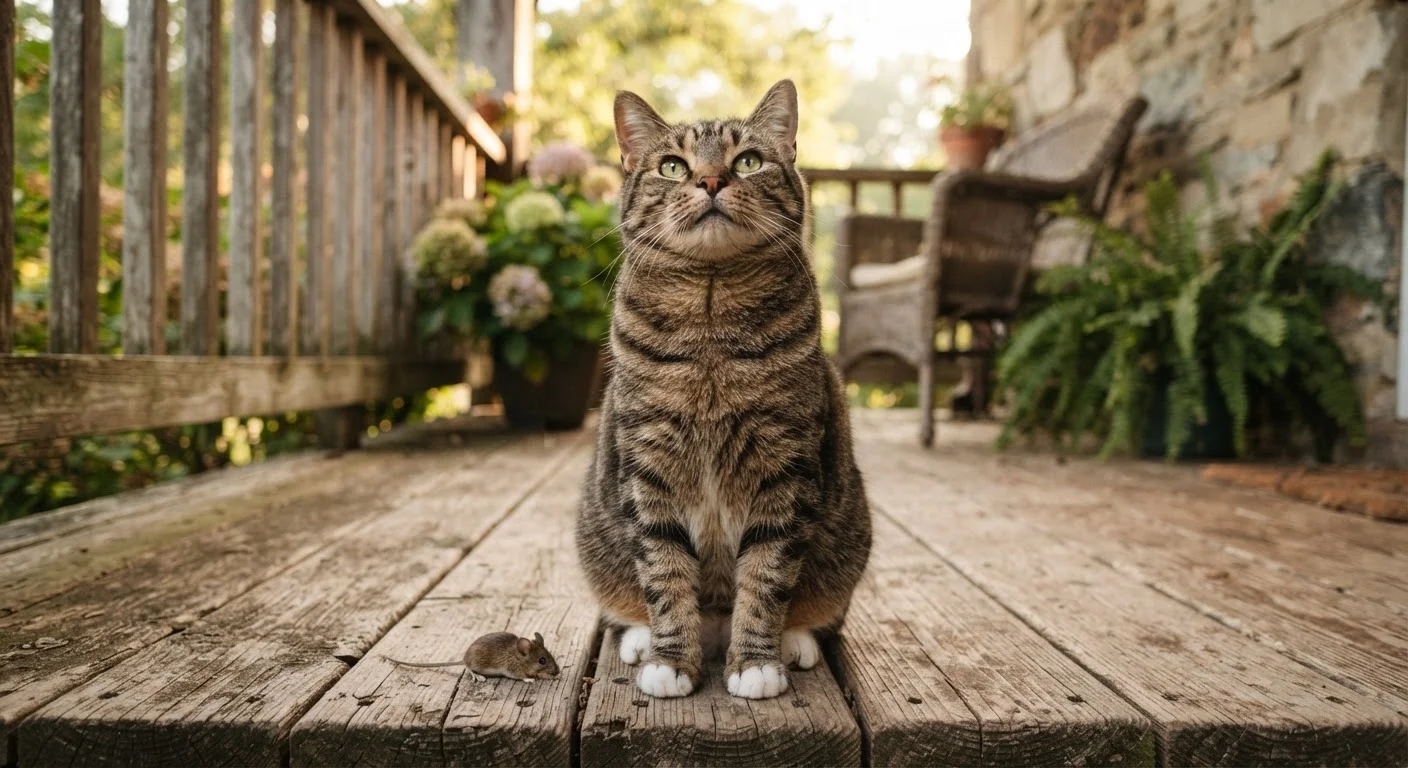
The Hunting Instinct That Never Clocks Out
No matter how full the food bowl is, a cat's predatory drive operates independently of hunger. Domestic cats (Felis catus) retain the full hunting sequence of their wild ancestors — stalking, pouncing, catching — because evolution built that circuitry for survival, not appetite. Satiation suppresses the urge to eat; it does not suppress the urge to hunt.
This is why outdoor cats can decimate local small-mammal and bird populations even when fed twice daily. The kill itself is the behavioral reward. Understanding this removes the temptation to interpret a dead mouse on the doormat as something your cat calculated — it didn't.
“The domestic cat retains a fully functional predatory motor pattern. Hunger can motivate a cat to eat its prey, but it is not required for the hunting sequence to be triggered and completed.”
— John Bradshaw, Anthrozoologist and author of 'Cat Sense'
What the Behavior Actually Communicates
When a cat carries prey back to the home — or to you specifically — it is likely expressing a blend of instincts rather than a single emotion. Animal behaviorists point to two overlapping explanations:
- Territory and safety: The home is your cat's core territory. Bringing prey there is consistent with how cats treat a secure base — it is where resources belong.
- Social provisioning: Female cats in the wild carry prey back to kittens. Some researchers suggest domestic cats extend this to their human household, treating owners as part of their social group. This does not mean your cat thinks you are incompetent — it reflects social bonding, not pity.
For a broader look at how cats use body signals to communicate beyond hunting behavior, see our field guide to feline body language.
1–34 animals/year
Estimated prey per free-roaming cat annually
A widely cited review published in Nature Communications (Loss et al., 2013) estimated that free-ranging domestic cats kill billions of birds and small mammals in the U.S. annually, with individual cats varying widely in hunting frequency.
~70%
Cats that hunt regardless of feeding status
Multiple ethological studies note that the predatory drive in cats operates independently of nutritional need, with the majority of outdoor cats hunting even when regularly fed by owners.
How to Respond — Calmly and Effectively
The most important thing to do when a cat presents prey is to react without drama. Loud reactions — whether disgust or excessive praise — can reinforce attention-seeking patterns around the behavior. Instead:
- Put on disposable gloves before handling any prey animal.
- Remove and dispose of the prey safely; rodents and birds can carry parasites or bacteria.
- Engage your cat immediately with an interactive toy to redirect the energy.
Make Play a Daily Priority
Two focused 10–15 minute interactive play sessions per day — using wand toys, feather lures, or laser pointers followed by a toy 'catch' — can substantially reduce hunting frequency in outdoor cats and eliminate it in indoor ones. End each session with a small food treat to complete the hunt-eat sequence and leave your cat satisfied.
Punishment is counterproductive. Because the behavior is instinctive rather than deliberate, scolding creates confusion and stress without changing anything. Your cat is not capable of connecting a reprimand delivered minutes after the fact to the act of hunting.
If your cat's hunting frequency concerns you — particularly given the real impact on local wildlife — it is worth a conversation with your veterinarian about environmental enrichment and safe outdoor access. Our article on indoor vs. outdoor living for cats covers those trade-offs in depth.
Redirecting the Drive: Practical Strategies
You cannot eliminate a cat's predatory instinct, but you can channel it productively. The goal is to give the hunting sequence — stalk, chase, pounce, catch — a safe and satisfying outlet every day.
Indoor cats who receive regular, structured play sessions tend to present toys rather than real prey, which is a healthy expression of the same behavior. Think of a toy mouse brought to your feet as the indoor equivalent of a field mouse — same instinct, zero wildlife impact.
For more insight into the instinct-driven quirks that puzzle cat owners, the real reasons cats knock things off tables explores another misunderstood feline habit with similar roots in curiosity and sensory drive.
This article is for general informational purposes only and is not a substitute for professional veterinary advice. Always consult a licensed veterinarian with concerns about your pet's behavior or health.
Frequently Asked Questions
It is a natural expression of feline hunting instinct, not a deliberate gesture. Cats are wired to hunt regardless of hunger, and bringing prey to a familiar location — including you — is consistent with how cats relate to their home territory and social group.
No. Scolding is ineffective because the behavior is instinctive, not calculated. Punishment can confuse your cat and damage trust without changing anything. Calmly removing the prey and redirecting your cat with interactive play is a more constructive approach.
Complete elimination is difficult since hunting is hardwired. Keeping cats indoors, using breakaway safety collars with bells, and providing robust daily play sessions can meaningfully reduce hunting frequency. Consult your vet about the best approach for your cat's situation.
Use gloves and dispose of prey carefully — rodents and birds can carry parasites, bacteria, and occasionally disease. Check that your cat is up to date on parasite prevention, and contact your veterinarian if you have specific health concerns about exposure.
Exactly the same instinct is at work. Indoor cats redirect their hunting drive onto toys, and presenting them to you mirrors the same provisioning behavior seen with real prey. It is a healthy outlet and a sign the behavior is being expressed safely.
Research and field observation suggest intact female cats show this behavior most frequently, likely tied to the maternal instinct to provision offspring. However, neutered cats of both sexes still hunt regularly, so sex is only one factor among several.
The content provided on our blog site traverses numerous categories, offering readers valuable and practical information. Readers can use the editorial team’s research and data to gain more insights into their topics of interest. However, they are requested not to treat the articles as conclusive. The website team cannot be held responsible for differences in data or inaccuracies found across other platforms. Please also note that the site might also miss out on various schemes and offers available that the readers may find more beneficial than the ones we cover.