

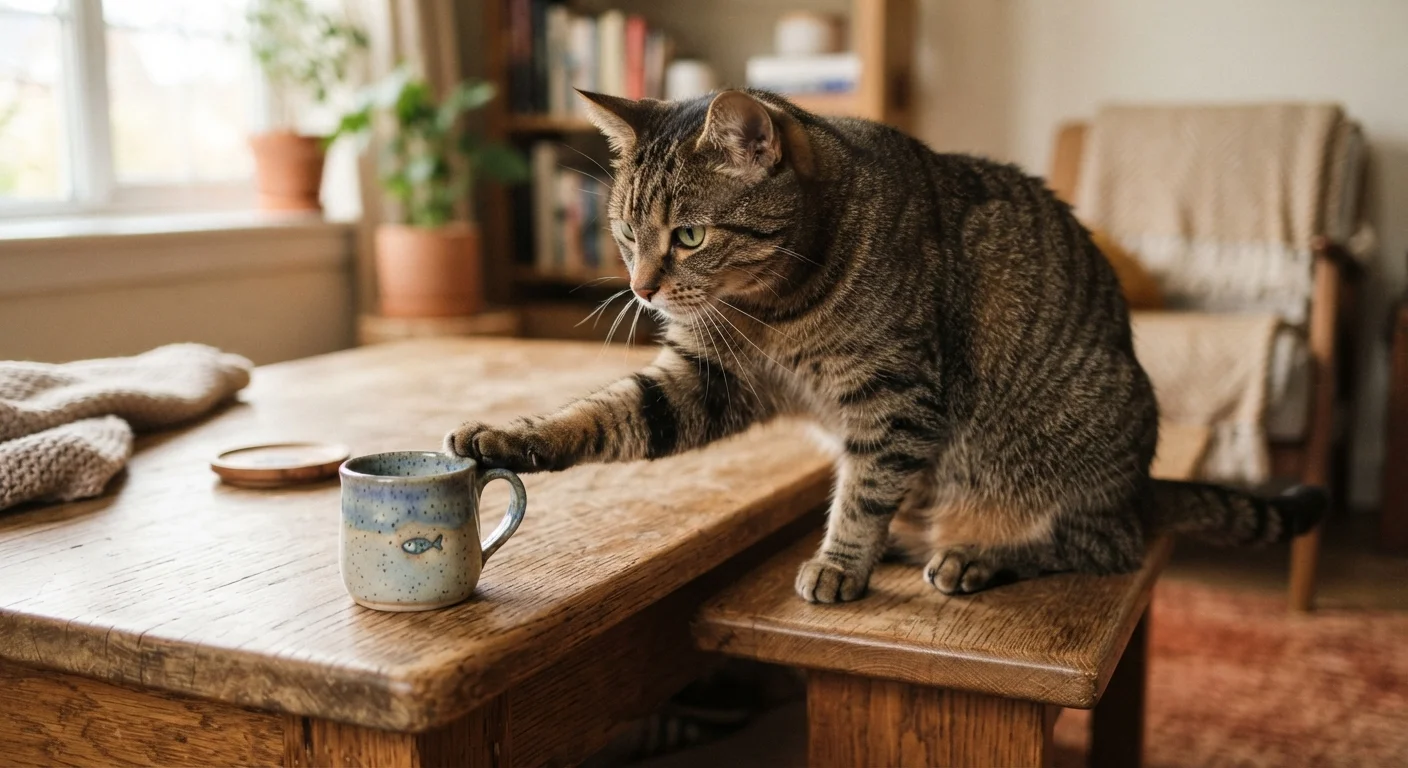
It Starts With Predatory Wiring
Cats are hardwired hunters, and that wiring doesn't switch off just because they live indoors. When a cat encounters a small object resting near the edge of a surface, its paw naturally investigates — testing movement, texture, and response. This is the same sensory probing behavior used to assess whether prey is alive or dead in the wild.
The satisfying cascade of a falling object — the movement, the sound, the bounce — mimics the feedback a cat gets from a successful strike on prey. It's stimulating in a very literal, neurological sense. This is especially relevant for indoor cats who have fewer opportunities to engage that hunting drive through real-world activity.
This Behavior Has Deep Instinctive Roots
Object-knocking isn't a personality flaw or a sign of a 'bad' cat. It's a behavioral expression of drives that exist in every domestic cat, regardless of breed or upbringing. Understanding the instinct behind it is the first step toward responding to it effectively rather than reactively.
Understanding this behavior connects to broader feline instincts — the same prey-tracking logic also explains why cats bring home dead animals. Both behaviors are rooted in predatory sequences, not social messaging directed at owners.
When Attention Becomes the Real Reward
Predatory instinct may start the behavior, but attention often sustains it. Cats are highly perceptive animals — they notice which of their actions produce the strongest human responses. If knocking a glass off the counter reliably causes you to jump up, gasp, or rush over, your cat has discovered an extremely effective on-demand attention button.
This isn't manipulation in the human sense, but it is learned behavior. Over repeated cycles, the cat connects the action to your response and repeats it when it wants engagement — particularly if interaction is otherwise sparse. Well-meaning owners can unknowingly strengthen this pattern, a dynamic explored further in our piece on how owners accidentally reinforce problem behaviors.
~50%
Indoor cats showing attention-seeking behaviors
Estimates from feline behavior literature suggest roughly half of indoor-only cats display some form of attention-seeking behavior when their enrichment needs are unmet.
63%
Cat owners reporting object-knocking in their cats
Informal surveys of cat owners consistently place object-knocking among the top five reported behavioral quirks, with most attributing it initially — and incorrectly — to spite.
Boredom, Routine, and Environmental Gaps
Object-knocking tends to cluster during specific times of day — often when the household is quiet and the cat is understimulated. Cats thrive on predictable structure, and an environment that lacks consistent enrichment or interactive play creates a behavioral vacuum that gets filled creatively.
Puzzle feeders, wand toys, climbing structures, and window perches all address the sensory and physical needs that drive restless pawing behavior. Routine shapes cat behavior more than most owners realize — structured daily play sessions in particular can significantly reduce how often a cat seeks self-generated stimulation through knocking objects around.
Schedule Play Before High-Risk Times
If your cat tends to knock things over at specific times — early morning, late afternoon — try scheduling an active play session 15–20 minutes beforehand. Wand toys that mimic prey movement are especially effective at discharging predatory energy. A cat that has 'hunted' is significantly less likely to seek stimulation through your belongings.
Responding in Ways That Actually Help
The least effective response is also the most natural one: reacting dramatically. Yelling, chasing, or rushing to intervene are all forms of attention, and they teach the cat that the behavior works. A calm, non-reactive approach — removing yourself briefly from the room or simply not engaging — withdraws the reward without frightening or confusing your cat.
Redirection is more productive than punishment. Offering an appropriate alternative — a toy, a foraging activity, a scratching post — gives your cat a sanctioned outlet for the same underlying need. Our guide on redirecting unwanted pet behaviors without punishment walks through this approach in practical detail. Securing genuinely fragile or valuable items from accessible surfaces is also a reasonable, low-effort precaution while you work on the behavior.
Frequently Asked Questions
Yes — cats do this deliberately, but not out of spite. The behavior is driven by curiosity, predatory instinct, or a desire for your attention. It becomes more intentional over time when it reliably produces a reaction from you.
That eye contact before the nudge is a strong indicator of attention-seeking behavior. Your cat has learned that this specific action gets your focus, and the stare is essentially a check to confirm the audience is watching.
The most effective approach is to avoid reacting dramatically, which removes the attention reward. Pairing that with enrichment — puzzle feeders, interactive play, vertical space — addresses the underlying need driving the behavior.
Boredom is one of the most common triggers, especially in indoor cats with limited stimulation. If the behavior happens frequently and throughout the day, it's worth evaluating whether your cat has enough environmental enrichment.
In most cases, no. However, if object-knocking begins suddenly in a cat that never did it before — or is paired with other behavioral changes — a veterinary check is reasonable to rule out any underlying medical cause.
The content provided on our blog site traverses numerous categories, offering readers valuable and practical information. Readers can use the editorial team’s research and data to gain more insights into their topics of interest. However, they are requested not to treat the articles as conclusive. The website team cannot be held responsible for differences in data or inaccuracies found across other platforms. Please also note that the site might also miss out on various schemes and offers available that the readers may find more beneficial than the ones we cover.