

Option A
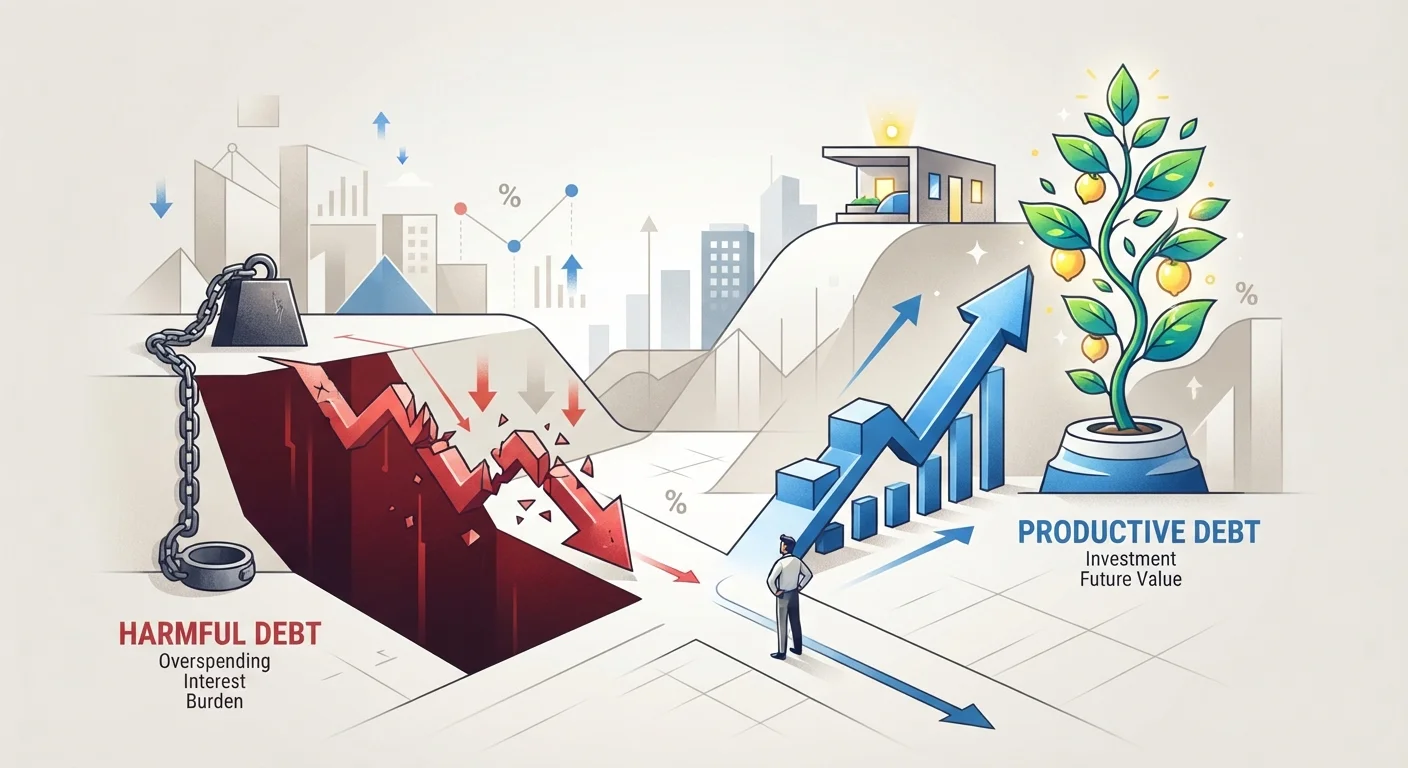
Good Debt
Debt that works as a financial tool, not a drain.
Best for: Individuals investing in assets or credentials that have a reasonable expectation of increasing income or net worth over time.
Option B
Bad Debt
High-cost borrowing that erodes financial stability.
Best for: Understanding what to prioritize paying down when building an emergency fund or restructuring your finances.
Why the Distinction Between Good and Bad Debt Matters
Most financial conversations treat debt as a single, uniformly negative thing to be eliminated as fast as possible. But financial educators have long recognized that not all debt is created equal. The distinction between debt that can build wealth and debt that erodes it is one of the most practically useful frameworks in personal finance.
Understanding this difference shapes smarter borrowing decisions and helps prioritize which obligations to pay down first — especially when you're trying to grow an emergency fund at the same time. As our article on the full costs inside your debt explains, debt carries more than just an interest rate — it includes opportunity costs and psychological strain that compound over time.
| Criterion | Good Debt | Bad Debt |
|---|---|---|
| Typical interest rate | Lower (e.g., 3–7% APR) | Higher (e.g., 15–30%+ APR) |
| Purpose | Finances appreciating assets or income growth | Finances consumption or depreciating goods |
| Net worth impact | Potentially positive over time | Typically negative; erodes wealth |
| Common examples | Mortgage, student loan, business loan | High-interest credit card, payday loan |
| Repayment priority | Manage within budget; minimum often sufficient | Aggressively pay down as soon as possible |
| Risk if mismanaged | Can become harmful if payments strain cash flow | Compounds quickly; traps borrowers in cycles |
What Makes Debt 'Good'?
The term good debt describes borrowing that finances something with a reasonable expectation of increasing your net worth, income potential, or quality of life in a durable way — typically at a relatively low interest rate. Common examples include:
- Mortgages: Real estate has historically appreciated over long time horizons (though this is not guaranteed), and mortgage interest rates are generally lower than consumer debt.
- Student loans: Education debt can be productive when it leads to measurably higher lifetime earnings in a chosen field — though this calculation depends heavily on field, institution, and total loan amount.
- Small business loans: Borrowing to fund a viable business that generates income can be a legitimate use of leverage.
It's important to note that even these forms of debt can become harmful. A mortgage that consumes too large a share of your income, or student debt that far outpaces likely earnings, may cross into counterproductive territory. Your debt-to-income ratio is a useful gauge here.
$1.13T
U.S. credit card debt outstanding
According to the Federal Reserve Bank of New York, total U.S. credit card balances surpassed $1 trillion in recent years, highlighting the scale of high-interest consumer debt.
~20%
Average credit card APR in the U.S.
The Federal Reserve tracks average credit card interest rates; rates have risen notably in recent tightening cycles, amplifying the cost of carrying revolving balances.
3–6 months
Recommended emergency fund size
Most financial planning guidance, including guidance from consumer finance agencies, suggests holding three to six months of essential expenses in liquid savings.
What Makes Debt 'Bad'?
Bad debt typically has two defining features: a high interest rate and a purpose that doesn't build lasting value. The clearest examples are high-interest credit card balances carried month to month, payday loans, and financing for depreciating consumer goods.
When you borrow at 20–30% annual interest to pay for everyday expenses or discretionary purchases, the compounding cost rapidly outpaces any short-term benefit. Unlike a mortgage or business loan, these debts don't produce an asset that offsets their cost.
There's also a behavioral dimension. Bad debt often makes routine spending feel affordable in the moment, which can mask underlying budget gaps. Over time, minimum payments on revolving balances can keep borrowers trapped in a cycle that's difficult to escape. Our piece on common debt myths addresses why minimum payments are far more costly than they appear.
The Gray Area: Auto Loans
Auto loans sit between 'good' and 'bad' debt for many households. A vehicle is a depreciating asset, so the loan doesn't build net worth the way a mortgage might. However, if the rate is low and the vehicle is essential for earning income, the debt may be reasonable. The key question is whether the monthly payment fits comfortably within your budget without crowding out savings or emergency fund contributions.
How to Apply This Framework to Your Own Finances
Classifying your own debts isn't about guilt — it's about prioritization. Here's a practical way to approach it:
- List all debts with their interest rates, balances, and monthly minimums.
- Identify high-interest obligations (generally above 7–8% APR) as candidates for aggressive repayment.
- Assess purpose: Does this debt finance something with lasting value, or did it fund a one-time expense or depreciating item?
- Consider cash flow impact: Even a low-rate debt becomes a problem if the payment strains your monthly budget to the point of preventing emergency savings.
Building even a modest emergency fund — typically three to six months of essential expenses — while paying down high-interest debt simultaneously is a strategy many financial planners support. The logic: without a cash cushion, an unexpected expense can push you deeper into bad debt. For a detailed comparison of repayment approaches, see our guide on avalanche vs. snowball repayment methods.
This article is for general informational and educational purposes only and does not constitute personalized financial, tax, or legal advice. Consult a qualified financial professional before making decisions based on your individual circumstances.
The content provided on our blog site traverses numerous categories, offering readers valuable and practical information. Readers can use the editorial team’s research and data to gain more insights into their topics of interest. However, they are requested not to treat the articles as conclusive. The website team cannot be held responsible for differences in data or inaccuracies found across other platforms. Please also note that the site might also miss out on various schemes and offers available that the readers may find more beneficial than the ones we cover.