

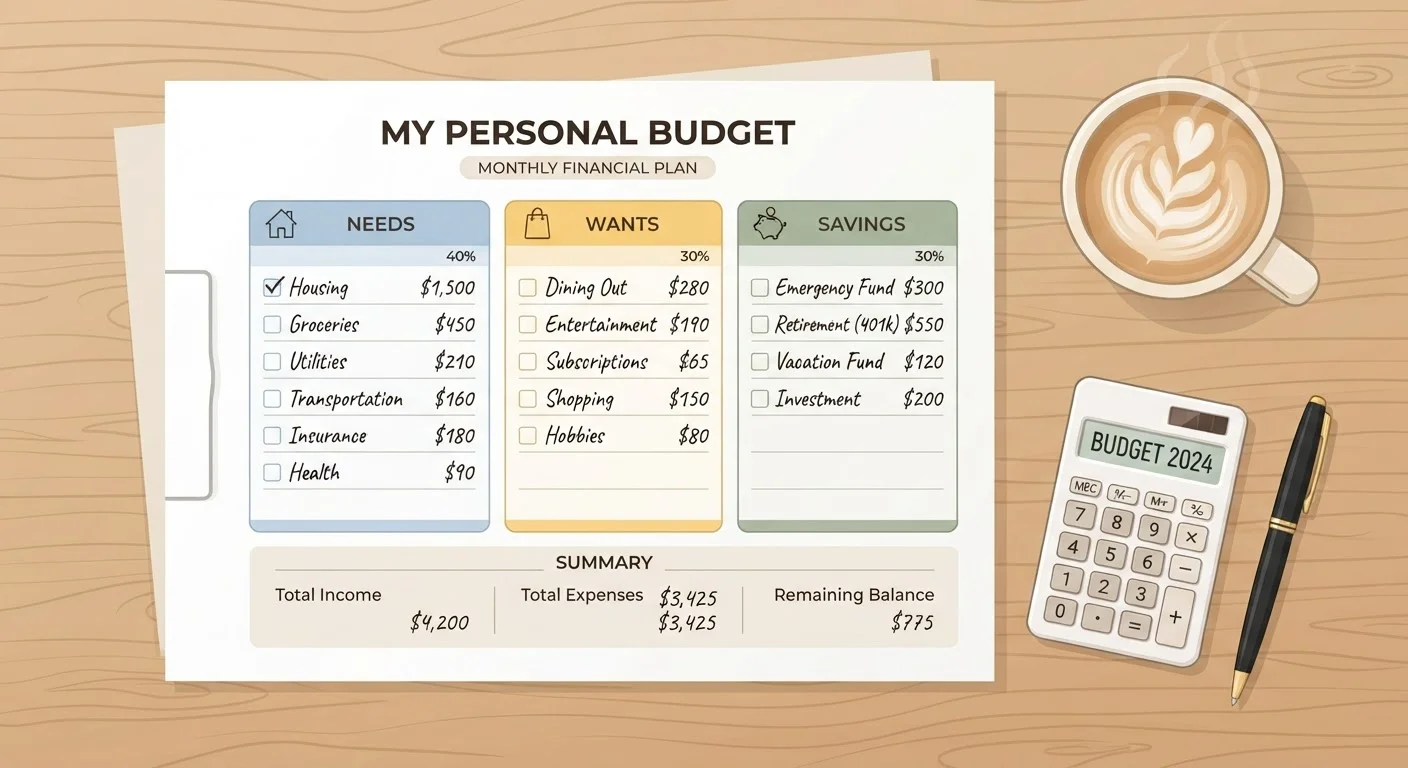
What the Three Categories Actually Mean
The 50/30/20 rule works by sorting every dollar of your after-tax paycheck into one of three buckets. Understanding what genuinely belongs in each category is what makes or breaks the method in practice.
50% - Needs
Needs are expenses that are truly non-negotiable: housing costs (rent or mortgage), utilities, groceries, transportation required for work, health insurance premiums, and minimum payments on any debt. If skipping a payment would put your housing, health, or employment at serious risk, it's a need.
30% - Wants
Wants cover the discretionary spending that makes life enjoyable but isn't strictly required to get by: restaurant meals, streaming services, vacations, new clothing beyond the basics, and entertainment. The honest challenge here is that many wants feel like needs - a gym membership or a premium phone plan may feel essential, but they belong in the wants bucket. For a more complete picture of spending categories that often go unaccounted for, see spending categories most budgets forget.
20% - Savings and Debt Repayment
Savings and debt payoff form the third bucket. This includes contributions to an emergency fund, retirement accounts, and other long-term savings goals, as well as any debt payments above the required minimums. This is the category that builds financial security over time. For guidance on the saving and debt fundamentals that complement this framework, those resources can help you prioritize within the 20%.
How to Apply It to Your Paycheck
Applying the rule starts with one number: your monthly after-tax income. If you receive a regular paycheck, this is simply your take-home pay. If your income varies, use a conservative average based on recent months.
From there, the math is straightforward:
- Multiply your monthly take-home by 0.50 to find your needs ceiling.
- Multiply by 0.30 to find your wants ceiling.
- Multiply by 0.20 to find your minimum savings and debt-payoff target.
For example, if your take-home pay is $4,000 per month, the split looks like this: up to $2,000 for needs, up to $1,200 for wants, and at least $800 directed toward savings and debt repayment.
Automate Your 20% First
One of the most effective ways to make the 50/30/20 rule stick is to treat savings as a fixed expense rather than whatever is left over at month's end. Set up an automatic transfer to a savings or retirement account on payday, before discretionary spending begins. This "pay yourself first" approach removes the temptation to spend money you intended to save.
Once you know your targets, compare them against your actual spending over the past two or three months. Most people find that their wants spending is higher than expected and their savings rate is lower. That gap between target and reality is where actionable decisions live. Use the Monthly Budget Setup Checklist to walk through the full process of building your budget around these numbers.
Limitations and When to Adjust the Percentages
The 50/30/20 rule is a heuristic - a useful starting point, not a financial law. Several real-world factors can make the default percentages impractical:
~33%
Average share of income spent on housing
The U.S. Bureau of Labor Statistics Consumer Expenditure Survey consistently finds housing consumes roughly a third of average household spending - the single largest expense category.
57%
Americans living paycheck to paycheck
According to a 2023 survey by LendingClub, more than half of U.S. adults reported they were living paycheck to paycheck, underlining how important a structured budgeting approach can be.
Less than 5%
U.S. personal savings rate in recent years
The U.S. Bureau of Economic Analysis has reported personal savings rates well below the 20% target in many recent periods, highlighting the gap between the 50/30/20 ideal and common practice.
- High cost-of-living areas: In cities where rent alone can consume 40-50% of a moderate income, the 50% needs allocation may already be exhausted before groceries and utilities are counted. In these cases, a 60/20/20 or 65/15/20 split may be more realistic while you work toward lowering fixed costs.
- Aggressive debt payoff goals: If you're prioritizing paying off high-interest debt quickly, you might redirect some of the wants budget into the savings/debt bucket temporarily.
- Lower incomes: Households earning below the median may find that needs reliably exceed 50%, leaving little room for wants or savings. The framework still has value as a target, but it should be applied with flexibility and without shame.
The rule is best understood as a framework for awareness. Knowing which category is out of balance tells you where to focus - whether that's reducing fixed expenses, trimming discretionary spending, or finding ways to increase income over time.
If you're curious how this approach stacks up against other systems, comparing the 50/30/20 method to zero-based budgeting can help you decide which fits your habits. For a broader survey of methods, see budgeting methods compared.
This article is for general informational and educational purposes only and does not constitute personalized financial advice. Consider consulting a licensed financial professional for guidance tailored to your specific situation.
Frequently Asked Questions
The rule applies to your after-tax (net) income - the amount that actually hits your bank account. If you're self-employed, subtract estimated taxes from your income before applying the percentages.
Needs are expenses you cannot reasonably avoid: rent or mortgage, utilities, groceries, health insurance, and minimum debt payments. Wants are discretionary - dining out, streaming subscriptions, gym memberships, and travel all fall here, even if they feel essential to your lifestyle.
Minimum required debt payments are typically classified as needs. Any extra payments above the minimum - accelerating payoff - belong in the 20% savings and debt category.
This is common, especially in high-cost cities. In that case, look for areas to reduce fixed costs over time, and temporarily adjust your percentages. The 50/30/20 split is a target, not a hard requirement.
Zero-based budgeting assigns every dollar a specific job down to the last cent, requiring more detailed tracking. The 50/30/20 rule is broader and lower-maintenance. See a full comparison in our <a href="/money-finance/budgeting-basics/zero-based-budgeting-vs-the-503020-method">Zero-Based Budgeting vs. the 50/30/20 Method</a> article.
It can be used as a starting point, but households with very tight budgets may find that needs consume far more than 50% of income. In those cases, the rule serves better as an aspirational guide than a strict formula.
The content provided on our blog site traverses numerous categories, offering readers valuable and practical information. Readers can use the editorial team’s research and data to gain more insights into their topics of interest. However, they are requested not to treat the articles as conclusive. The website team cannot be held responsible for differences in data or inaccuracies found across other platforms. Please also note that the site might also miss out on various schemes and offers available that the readers may find more beneficial than the ones we cover.