

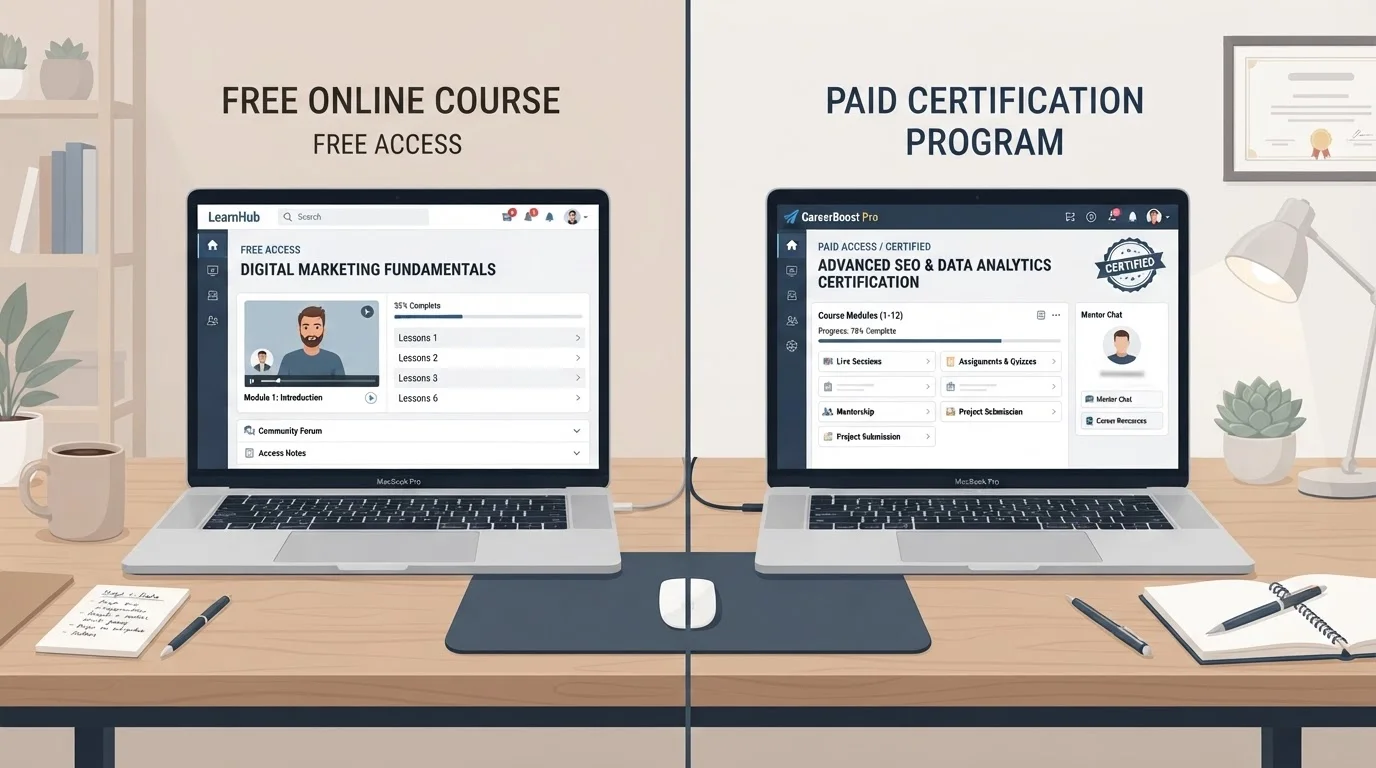
Our Verdict
Free courses are a smart starting point for curiosity-driven or budget-conscious learners who don't need a credential. Paid courses earn their cost when a recognized certificate, personalized feedback, or structured accountability is essential to your goal. The price tag itself is rarely the most important variable - the match between course design and your specific objective is.
| Best for | Recommended |
|---|---|
| Explorers testing a new subject before committing | Free courses |
| Professionals seeking employer-recognized credentials | Paid courses |
| Self-motivated learners on a tight budget | Free courses (audited) |
| Career-changers who need structured support and feedback | Paid courses |
What You Actually Get With Free vs. Paid Courses
The online learning market has expanded dramatically, and the line between free and paid content is blurrier than it looks. Many platforms - including those offering what are commonly called MOOCs (Massive Open Online Courses) - let learners audit courses at no cost while reserving certificates, graded assignments, and instructor feedback for paying students. Learn how MOOCs are structured to understand exactly what you're getting before you assume "free" means limited.
Free courses generally offer video lectures, reading materials, and sometimes quizzes. What they rarely include is substantive human feedback, peer accountability, or a credential that carries institutional weight. Paid courses - ranging from a one-time fee of $20 to multi-thousand-dollar professional programs - typically layer on structured assignments, graded projects, and certificates tied to recognized organizations.
| Free Courses | Paid Courses | |
|---|---|---|
| Cost | $0 | $20-$5,000+ |
| Certificate or credential | Rarely included | Usually included |
| Instructor feedback | Uncommon or absent | Common in structured programs |
| Accountability features | Minimal | Deadlines, cohorts, grading |
| Employer recognition | Varies widely | Higher - if issuer is known |
| Best for | Exploration, self-directed learning | Credentials, career transitions |
When Free Is Genuinely Enough
Free content is the right call more often than people assume. If your goal is personal enrichment, exploring a new field before committing financially, or refreshing a skill you already have, paying serves no real purpose. University-affiliated platforms publish full course materials from top institutions at no charge. Public libraries frequently provide free access to learning platforms. YouTube hosts thousands of well-structured instructional series on technical and creative subjects.
Self-motivated learners who don't need external validation - and who are honest with themselves about their discipline - can build genuine competency through free resources. The key variable isn't money; it's whether you have a clear learning objective and the habit structure to follow through. Comparing self-paced and cohort-based formats can help you identify which environment keeps you on track.
Audit First, Then Decide
Many paid platforms let you audit the same course for free before purchasing. Take two or three lessons to assess the teaching style, content depth, and your own engagement level. If you're still motivated after the free portion, that's a stronger signal to invest than enthusiasm at signup alone.
When Paying Is Worth It
Paid courses justify their cost under a narrower set of circumstances - but those circumstances are common. If you're pursuing a career change and need a portfolio-ready credential, employer recognition matters. A certificate from a well-known industry body or an accredited institution carries weight that a self-reported free course completion does not. Run through this checklist before enrolling to verify whether a paid program's credential is actually recognized in your target field.
Paid programs also tend to include features that sustain motivation: cohort schedules, instructor office hours, graded feedback, and sometimes job placement support. For learners who struggle with accountability in self-directed environments, these structural elements can be the difference between completing and abandoning a course. The cost itself can also function as a commitment device - though that alone shouldn't justify the expense.
Not All Paid Certificates Are Recognized
A course fee does not guarantee that a certificate holds professional value. Some online certificates are unrecognized in hiring or academic contexts despite high production quality. Always verify recognition by searching recent job postings in your field and asking professionals whether a specific credential appears in their experience.
The Credential Question: What Certificates Are Actually Worth
One of the most misunderstood aspects of online learning is what certificates signal to others. A paid certificate only carries value if the issuing organization is recognized by people who matter to your goal - hiring managers, licensing boards, or admissions committees. Many online certificates, paid or otherwise, are not equivalent to accredited academic credits. Community college courses often provide transferable, accredited credit at lower cost than many private online programs - an important alternative to evaluate.
Before paying for any certificate, research whether professionals in your target industry list it on their resumes and whether employers reference it in job postings. If the answer is unclear, a free audit of the same course content may be the more rational choice while you gather more information. Understand what online learning gives up before assuming any format - free or paid - fully replicates in-person credentialing.
The content provided on our blog site traverses numerous categories, offering readers valuable and practical information. Readers can use the editorial team’s research and data to gain more insights into their topics of interest. However, they are requested not to treat the articles as conclusive. The website team cannot be held responsible for differences in data or inaccuracies found across other platforms. Please also note that the site might also miss out on various schemes and offers available that the readers may find more beneficial than the ones we cover.