

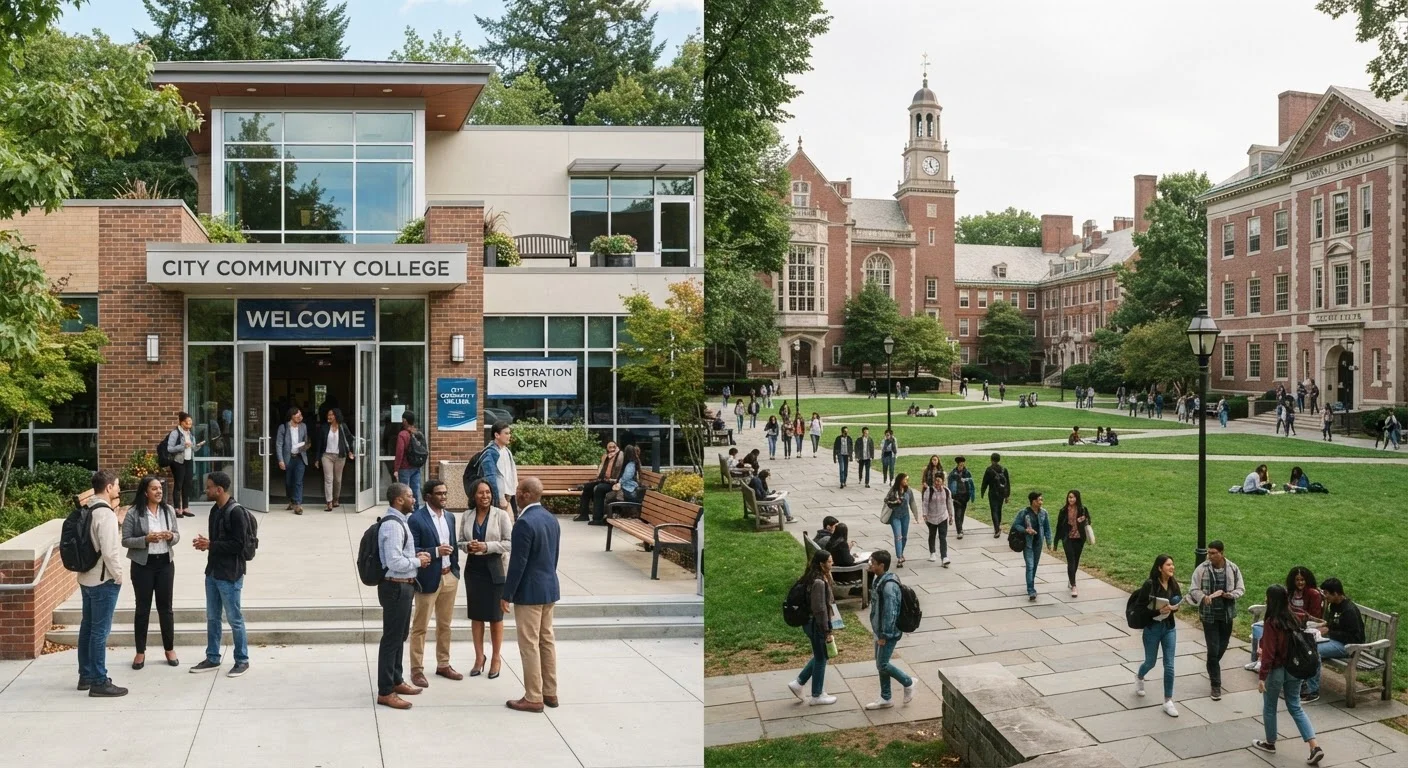
Our Verdict
Community college offers a cost-effective, flexible entry point that works especially well for students managing financial constraints, family responsibilities, or academic uncertainty. Four-year universities provide a more immersive experience with broader resources, but at a significantly higher price and with a more rigid structure. The strongest outcomes often come not from choosing the 'right' institution type, but from having a clear plan within whichever path you choose.
Community college is best for budget-conscious students, working adults, and those who want to explore academic interests before committing to a four-year degree program.
Understanding the Two Paths
For most Americans, the college decision gets framed as a single question: which four-year university should I attend? But a large portion of U.S. undergraduates begin their higher education at a community college - a two-year public institution offering associate degrees, certificates, and transfer preparation. Both paths lead to legitimate credentials and meaningful careers, but they operate on very different terms.
Four-year universities - whether public state schools or private institutions - offer bachelor's degrees across a wide range of fields, typically delivered over four years of full-time study. Community colleges offer two-year associate degrees and can serve as a launching pad toward a bachelor's through transfer agreements. Understanding the structural differences between these options is the foundation of any sound college decision. For students also weighing time away before enrolling, the gap year question deserves parallel consideration.
The Case for Community College
The most immediate advantage of community college is cost. According to the American Association of Community Colleges, average annual tuition at a community college is a fraction of what public four-year universities charge - and a much smaller fraction compared to private institutions. For students who complete an associate degree or fulfill core requirements at a community college before transferring, the total cost of earning a bachelor's degree can be substantially reduced.
Significantly lower tuition and total cost
Community college tuition is consistently lower per credit hour than four-year institutions, making it easier to complete lower-division coursework without accumulating substantial debt.
Flexible scheduling for working adults
Evening, weekend, and online course options make community college accessible to students balancing jobs, caregiving, or other responsibilities.
Transfer pathways to bachelor's degrees
Formal articulation agreements in many states allow students who meet GPA thresholds to transfer with junior-level standing, potentially reducing the overall cost of a four-year degree.
Smaller class sizes in early coursework
Introductory courses at community colleges tend to have fewer students, which can mean greater instructor access compared to large lecture halls at universities.
Lower-stakes environment to build academic skills
Students who are uncertain about their academic readiness can build foundational skills and GPA before committing to a more competitive four-year setting.
Flexibility is another genuine strength. Many community colleges offer evening, weekend, and online courses that accommodate students who work full- or part-time, have children, or carry other responsibilities that make a traditional residential college schedule impractical. Class sizes tend to be smaller in lower-division courses, which can mean more direct access to instructors.
Transfer pathways - formal agreements between community colleges and four-year universities - have expanded considerably. Many states maintain guaranteed transfer programs that allow students who meet GPA requirements to transfer with junior-level standing. That said, transfer policies vary significantly by institution and major, so it's critical to research specific articulation agreements before assuming credits will transfer cleanly.
The Case for a Four-Year University
Four-year universities offer a breadth of resources that community colleges generally cannot match: research libraries, faculty engaged in active scholarship, specialized labs, career centers, alumni networks, and extracurricular organizations. For students pursuing competitive graduate programs or fields where institutional prestige carries weight in hiring - such as law, medicine, or certain corporate sectors - the name on a degree can matter.
Limited on-campus resources and facilities
Community colleges typically lack the research libraries, specialized labs, and breadth of extracurricular programs available at four-year universities.
Transfer credit complications
Not all credits transfer cleanly to every four-year program; students who don't research articulation agreements carefully risk losing coursework or adding time to their degree.
Weaker alumni networks in some fields
For industries where institutional prestige and alumni connections drive hiring - such as finance, law, or competitive research roles - a community college background may carry less professional weight.
No traditional residential college experience
Community colleges are generally commuter institutions, meaning students miss the residential life, peer community, and campus immersion that many associate with college development.
Completion rates can be lower
Research consistently shows that community college students complete degrees at lower rates than four-year university students, though this reflects the demographics served as much as institutional quality.
The residential experience at a four-year university also provides structured social development: living with peers, joining student organizations, attending campus events. These experiences aren't incidental - they often shape professional networks and personal identity in lasting ways. For students who are 18 and academically ready, diving into that environment can accelerate both learning and maturity.
~41%
U.S. undergraduates enrolled at community colleges
According to the American Association of Community Colleges, community colleges enroll a substantial share of all U.S. undergraduate students each year.
~$3,990
Average annual community college tuition
The College Board's Trends in College Pricing data consistently shows community college tuition running well below public four-year in-state rates.
~$11,260
Average in-state public university tuition
College Board data places average in-state public four-year tuition at roughly three times the community college rate, before room, board, and fees.
For students uncertain about holistic admissions and what selective schools actually weigh, understanding what reviewers look for beyond GPA is a useful parallel read.
Making an Honest Comparison
The community college vs. university comparison is often distorted by two opposing myths: that community college is a lesser or remedial option, and that a four-year degree is always worth the cost. Neither holds up to scrutiny. Completion rates, transfer success, and post-graduation outcomes all depend heavily on individual motivation, institutional quality, field of study, and how well a student uses available resources - not on institution type alone.
Students considering vocational or technical routes should know this isn't the only binary. Trade school offers a third legitimate path with different timelines and outcomes worth understanding. And for those wondering how learning format affects success, the trade-offs of fully online education apply to both community college and university programs alike.
Transfer Planning Matters Early
If you're attending community college with the intention of transferring, the time to research articulation agreements is before you register for courses - not in your second year. Some four-year programs have specific prerequisite requirements that must be met at the community college level. Speak with an academic counselor and the transfer admissions office at your target institution early in the process. Assumptions about credit transferability are one of the most common and costly mistakes transfer students make.
Ultimately, the most important factor in any college decision is fit: financial fit, academic fit, and life-stage fit. A clear-eyed look at your own situation - rather than status assumptions about institution type - is where the real analysis begins.
The content provided on our blog site traverses numerous categories, offering readers valuable and practical information. Readers can use the editorial team’s research and data to gain more insights into their topics of interest. However, they are requested not to treat the articles as conclusive. The website team cannot be held responsible for differences in data or inaccuracies found across other platforms. Please also note that the site might also miss out on various schemes and offers available that the readers may find more beneficial than the ones we cover.