

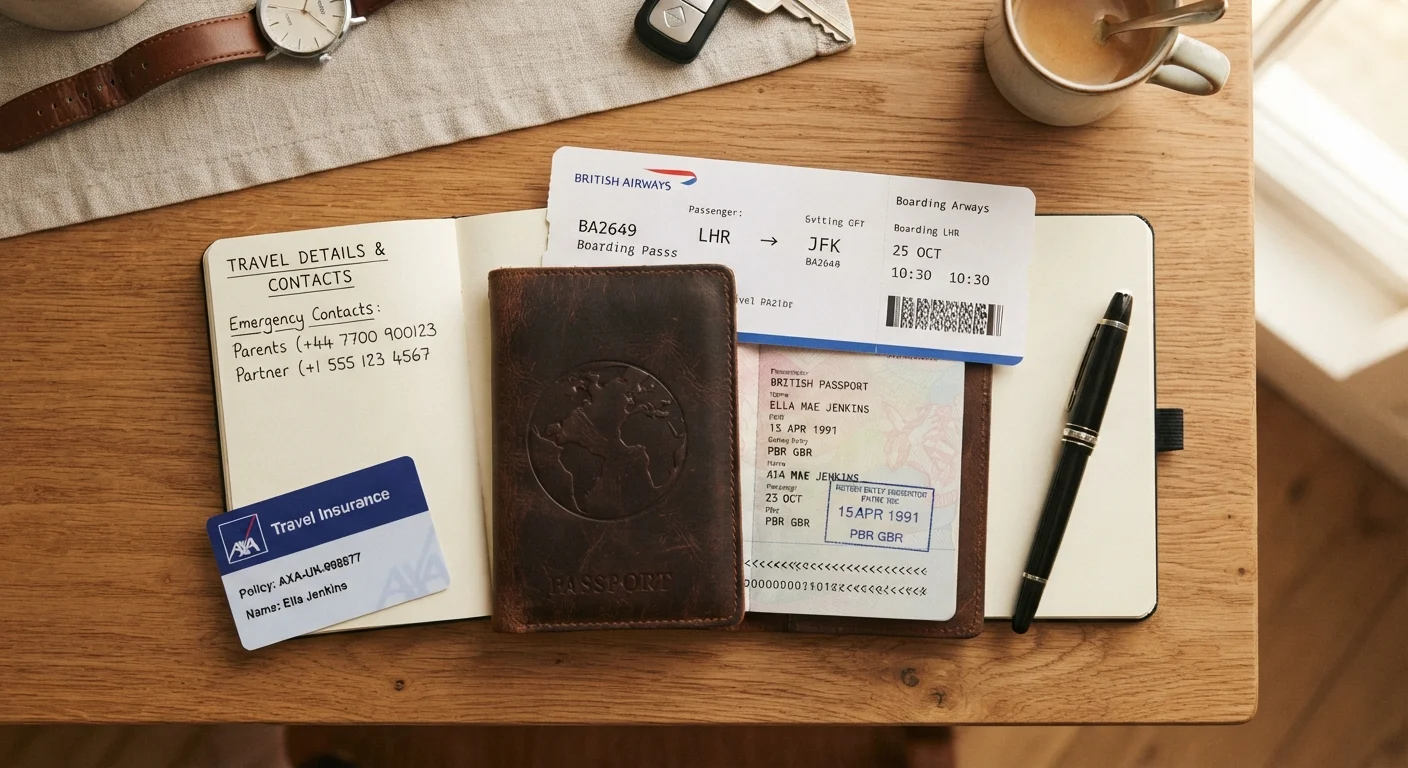
Why Document Prep Is the Foundation of Any Good Trip
Most travel hiccups aren't about missing a museum or booking the wrong hotel — they're about being caught without the right paper at the wrong moment. A lost passport at a foreign airport, a medical emergency with no insurance info in hand, or a car rental agent asking for a document you left on your kitchen counter: these are the moments that turn adventures into ordeals.
Whether you're heading across town for a long weekend or flying internationally for the first time, building a solid document and emergency-contact system before you leave is one of the highest-return habits a traveler can develop. It takes less than an hour and can save you an enormous amount of stress. See our complete pre-trip checklist for a broader look at everything worth handling before departure.
| Passport validity required | 6+ months beyond travel dates (varies by country) (U.S. Department of State guidance) |
| Recommended backup sets | 2 physical + at least 2 digital copies (General travel safety guidance) |
| Emergency contacts to list | Minimum 2 personal + embassy + insurer hotline |
| IDP required in many countries | Yes — alongside a valid U.S. driver's license (American Automobile Association (AAA)) |
| Payment card backup | Carry 2 cards on different networks |
| Time to complete document prep | Under 1 hour for most travelers |
Core Documents to Carry on Every Trip
The exact documents you need depend on your destination and mode of travel, but several items belong in virtually every traveler's bag:
- Government-issued photo ID: A driver's license or state ID for domestic travel; a valid passport for international trips. Check your passport's expiration date — many countries require at least six months of validity beyond your travel dates.
- Travel insurance card or policy summary: Carry proof of coverage, including the insurer's emergency assistance phone number. Verify entry requirements and vaccination rules with official government sources before you go.
- Health insurance card: Even domestically, having your insurance details on hand speeds up any urgent care visit. For international travel, confirm whether your plan covers overseas care.
- Reservation confirmations: Hotel, flight, train, or rental car bookings — printed or downloaded offline so they're accessible without Wi-Fi.
- Payment cards and some local cash: Carry at least two cards from different networks in case one is blocked abroad.
- Driver's license and International Driving Permit (if driving abroad): Many countries require an IDP alongside your U.S. license. Check requirements with the embassy or tourism office of your destination.
For road travelers, our road trip safety and legal readiness checklist covers vehicle-specific documents like registration and proof of insurance.
International Driving Permit (IDP)
A standardized translation of your U.S. driver's license recognized in over 150 countries. It must be used alongside your valid U.S. license, not as a standalone document.
Travel insurance emergency assistance line
A 24/7 phone line provided by travel insurers for urgent situations abroad, such as medical evacuation coordination or lost-document guidance. It is separate from routine customer service.
Two-factor authentication (2FA)
A security method requiring two forms of verification to access an account — typically a password plus a code sent to your phone or email. Strongly recommended for cloud storage holding sensitive travel documents.
Cloud storage
A service that stores files on remote internet-connected servers, making them accessible from any device with login credentials. Examples include services like Google Drive or iCloud.
Backups: The Copies That Could Save Your Trip
Originals get lost. Phones die. Bags get stolen. A layered backup strategy means losing one thing doesn't mean losing everything.
Physical copies
Make two photocopies of your passport photo page, driver's license, travel insurance summary, and key reservation confirmations. Keep one set in your carry-on and leave one set with a trusted person at home.
Digital copies
Photograph or scan the same documents and store them in at least two places: a secure cloud service (with a strong password and two-factor authentication) and an encrypted note or folder on your phone — downloaded for offline access. Avoid storing sensitive scans in unsecured email drafts or public cloud folders.
Email yourself a summary
A single email with key booking reference numbers, your insurance policy number, and your accommodation addresses can be accessed from any device worldwide. Keep it brief and don't include passwords or full card numbers.
International travelers should pay extra attention to this step — our pre-departure checklist for international travelers walks through digital backup strategies alongside health and financial prep.
Secure Your Digital Copies Carefully
Storing scanned passports or ID images in an unprotected email account or a public-facing folder creates its own security risk. Use a password-protected app or encrypted cloud folder, and enable two-factor authentication on any account holding sensitive documents. Avoid accessing these files on public or shared computers.
Emergency Contacts: Who to List and How
An emergency contact list is only useful if it's findable and complete. Build yours before every trip and share it with at least one person staying home.
What to include
- Personal emergency contacts: Two people who know your itinerary and can be reached at any hour — name, relationship, and multiple phone numbers.
- U.S. Embassy or Consulate (for international travel): Look up the embassy address and 24-hour emergency phone number for each country you're visiting. The U.S. Department of State's website maintains current contact details.
- Travel insurance emergency line: This is separate from the general customer service number — find the 24/7 assistance line and write it down.
- Your doctor and pharmacy: Especially important if you take prescription medications. Include your pharmacy's phone number and your prescription details (drug name, dosage, prescribing doctor).
- Bank fraud line: The number on the back of each card you're carrying, so you can freeze accounts quickly if a card is lost or stolen.
- Accommodation addresses and phone numbers: For each place you're staying — useful in a taxi, medical, or police situation where you need a physical address.
Keep a printed copy of this list in your money belt or a zippered inner pocket — somewhere separate from your phone, in case the phone is the thing that goes missing. Traveling across multiple states? Our multi-state road trip checklist covers emergency supplies and contacts for longer domestic drives as well.
1 in 4
Travelers who experience a trip disruption
Travel disruptions — from lost bags to medical incidents — are common enough that preparedness experts consistently recommend backup documentation for all trips.
~10M
U.S. passports reported lost or stolen historically
The U.S. Department of State has processed millions of lost and stolen passport reports, underscoring the value of keeping backup copies separate from the original.
The content provided on our blog site traverses numerous categories, offering readers valuable and practical information. Readers can use the editorial team’s research and data to gain more insights into their topics of interest. However, they are requested not to treat the articles as conclusive. The website team cannot be held responsible for differences in data or inaccuracies found across other platforms. Please also note that the site might also miss out on various schemes and offers available that the readers may find more beneficial than the ones we cover.