

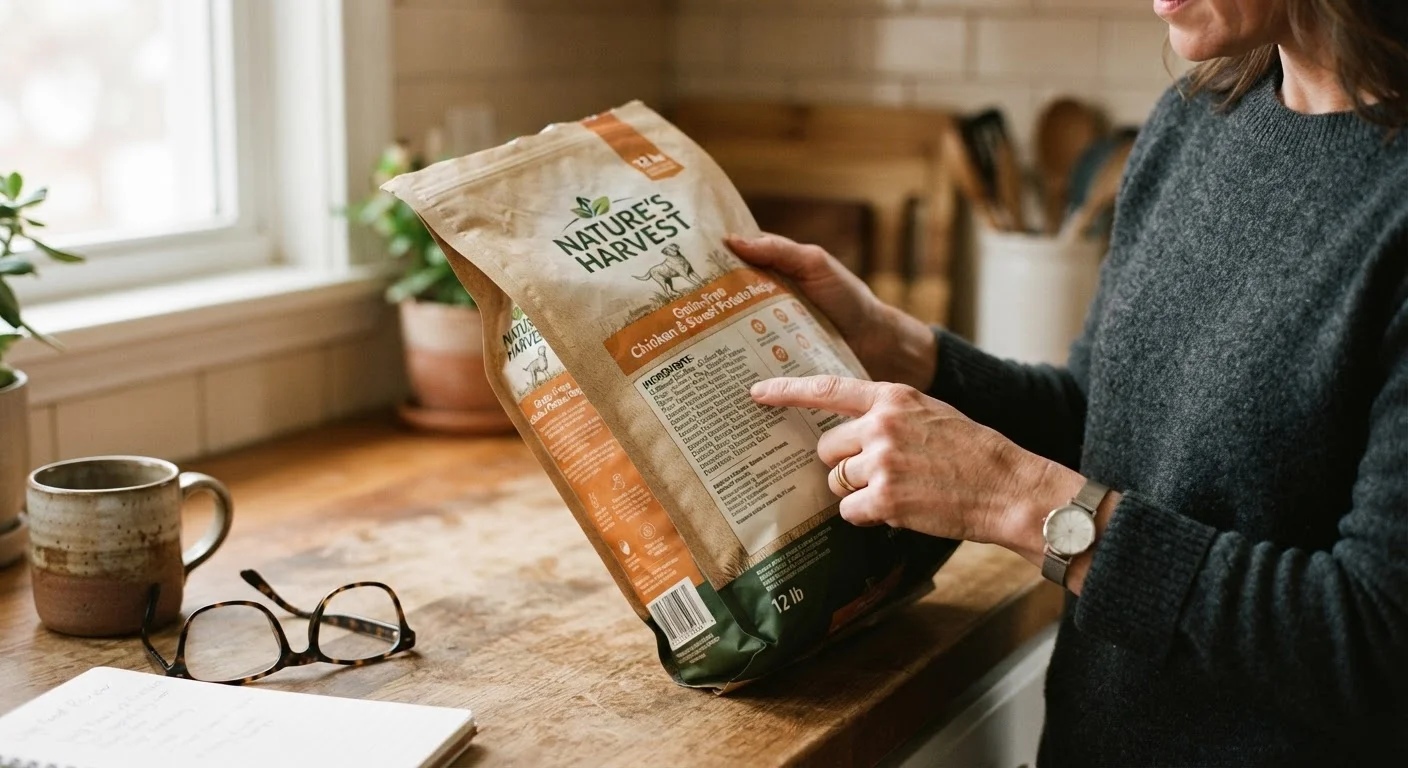
The Ingredient List: What It Tells You — and What It Doesn't
The ingredient list runs from heaviest to lightest by weight before processing. That ordering sounds straightforward, but it creates a well-known quirk: raw meats contain significant water, so they weigh more before cooking and appear near the top even if they contribute less protein to the finished product than their ranking implies.
This is why "ingredient splitting" matters. A manufacturer can divide a single ingredient — say, brown rice — into brown rice, rice bran, and rice flour. Each fraction appears separately and lower on the list, making the total rice content harder to spot at a glance. Awareness of this tactic helps you read the full list rather than just scanning the first few items.
Common terms worth knowing: meal (rendered, dried protein concentrate), by-products (organ meats and other parts with a specific AAFCO definition — not low-quality scraps), and digest (processed animal tissue used as a flavor enhancer). None of these are automatically good or bad; what matters is the overall nutritional picture. For a broader look at how food composition myths travel, see common pet nutrition myths that are worth examining critically.
Start With the AAFCO Statement, Not the Front
The front of a pet food bag is marketing. The AAFCO nutritional adequacy statement on the back or side panel is regulation. Before evaluating ingredient quality or protein percentages, confirm the food carries a complete-and-balanced claim for your pet's life stage — that single line filters out foods that should not serve as a sole diet.
The Guaranteed Analysis: Percentages With Important Limits
The guaranteed analysis panel lists minimum percentages for crude protein and crude fat, and maximum percentages for crude fiber and moisture. The word "crude" refers to the laboratory method used to estimate each nutrient — it is not a quality judgment.
One limitation of this panel is that it shows boundaries, not exact values. A food could contain significantly more fat than the minimum listed. Another complication is moisture: dry kibble and wet food have very different water content, making direct percentage comparisons misleading. To compare them fairly, you need to convert both to a dry matter basis by removing moisture from the equation mathematically. Your veterinarian can help with this calculation if you are evaluating options for a pet with specific health needs.
~70–80%
Typical moisture content in wet pet food
This high water content explains why guaranteed analysis percentages on wet food labels appear much lower than on dry kibble, making direct comparisons misleading without dry matter conversion.
~10%
Typical moisture content in dry pet kibble
AAFCO sets a maximum of 12% moisture for dry pet food, meaning nutrient percentages in dry food are already close to a dry matter basis, unlike wet formulas.
The guaranteed analysis does not tell you about ingredient quality, digestibility, or bioavailability — all of which influence how much of those nutrients your pet actually absorbs and uses.
The AAFCO Statement: The Most Important Line on the Bag
The nutritional adequacy statement is where the label tells you whether this food is meant to be a complete diet — or not. It will say something like: " is formulated to meet the nutritional levels established by the AAFCO Dog Food Nutrient Profiles for adult maintenance."
There are two types of claims. A formulated claim means the recipe meets published nutrient profiles on paper. A feeding trial claim means the food was fed to animals under AAFCO protocols and the animals maintained acceptable health markers. Both are legitimate, but a feeding trial provides an additional layer of real-world validation.
The life stage designation matters as much as the claim type. "All life stages" is the most demanding standard, covering growth and reproduction. "Adult maintenance" does not meet the higher mineral and caloric demands of puppies or kittens. If the label says "for supplemental or intermittent feeding only," the food is not designed to be your pet's sole diet. Understanding how nutrition shapes long-term health is covered in more depth in the role of nutrition in pet health.
AAFCO Does Not 'Approve' Pet Foods
A common misconception is that AAFCO certifies or approves individual products. It does not. AAFCO publishes the nutrient profiles and model regulations that states adopt; manufacturers self-certify that their products meet those standards. Regulatory enforcement is handled at the state and federal level, not by AAFCO directly.
Feeding Guidelines and Everything Else on the Label
Feeding guidelines are starting points, not precise prescriptions. They are calculated for an average animal at a typical activity level, which may not describe your pet at all. Use them as a baseline and adjust based on your pet's body condition over time — your veterinarian is the right partner for that calibration, especially for pets with health conditions or unusual energy needs.
Other label elements worth a quick check include the manufacturer's contact information (required by regulation and useful if you have quality concerns), the net weight, and the best by date. A freshness date is especially relevant for dry foods, whose fats can oxidize over time.
If you are weighing wet versus dry food options, the label-reading principles here apply to both — though moisture differences make direct comparison trickier. Wet food vs. dry food covers those trade-offs in detail. Labels give you the data; your vet helps you interpret it for your specific pet's needs.
This article is for general informational purposes only and is not a substitute for professional veterinary advice. Always consult a licensed veterinarian for guidance specific to your pet's health and nutritional needs.
Frequently Asked Questions
It means the food has been formulated or tested to meet AAFCO nutrient profiles for a specific life stage, such as adult maintenance or growth. It is a regulated claim, not a marketing phrase. A food without this statement should not be used as a sole diet.
Ingredients are listed by weight before processing. Raw chicken, for example, contains a lot of water, which makes it heavy. Once moisture is cooked away, the actual meat content shrinks significantly. Grains listed lower down may contribute more dry matter to the finished food than their position suggests.
"Chicken" refers to fresh or frozen muscle meat including water. "Chicken meal" is chicken that has already been rendered and dried, so it is a more concentrated protein source by weight. Neither is inherently superior — both can contribute quality protein.
Not necessarily. By-products such as liver, kidneys, and lungs are nutrient-dense and are consumed by animals in the wild. The term has a specific AAFCO definition — it does not include hooves, hair, or floor sweepings. Concerns about by-products are often based on misconception rather than nutritional evidence.
Look for the AAFCO nutritional adequacy statement, which specifies whether the food is intended for growth, adult maintenance, all life stages, or supplemental feeding only. Puppies and kittens have different nutritional requirements than adult animals, so matching life stage matters.
Feeding trial statements mean the food was tested on actual animals for a set period and met AAFCO protocols. Formulated statements mean the recipe meets nutrient profiles on paper. Both can produce nutritious foods, but a feeding trial provides an extra layer of real-world evidence.
The content provided on our blog site traverses numerous categories, offering readers valuable and practical information. Readers can use the editorial team’s research and data to gain more insights into their topics of interest. However, they are requested not to treat the articles as conclusive. The website team cannot be held responsible for differences in data or inaccuracies found across other platforms. Please also note that the site might also miss out on various schemes and offers available that the readers may find more beneficial than the ones we cover.