

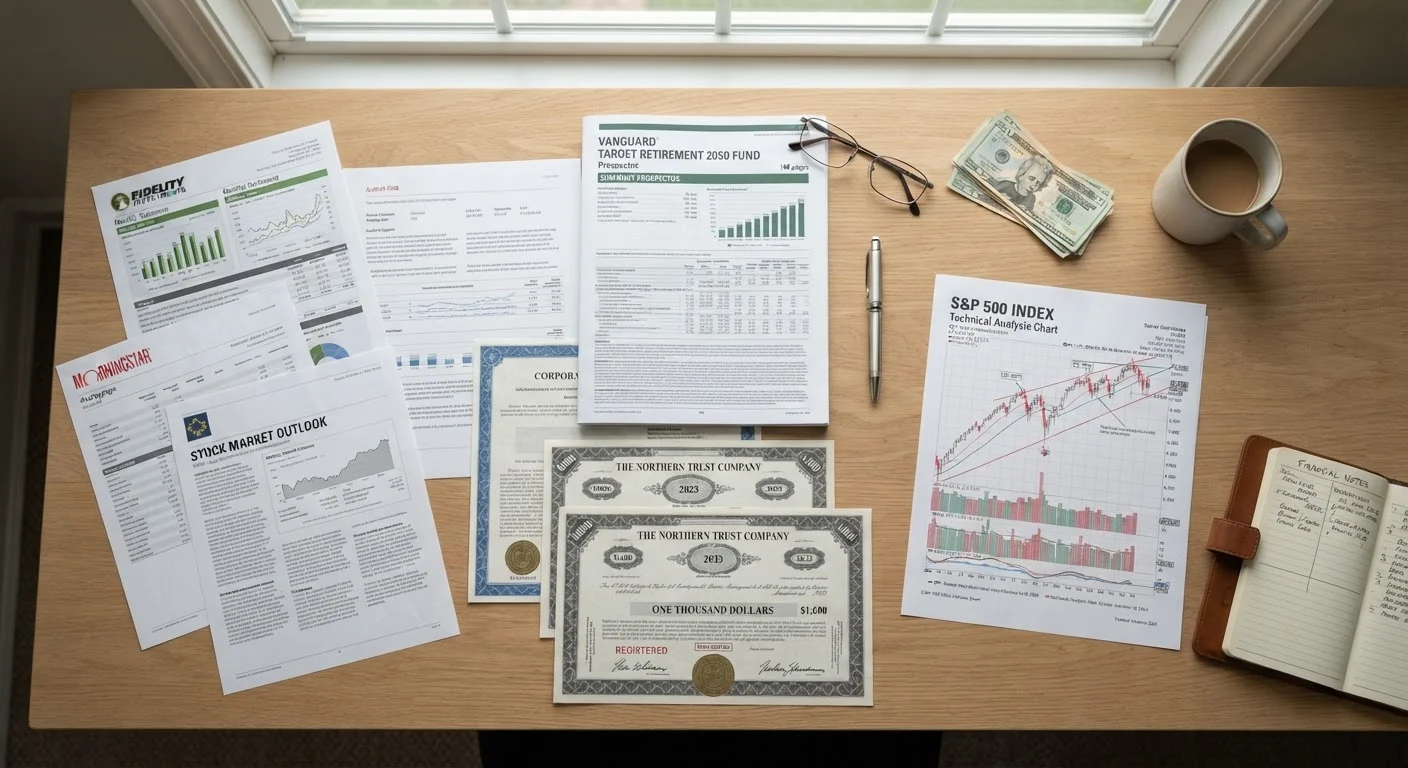
The Three Core Asset Classes
When people talk about investing, they're almost always referring to three foundational asset classes: stocks, bonds, and funds. Each works differently, carries different risks, and plays a different role in a portfolio. Understanding what you'd actually own - before you invest - is essential groundwork. For a deeper look at the marketplace where these assets trade, see what the stock market actually is and how it works.
Equity
Ownership interest in a company, represented by shares of stock. Equity holders benefit when the company grows but can also lose value if it declines.
Bond
A debt instrument where an investor lends money to a government or corporation in exchange for regular interest payments and return of principal at maturity.
Mutual Fund
A pooled investment vehicle managed by a professional that collects money from many investors and buys a diversified mix of stocks, bonds, or other assets.
ETF (Exchange-Traded Fund)
A fund that holds a collection of assets and trades on a stock exchange throughout the day, similar to an individual stock. Many ETFs passively track an index.
Dividend
A portion of a company's earnings distributed to shareholders, typically paid quarterly. Not all stocks pay dividends.
Index Fund
A mutual fund or ETF designed to mirror the performance of a market index, such as the S&P 500, by holding the same securities in the same proportions.
Asset Class
A broad category of investments that share similar characteristics and behave similarly in the market - common classes include stocks, bonds, and cash equivalents.
Expense Ratio
The annual fee a fund charges investors, expressed as a percentage of assets. A 0.10% expense ratio means $1 per year on every $1,000 invested.
These categories are not competing choices - most long-term investors hold a mix of all three. The right proportion depends on goals, time horizon, and investment risk tolerance, which is a foundational concept worth exploring separately.
Stocks: Ownership With Upside and Downside
A stock (also called a share or equity) represents a fractional ownership stake in a publicly traded company. When that company becomes more valuable, your shares are worth more. When it struggles, your shares lose value - and in rare worst-case scenarios, they can become worthless.
Stocks have historically produced higher long-term returns than bonds or cash, but they carry more short-term volatility. Some stocks pay dividends - regular cash distributions from company profits - while others reinvest all earnings back into the business for growth.
| Primary stock risk | Price can fall to zero if the company fails |
| Bond repayment priority | Bondholders are paid before stockholders in bankruptcy |
| Typical index fund expense ratio | 0.03%-0.20% annually (Morningstar fund fee research) |
| S&P 500 composition | 500 of the largest U.S. publicly traded companies |
| ETF trading hours | Throughout the trading day, like individual stocks |
| Common bond maturity ranges | Short-term (under 2 years), intermediate (2-10 years), long-term (10+ years) |
Individual stock-picking requires research and carries concentrated risk: if you own only one or two stocks, a single company's bad news hits your whole portfolio hard. This is why diversification matters more than picking the right stock - a principle backed by decades of financial research.
Bonds: Lending Money for Predictable Returns
When you buy a bond, you're acting as a lender. Governments (federal, state, and local) and corporations issue bonds to raise money, promising to pay you interest on a fixed schedule and return your original investment - called the principal - at a set maturity date.
Bonds are generally considered lower risk than stocks because the income stream is contractual, not dependent on company profits. However, bonds carry their own risks:
- Credit risk: The issuer could default and fail to make payments.
- Interest rate risk: When prevailing interest rates rise, existing bond prices typically fall.
- Inflation risk: Fixed interest payments may not keep pace with rising prices over time.
U.S. Treasury bonds are backed by the federal government and are considered among the lowest-risk bonds available. Corporate bonds offer higher interest rates but come with higher default risk, especially lower-rated high-yield bonds.
This Is General Education, Not Investment Advice
This article explains how different investment types work at a conceptual level. It does not constitute personalized financial, tax, or investment advice. Investment involves risk, including the possible loss of principal. For decisions specific to your situation, consult a licensed financial adviser.
Funds: Built-In Diversification
Funds pool money from many investors to buy a basket of securities - which is why they're the most common vehicle for everyday investors. Instead of picking individual stocks or bonds, you buy a share of the entire pool.
~58%
U.S. adults who own stock
According to Gallup's 2023 Economy and Personal Finance survey, roughly 58% of Americans report owning stocks, mutual funds, or retirement accounts invested in equities.
$27T+
U.S. mutual fund and ETF assets
The Investment Company Institute reported over $27 trillion in combined U.S. mutual fund and ETF assets as of 2023, reflecting their central role in American investing.
70%+
Index funds' share of new fund flows
Passive index funds have consistently captured the majority of new investment dollars in recent years, reflecting a broad shift away from actively managed funds.
Mutual Funds
Managed by professional portfolio managers, mutual funds are priced once per day after markets close. Actively managed mutual funds attempt to outperform a market benchmark; passively managed index mutual funds simply track one. Both charge an expense ratio - a key cost to compare when evaluating any fund.
ETFs (Exchange-Traded Funds)
ETFs function similarly to index mutual funds but trade on exchanges throughout the day like individual stocks. They typically carry very low expense ratios. Most ETFs are passively managed, tracking an index such as the S&P 500 or the U.S. bond market.
Index Funds
Index funds - available as either mutual funds or ETFs - are designed to match the performance of a specific market index rather than beat it. Because they require minimal management, they tend to have the lowest costs. For beginning investors, starting to invest often begins here. For a deeper reference on the vocabulary that comes with these products, see key investing terms every beginner needs.
Before putting money into any of these vehicles, it's worth reviewing a pre-investment checklist - including whether your emergency fund is in place and high-interest debt is addressed. Managing those fundamentals first is covered in the Saving & Debt hub.
This article is for informational and educational purposes only and does not constitute personalized investment, financial, or tax advice. All investing involves risk, including potential loss of principal. Past performance does not guarantee future results. Consult a licensed financial professional before making investment decisions.
The content provided on our blog site traverses numerous categories, offering readers valuable and practical information. Readers can use the editorial team’s research and data to gain more insights into their topics of interest. However, they are requested not to treat the articles as conclusive. The website team cannot be held responsible for differences in data or inaccuracies found across other platforms. Please also note that the site might also miss out on various schemes and offers available that the readers may find more beneficial than the ones we cover.