

The Myth of Picking Winners
One of the most persistent ideas in personal finance is that the key to investment success is finding the right stocks — spotting tomorrow's giants before everyone else does. It's an appealing story. In practice, it doesn't hold up.
Academic research spanning decades shows that the vast majority of professional fund managers — with full-time analytical teams and privileged access to data — fail to consistently outperform simple market benchmarks after fees. For individual investors without those resources, the odds are even less favorable. Stock prices reflect enormous amounts of public information almost instantly, leaving little predictable edge.
The more reliable path, supported by a large body of evidence, runs through diversification — spreading risk across many investments rather than concentrating it in a few. Before diving into how, it's worth grounding the concept in basics. If investing terminology is still unfamiliar, a glossary of core investing terms is a useful starting point.
“Diversification is the only free lunch in investing. It allows you to reduce risk without necessarily sacrificing expected return.”
— Harry Markowitz, Nobel Prize-winning economist and originator of Modern Portfolio Theory
What Diversification Actually Does
Diversification reduces what's called unsystematic risk — the risk specific to a single company or industry. If you hold one stock and that company has a terrible year, your portfolio suffers entirely. If you hold 500 stocks across many sectors and one collapses, the damage is contained.
What diversification cannot eliminate is systematic risk — the broad market downturns that affect nearly all assets simultaneously, like a deep recession. No portfolio is immune to that. But a well-diversified portfolio typically experiences smaller peaks and valleys than a concentrated one, making it easier for investors to stay the course rather than sell in a panic.
~90%
Active funds underperforming their benchmark
S&P Dow Jones Indices' SPIVA reports have repeatedly found that roughly 90% of actively managed U.S. equity funds underperform their benchmark index over a 20-year period.
1952
Year Modern Portfolio Theory was introduced
Economist Harry Markowitz published his groundbreaking paper on portfolio selection in 1952, establishing the mathematical basis for diversification in investing.
This is not a new idea. It is, in fact, the foundation of Modern Portfolio Theory, developed in the 1950s, which demonstrated mathematically that combining assets with different risk profiles can improve a portfolio's overall risk-adjusted return.
Best Practices for Diversifying Your Portfolio
Knowing diversification matters is one thing; putting it into practice is another. The following approaches reflect established principles that beginning and intermediate investors can apply systematically.
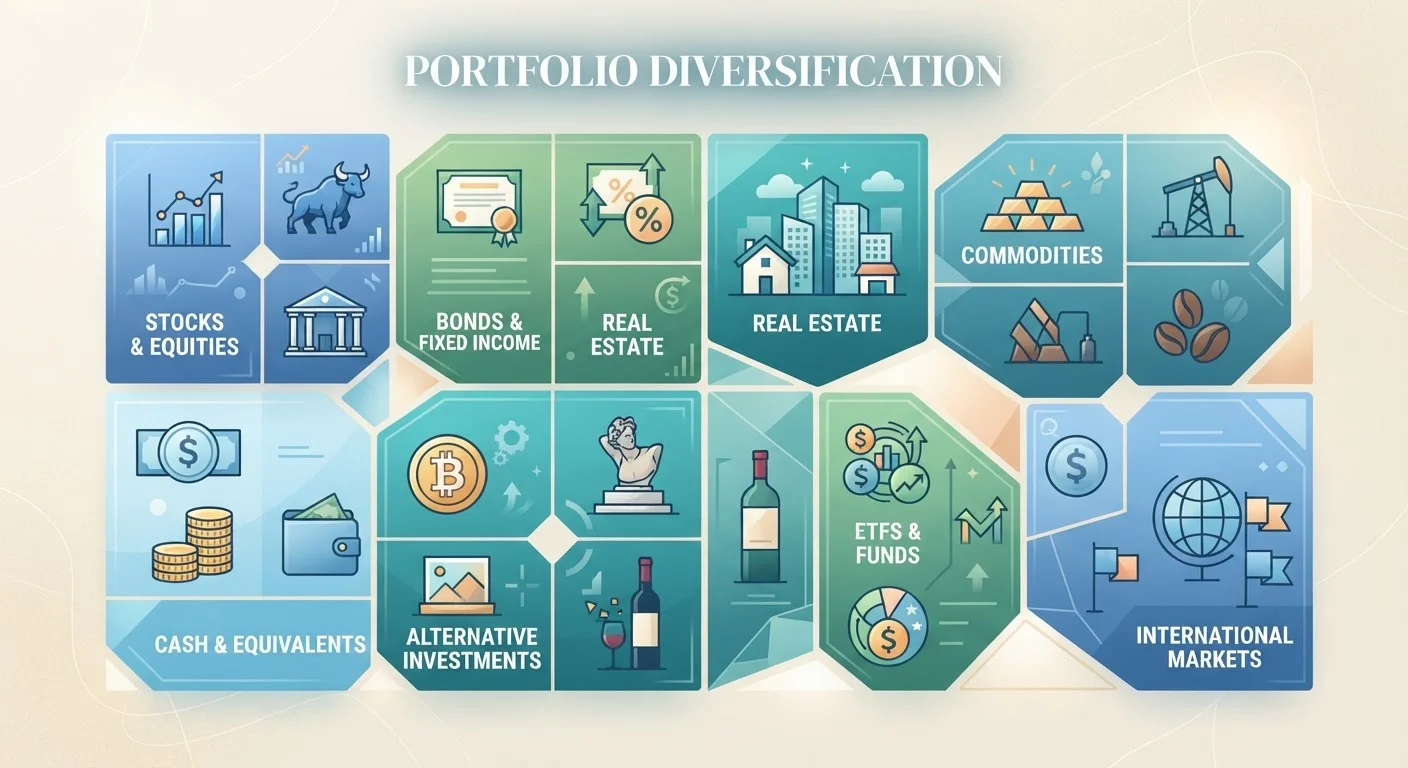
Spread holdings across multiple asset classes, not just stocks.
Stocks, bonds, real estate investment trusts (REITs), and cash equivalents tend to respond differently to economic conditions. When one class declines, others may hold steady or rise, cushioning your overall portfolio against sharp swings.
Diversify within equities across sectors and geographies.
Even within the stock market, concentration in a single industry or country creates hidden risk. Technology stocks, for example, can fall sharply while healthcare or consumer staples remain more stable. International exposure adds another layer of protection against domestic economic cycles.
Use low-cost index funds as a practical diversification tool.
A single broad-market index fund can hold hundreds or thousands of securities, providing instant diversification at minimal cost. Research consistently shows that the majority of actively managed funds underperform their benchmark index over long periods, partly because of higher fees. See how index funds compare to active management for a deeper look.
Rebalance your portfolio periodically to maintain your target allocation.
Over time, strong-performing assets grow to represent a larger share of your portfolio than intended, inadvertently increasing concentration risk. Periodic rebalancing — selling a portion of outperformers and adding to underperformers — restores your original risk profile.
Align your diversification strategy with your risk tolerance and time horizon.
Diversification is not one-size-fits-all. A younger investor with decades until retirement can typically absorb more equity exposure, while someone approaching retirement generally benefits from a more conservative mix. Understanding your investment risk tolerance is foundational to building the right portfolio.
This Is Education, Not Personalized Advice
This article provides general financial information for educational purposes only. It is not personalized investment, tax, or legal advice. Every investor's situation is different — consult a qualified, licensed financial professional before making decisions about your own portfolio.
Start Simply and Build from There
Diversification doesn't require a complex strategy or a large sum to get started. Many investors begin with a single broad-market index fund and expand from there as their knowledge and portfolio grow. The important thing is to avoid the common trap of believing you need to wait until you have a perfect plan — or a perfect market moment.
Common investing myths — like needing a lot of money to start — often delay people from building even a basic, diversified position. And combining diversification with a disciplined contribution strategy, such as dollar-cost averaging, can reduce the emotional pressure of trying to time your investments perfectly.
This article is for general informational and educational purposes only and does not constitute personalized investment, tax, or legal advice. Consult a qualified financial professional before making decisions based on your individual circumstances.
The content provided on our blog site traverses numerous categories, offering readers valuable and practical information. Readers can use the editorial team’s research and data to gain more insights into their topics of interest. However, they are requested not to treat the articles as conclusive. The website team cannot be held responsible for differences in data or inaccuracies found across other platforms. Please also note that the site might also miss out on various schemes and offers available that the readers may find more beneficial than the ones we cover.