

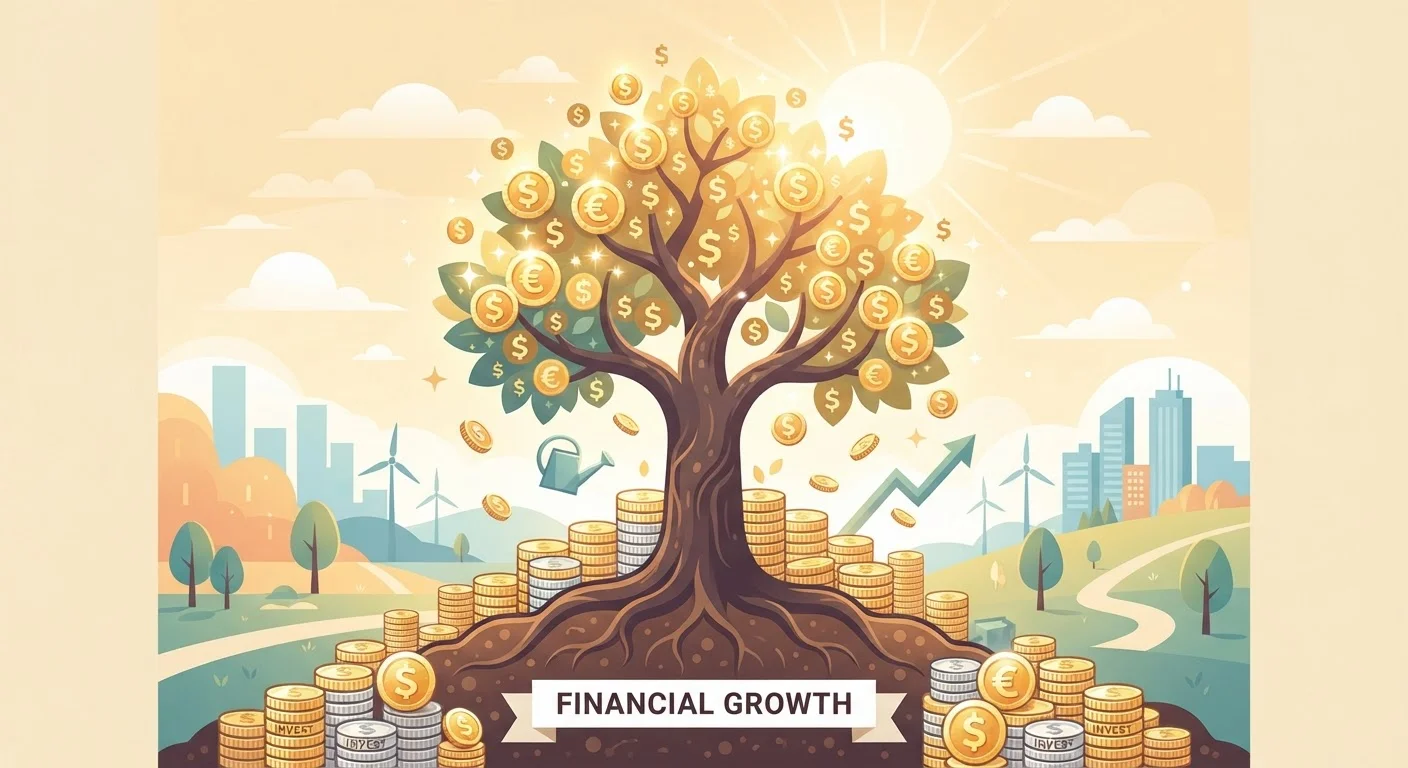
How Compound Interest Actually Works
At its core, compound interest is interest earning interest. When you deposit $1,000 in a savings account at 5% annual interest, you earn $50 in year one. In year two, you earn 5% not on $1,000 but on $1,050 - so you earn $52.50. That extra $2.50 is compounding in action. Modest in year two, but transformative over decades.
Compare this with simple interest, where you'd earn exactly $50 every year regardless of accumulated interest. Over 30 years, $1,000 at 5% simple interest grows to $2,500. With compound interest at the same rate, it grows to approximately $4,322 - nearly 73% more, with no additional effort.
For a broader grounding in the vocabulary around interest, see our glossary of key interest rate terms that covers APR, APY, and related concepts plain language.
$260,000+
Potential growth of $100/month invested over 40 years
Based on a hypothetical 7% average annual return, illustrating how compound growth dwarfs the total $48,000 contributed.
72
Rule of 72: years to double money (divide by rate)
A widely used financial heuristic - at 6% annual return, money doubles in roughly 12 years (72 ÷ 6).
20 years
Advantage of starting to invest early
Investors who begin two decades earlier often accumulate more wealth even with smaller total contributions, due to additional compounding time.
Why Time Is the Most Valuable Variable
No variable influences compound growth more than time. Consider two hypothetical investors: one starts investing $200 per month at age 25 and stops at 35 - just 10 years of contributions. The other starts at 35 and contributes $200 per month for 30 years. Assuming the same annual return, the earlier investor often ends up with more money at retirement, despite contributing far less. This isn't magic - it's decades of compounding doing the heavy lifting.
This is why retirement accounts like 401(k)s and IRAs are structured to reward early, consistent participation. The tax-advantaged growth environment amplifies what compounding already does naturally.
Automate Contributions for Maximum Impact
One of the most effective ways to harness compound interest is to set up automatic contributions - even small ones - to a savings or retirement account. Automation removes the temptation to skip months, and consistent investing ensures your money spends as much time in the market as possible. Consistency matters more than the size of any single contribution.
It's worth noting that compounding also works powerfully in reverse when you carry debt. Credit card balances compound against you, growing faster the longer they're unpaid. Our article on the hidden costs inside your debt explores how fees and compounding stack up for borrowers.
Compounding Frequency and Rate: What Moves the Needle
Two other factors shape how much compound interest you accumulate: the interest rate and how frequently it compounds. A higher rate accelerates growth significantly. Moving from a 4% to a 7% annual return on $10,000 over 30 years produces a difference of roughly $48,000 - on the same initial deposit, just a different rate.
Compounding frequency refers to how often interest is calculated and added to your balance - daily, monthly, quarterly, or annually. The more frequently interest compounds, the higher your effective annual yield. This is why APY (Annual Percentage Yield) - which accounts for compounding - is a more useful comparison figure than a stated annual rate. For a full breakdown of these terms, the interest rate terminology glossary is a helpful reference.
Putting Compound Interest to Work in Your Financial Life
Understanding compound interest transforms how you think about saving, investing, and debt. For wealth-building, the practical implications are clear: start early, contribute consistently, and let time do the work. Even modest, regular contributions to an employer-sponsored retirement plan or an individual retirement account can grow substantially over a 30- to 40-year horizon.
If you're also managing debt, it's worth understanding how compounding functions on both sides of the ledger. Our article on saving while in debt walks through when building savings alongside debt repayment can make financial sense.
This article is for general informational and educational purposes only. It does not constitute personalised financial, investment, or tax advice. Past investment performance does not guarantee future results. Please consult a licensed financial adviser or other qualified professional regarding decisions specific to your financial situation.
Frequently Asked Questions
It depends on the account or investment. Savings accounts often compound daily or monthly, while some bonds compound annually. More frequent compounding produces slightly higher returns at the same stated interest rate.
The Rule of 72 is a simple mental math shortcut: divide 72 by your annual interest rate to estimate how many years it will take to double your money. At a 6% annual return, your investment would roughly double in 12 years (72 ÷ 6 = 12).
Yes. Tax-advantaged accounts like 401(k)s and IRAs benefit from compounding because investment gains are reinvested over time. Tax deferral means you're also compounding on money that would otherwise have gone to taxes, magnifying the effect.
Absolutely. Credit card balances, personal loans, and other debts accrue compound interest just as savings do - but it works against you. Unpaid balances grow quickly, making it harder to pay off debt over time. See our related article on <a href="/money-finance/saving-and-debt/compound-interest-the-force-that-works-for-savers-and-against-borrowers">how compound interest affects both savers and borrowers</a>.
For savings and investments, yes - more frequent compounding means more interest earned per year at the same stated rate. However, the difference between daily and monthly compounding is often very small; the interest rate and time invested matter far more.
As early as possible. Even small contributions made in your 20s can outgrow larger contributions made in your 40s, simply because of additional compounding time. This is general educational information - consult a licensed financial adviser for advice tailored to your situation.
The content provided on our blog site traverses numerous categories, offering readers valuable and practical information. Readers can use the editorial team’s research and data to gain more insights into their topics of interest. However, they are requested not to treat the articles as conclusive. The website team cannot be held responsible for differences in data or inaccuracies found across other platforms. Please also note that the site might also miss out on various schemes and offers available that the readers may find more beneficial than the ones we cover.