

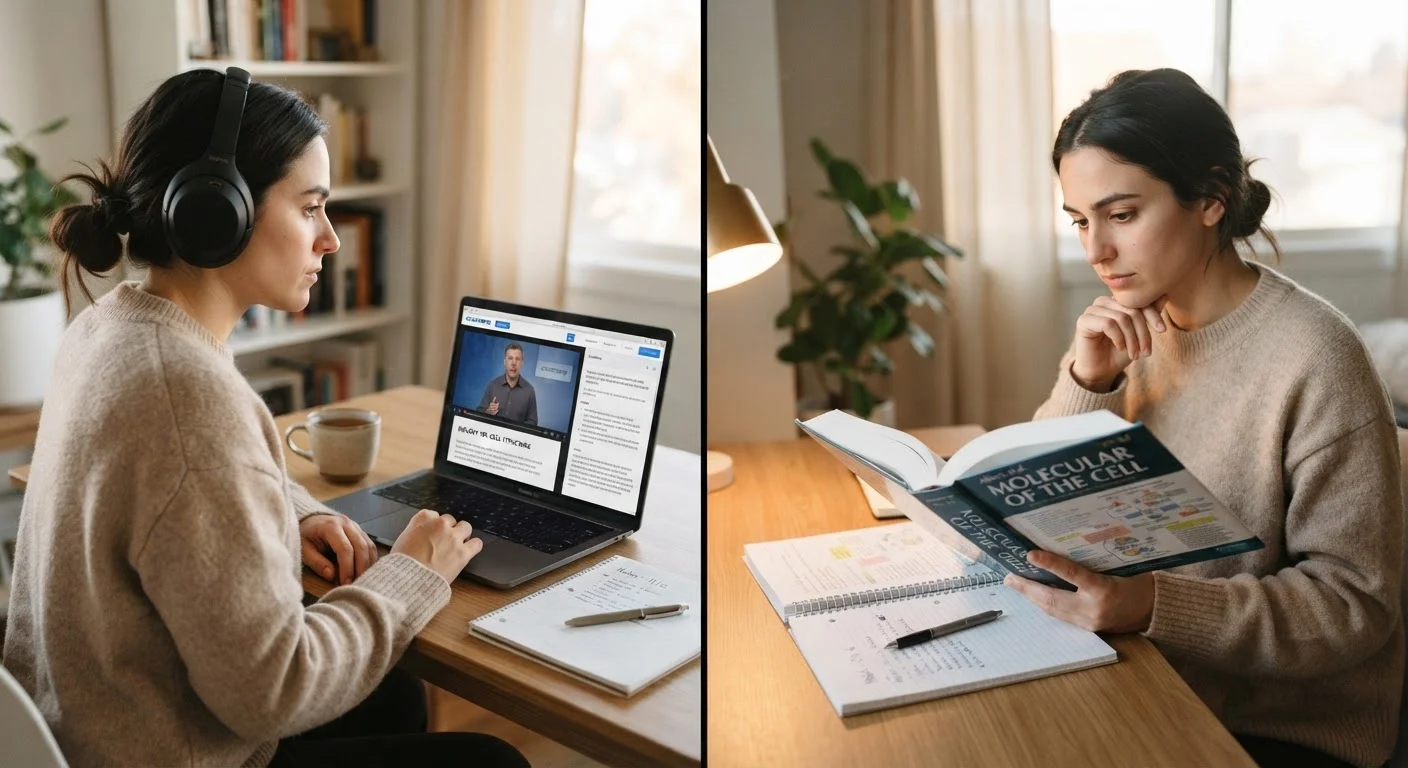
Our Verdict
Online courses have a clear edge for skill-based, applied learning where demonstrations and pacing matter. Textbooks remain the stronger choice for in-depth conceptual study, academic reference, and offline access. For most adult learners, a hybrid approach - using each format where it performs best - tends to outperform either alone.
| Best for | Recommended |
|---|---|
| Learners who need structured progression with visual and audio demonstrations | Online Courses |
| Those studying dense academic or technical material that requires repeated reference | Textbooks |
| Busy adults seeking flexibility and a credential or certificate outcome | Online Courses |
| Learners who prefer offline access, annotation, and non-linear navigation | Textbooks |
What Each Format Actually Offers
Online courses and textbooks both deliver knowledge - but through fundamentally different mechanisms. Understanding those mechanisms is the starting point for choosing wisely.
Online courses typically combine video lectures, quizzes, downloadable resources, and sometimes peer forums or instructor feedback. They're built to guide you through a topic in a defined sequence, often with progress tracking built in. Platforms vary widely in depth and rigor, and so do completion rates - research consistently shows that self-motivation plays a large role in whether learners finish. For a fuller picture of digital study options, see the Online Learning hub.
Textbooks - whether print or digital - offer continuous, authored prose that builds arguments and concepts in sustained depth. A good textbook allows non-linear navigation: you can jump to a chapter, re-read a section, or scan an index without sitting through a module. They require active reading discipline but reward it with nuanced understanding that video often compresses or skips.
Where Online Courses Have the Edge
Online courses tend to outperform textbooks in several concrete situations:
- Skill demonstration: Watching someone write code, execute a design, or perform a technique in real time transfers far more efficiently than reading a description of the same process.
- Pacing and accountability: Course structures - modules, deadlines, quizzes - provide external scaffolding that many self-directed learners need. Understanding synchronous vs. asynchronous formats can help you pick the right kind of structure for your schedule.
- Credentialing: Many online courses issue certificates that can be shared with employers or added to a professional profile - something a textbook inherently cannot provide.
- Engagement for new topics: When you're unfamiliar with a subject, a guided course can reduce cognitive overload by breaking material into manageable pieces with immediate feedback.
Try Before You Commit
Many online courses offer a free preview of the first module, and most libraries provide textbook access at no cost. Before investing time or money, sample the material in both formats if possible. A few minutes of reading or watching can reveal whether the instructor's style or the author's approach genuinely suits how you take in information.
For working adults balancing jobs and study, online courses can also be more time-efficient - a complete overview of online learning for working adults covers how to evaluate programs for your specific situation.
Where Textbooks Still Win
Despite the appeal of video-based learning, textbooks hold real advantages that shouldn't be overlooked:
- Depth and precision: Academic and technical textbooks cover topics with a rigor that most online courses don't match. For foundational disciplines - law, medicine, engineering, economics - the textbook remains the benchmark.
- Annotation and review: Highlighting, margin notes, and tabbing pages are powerful study tools. Research on learning supports the idea that writing by hand while reading aids retention and comprehension.
- No access barriers: A physical textbook works without Wi-Fi, a subscription, or a charged device. For learners in areas with unreliable connectivity, this matters considerably.
- Longevity of reference: A well-chosen textbook serves as a reference you return to over years. Online course content can be removed, updated without notice, or locked behind paywalls.
| Online Courses | Textbooks | |
|---|---|---|
| Learning style served | Visual and auditory learners | Reading-focused, analytical learners |
| Depth of coverage | Moderate; curated and condensed | High; sustained and rigorous |
| Credentialing | Certificates often available | No credential issued |
| Cost range | Free to several hundred dollars | Free (library/OER) to expensive new |
| Offline access | Limited; usually requires internet | Full offline access (print) |
| Annotation and review | Limited note tools in most platforms | Highlighting, tabs, margin notes |
| Best for | Skill-based or applied learning | Conceptual, academic, or reference study |
Cost is also worth considering. Textbooks can be expensive when purchased new, but library access, used copies, and open educational resources (OERs) can bring that cost close to zero. Online courses range from free to hundreds of dollars - learn when a course's price tag actually matters before committing.
How to Match Format to Your Learning Goals
The most practical question isn't which format is better in the abstract - it's which is better for this subject and for how you work. A few guiding questions help clarify that:
- Is the skill procedural or conceptual?
- Procedural skills (coding, editing video, using software) generally benefit from course-style demonstration. Conceptual mastery (history, philosophy, economics) often runs deeper in text.
- Do you need a certificate or credential?
- If an employer or institution needs to see proof of completion, an online course with a certificate is the only format that delivers that directly.
- How do you prefer to study?
- Honest self-knowledge matters. If you've historically finished books but abandoned video series, lean toward text - and vice versa. Comparing self-paced vs. cohort-based courses can further refine which online format works for you.
- What does your schedule look like?
- A textbook can be read in five-minute windows anywhere. Many courses require more sustained sessions to follow a lecture coherently.
For many adult learners, the answer is a deliberate combination: use an online course to build a working foundation and acquire a credential, then turn to textbooks to deepen understanding over time. The trade-offs of learning entirely online offers an honest look at what any all-digital approach gains and gives up.
The content provided on our blog site traverses numerous categories, offering readers valuable and practical information. Readers can use the editorial team’s research and data to gain more insights into their topics of interest. However, they are requested not to treat the articles as conclusive. The website team cannot be held responsible for differences in data or inaccuracies found across other platforms. Please also note that the site might also miss out on various schemes and offers available that the readers may find more beneficial than the ones we cover.