

Our Verdict
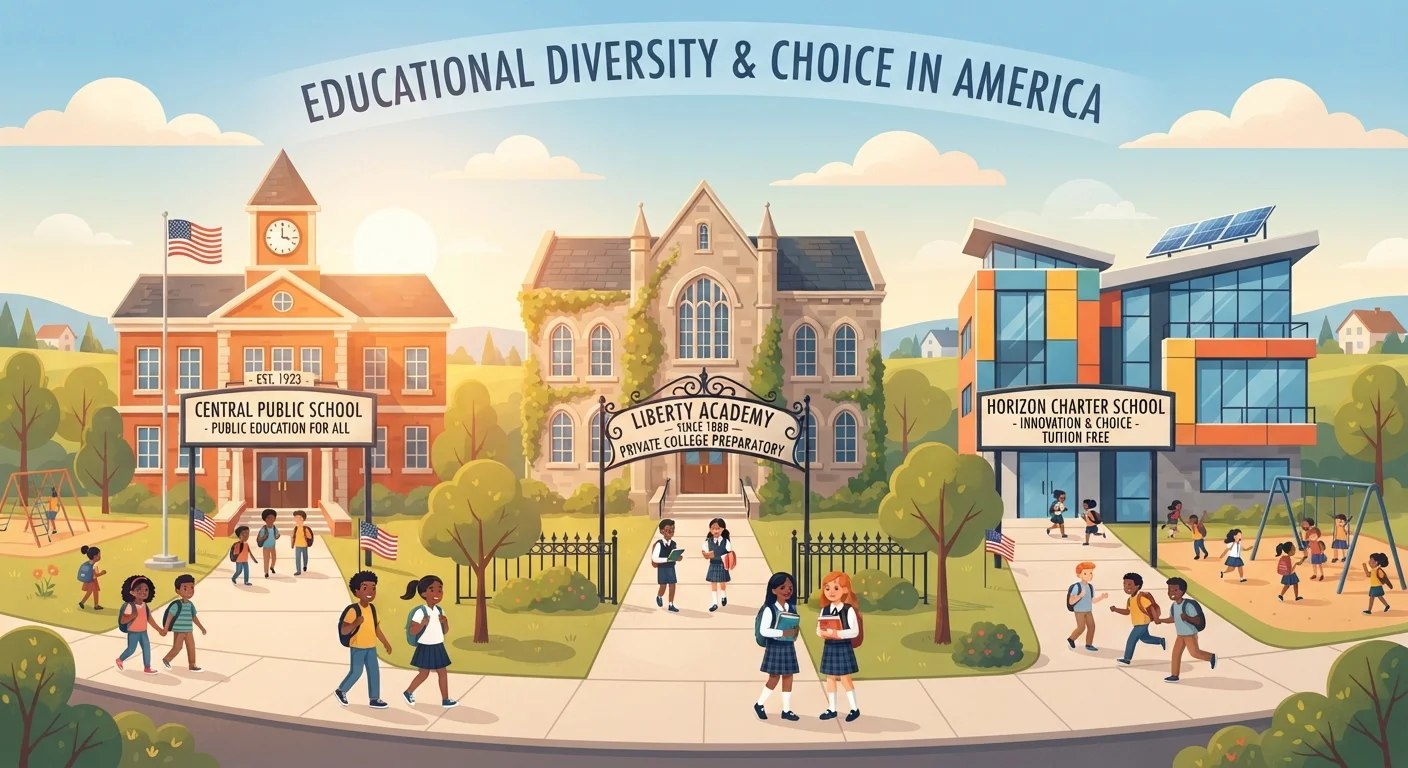
Public, private, and charter schools each serve different needs and reflect different philosophies about how education should be organized and delivered. No single type is universally superior - the right choice depends on what a student needs, what a family values, and what options are realistically available in their area.
| Best for | Recommended |
|---|---|
| Families seeking tuition-free, universally accessible education with broad programming | Public schools |
| Students who benefit from specialized curricula, religious instruction, or smaller class settings | Private schools |
| Families who want public funding with an alternative or theme-based educational model | Charter schools |
How Funding Shapes Each School Type
The most fundamental difference between the three school types is where their money comes from - and that funding source shapes nearly everything else about how they operate.
Public schools are funded through a combination of local property taxes, state government allocations, and federal dollars. Because they are tax-supported institutions, they must be free to attend and must accept any student living within their assigned district. For a full picture of how public schools fit into the broader U.S. education structure, see The American K-12 System Explained.
Private schools rely primarily on tuition paid by families, supplemented by endowments, donations, and sometimes religious organization support. This financial independence means they receive little to no public funding and are not subject to most government mandates.
Charter schools occupy a middle ground: they receive public funding (similar to traditional public schools) but are operated by independent organizations - often nonprofits - under a performance agreement, or "charter," with a state or local authority. They do not charge tuition.
~50 million
Students in U.S. public schools
According to the National Center for Education Statistics, roughly 50 million students attend public K-12 schools annually.
~3.3 million
Students enrolled in charter schools
The National Alliance for Public Charter Schools estimated approximately 3.3 million students attended charter schools in recent years.
~5.8 million
Students in private schools
The NCES reports around 5.8 million students are enrolled in private K-12 schools across the United States.
Admissions, Enrollment, and Who Can Attend
Funding structures directly influence who gets through the door.
Public schools must enroll every student in their geographic zone - this is the cornerstone of the public education promise. Students cannot be turned away based on academic performance, disability status, or language background.
Private schools set their own admissions criteria. Some are highly selective, requiring entrance exams, interviews, or auditions. Others are less competitive but still screen applicants. Families must apply and be accepted - and then pay tuition, which can range widely from a few thousand to over $50,000 per year depending on the school.
Charter schools are tuition-free and open to any student, regardless of where they live (in most states), but they have limited seats. When demand exceeds capacity - which is common - most states require charter schools to use a lottery system to fill spots, rather than selective admissions.
| Public Schools | Private Schools | Charter Schools | |
|---|---|---|---|
| Funding source | Government (taxes) | Tuition & donations | Government (public funds) |
| Tuition cost | Free | Varies; often significant | Free |
| Admissions | Open to all in district | Selective; application required | Open; lottery if oversubscribed |
| Curriculum control | State standards | School-determined | Theme-based; state standards apply |
| Teacher certification | State-required | School-determined | Varies by state |
| Accountability | School board & state | Board & families | Charter authorizer |
| Special education services | Federally mandated (IDEA) | Varies; limited obligation | Federally mandated (IDEA) |
Curriculum, Teaching, and School Culture
Who controls the curriculum is another major dividing line.
Public schools follow curriculum standards set by their state education department. Teachers are generally required to hold state teaching certifications, and the school must offer federally mandated programs such as special education services under the Individuals with Disabilities Education Act (IDEA).
Private schools have significant freedom to design their own curriculum. Many are affiliated with a religious tradition and incorporate faith-based instruction. Others focus on specific pedagogical philosophies - Montessori, classical education, or project-based learning, for example. Teacher certification requirements vary and are typically set by the school, not the state.
Charter schools are somewhere in between. Many are built around a specific educational theme - STEM, arts, language immersion, or college-prep - which is their reason for existing. They must meet state academic standards and often administer the same standardized tests as public schools, but they have more flexibility in how they meet those standards and structure the school day.
Visit Before You Decide
School websites and brochures only tell part of the story. If you're evaluating school options for a child, request a tour or attend an open house when possible. Speaking directly with teachers and current families often reveals cultural and practical details - class sizes, daily routines, communication norms - that official materials don't capture. Many charter schools also hold information sessions during their enrollment periods.
Accountability and Oversight
Because public money is involved, both traditional public schools and charter schools face formal accountability requirements. Public schools are overseen by elected school boards and state education agencies. If a school consistently underperforms, there are structured intervention processes.
Charter schools are accountable to the authorizing body that granted their charter - typically a state or district authority. If a charter school fails to meet the academic or financial terms of its agreement, its charter can be revoked and the school can be closed. This market-style accountability is a defining feature of the charter model.
Private schools operate under the least external oversight. They are not required to administer state standardized tests or report academic outcomes to government agencies in the same way. Their accountability is primarily to their families and governing boards - and, ultimately, to their enrollment numbers.
Once students finish K-12, the choices expand further. If you're weighing what comes next, Community College vs. Four-Year University explores the real trade-offs of each postsecondary path.
The content provided on our blog site traverses numerous categories, offering readers valuable and practical information. Readers can use the editorial team’s research and data to gain more insights into their topics of interest. However, they are requested not to treat the articles as conclusive. The website team cannot be held responsible for differences in data or inaccuracies found across other platforms. Please also note that the site might also miss out on various schemes and offers available that the readers may find more beneficial than the ones we cover.