

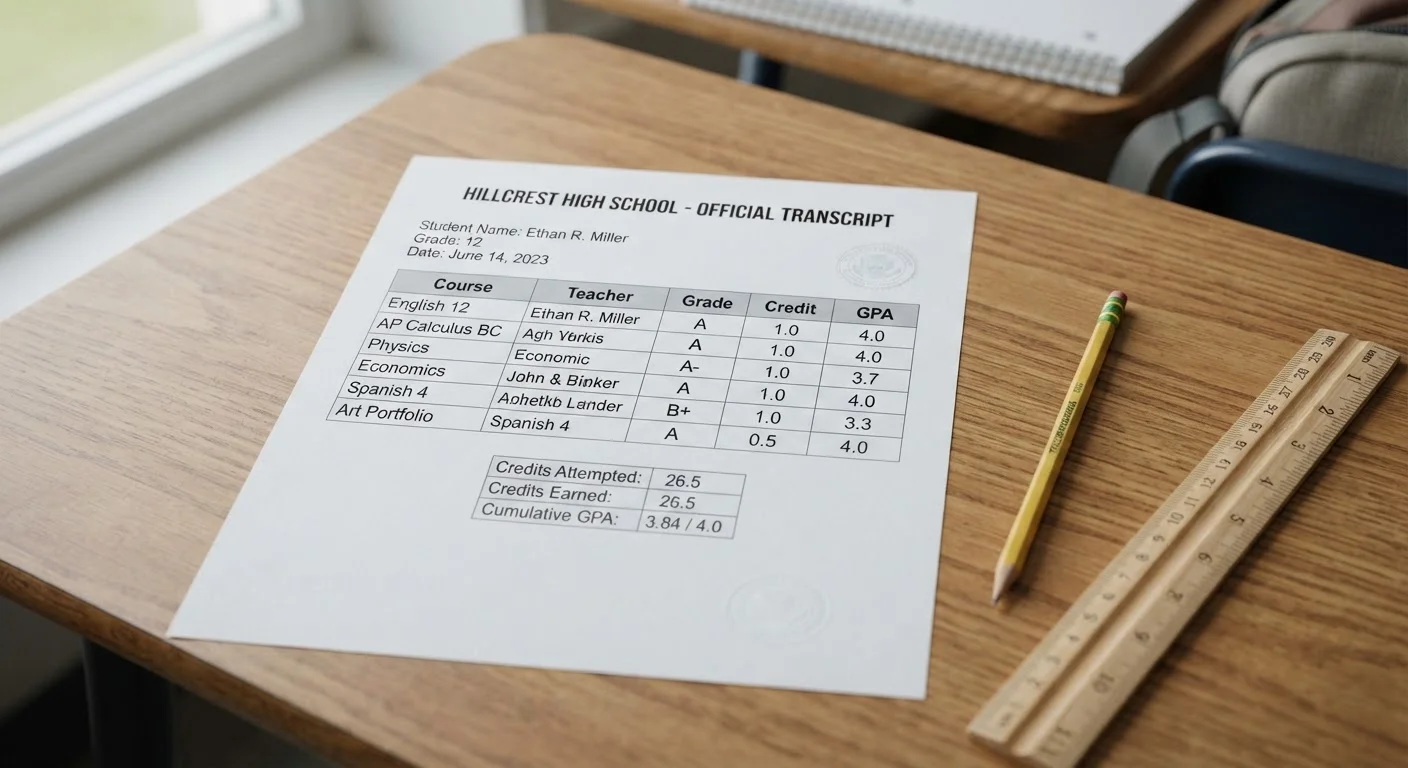
The Basics: How GPA Is Calculated
Grade Point Average starts with a simple translation of letter grades into numbers. In the most common U.S. system, an A equals 4.0, a B equals 3.0, a C equals 2.0, a D equals 1.0, and an F equals 0. A student's GPA is the average of those point values across all courses taken.
This straightforward approach is called an unweighted GPA. Every course - whether basic English or honors chemistry - contributes the same maximum of 4.0 points. Two students with a 3.8 unweighted GPA may have taken dramatically different course loads, but that number won't reveal it.
To understand where GPA fits in the bigger picture of American schooling, see our overview of the U.S. K-12 system, which covers how grades and coursework are structured from kindergarten through senior year.
What Weighted GPA Actually Does
Weighted GPA introduces a course-difficulty multiplier. Schools typically assign bonus points to three tiers: standard (no bonus), honors (often +0.5), and AP or International Baccalaureate - IB - courses (often +1.0). That shifts the scale's ceiling from 4.0 to 5.0.
So a student who earns an A in an AP course might receive 5.0 points for that class rather than 4.0, while a B in the same course might earn 4.0 instead of 3.0. The intent is to reward academic ambition - taking harder courses shouldn't automatically penalize a student's GPA relative to a peer in easier classes.
55%+
High schools that offer AP courses
According to College Board data, more than half of U.S. high schools participate in the AP program, though access to specific AP courses varies widely by school and district.
~50%
High schools that no longer report class rank
The National Association for College Admission Counseling has tracked a long-term decline in class rank reporting, with roughly half or fewer of high schools now including it on transcripts.
The catch is that no national standard governs how weighting works. One district might weight dual-enrollment college courses; another might not. Some schools cap which courses qualify; others apply weighting more broadly. This inconsistency is exactly why a weighted 4.0 from one school cannot be directly compared to one from another.
How Class Rank Adds Context
Class rank orders students within their graduating class from highest to lowest GPA, expressed either as a specific number (e.g., 12 out of 350) or a percentile (top 5%). It answers a question a raw GPA cannot: how does this student perform relative to peers who attended the same school, took similar courses, and were graded by the same teachers?
Class rank has become less common - many high schools, particularly more competitive private schools, have eliminated it to reduce pressure and grade competition. According to data from the National Association for College Admission Counseling, fewer than half of high schools now report class rank to colleges.
“A GPA is only meaningful in context. Admissions readers are trained to interpret a transcript alongside the school profile - the course offerings, the grading scale, and the academic environment all shape what a number actually tells us.”
— An admissions professional at a U.S. university, College admissions educator and counselor
When class rank is reported, it gives colleges a powerful piece of context. A 3.6 GPA that ranks a student in the top 10% of a rigorous school tells a very different story than a 3.6 that falls in the middle of the class.
How Colleges Actually Interpret All of This
Because high schools use such varied grading systems, most colleges recalculate GPAs on their own terms. Admissions offices typically strip away a school's weighting and rebuild the GPA using a standardized formula - often counting only core academic courses like English, math, science, social studies, and foreign language.
This recalculation creates a more level comparison across applicants from thousands of different schools. A student from a school with grade inflation doesn't automatically benefit, and a student from a rigorous school with tougher grading isn't unfairly penalized.
Ask Your School Counselor for the Profile
High school counselors send a school profile to colleges along with your transcript. Asking to see this document helps you understand how your GPA and course choices are being presented to admissions offices. It often includes grading scale details, course rigor information, and context that numbers alone don't convey.
Colleges also read school profiles - documents that high school counselors send alongside transcripts - to understand the grading scale, course offerings, and academic context of each applicant's school. A student who took the most challenging available courses at their school, even if that school offers few AP classes, is viewed differently from a student who avoided rigor at a school with abundant options.
This admissions complexity is explored further in our article on why strong grades alone won't guarantee college admission, which examines what holistic review really considers beyond GPA.
What Students and Families Should Keep in Mind
Understanding GPA weighting matters most when students are making course choices and when families are interpreting college application outcomes. A few practical points worth knowing:
- Challenge matters as much as the number. Colleges generally prefer a slightly lower GPA in rigorous courses over a perfect GPA in easy ones.
- Your school's scale shapes your number. A 3.9 at a school on a 100-point scale or a school with strict grading is not the same as a 3.9 somewhere else - and admissions offices know this.
- Weighted GPAs above 4.0 can be confusing. If a student reports a 4.6 GPA, that figure only makes sense in the context of the school's weighting system.
- Class rank, when available, is worth noting. It provides the peer-comparison context that a standalone GPA number lacks.
For students considering post-secondary options, our overview of community college versus four-year university trade-offs explains how admissions standards - including GPA expectations - differ across types of institutions.
Frequently Asked Questions
An unweighted GPA uses a standard 0-4.0 scale where an A equals 4.0 in every course. A weighted GPA adds extra points for difficult courses such as AP or honors classes, often raising the maximum possible GPA to 5.0. Weighted GPAs are meant to reflect course rigor, not just grade achievement.
Yes, on a weighted scale it is possible to exceed 4.0 if a student earns A grades in honors or AP courses that carry extra grade points. On a traditional unweighted scale, 4.0 is the maximum. Schools vary in how high their weighted scales go.
Most colleges recalculate an applicant's GPA using their own internal formula rather than relying solely on the school-reported figure. This recalculation often uses an unweighted or standardized weighted scale so all applicants can be compared fairly, regardless of their high school's grading system.
Class rank is a student's position within their graduating class based on GPA, showing how they compare to peers at the same school. Its use has declined - many high schools no longer report it - but when available, it helps colleges understand a GPA in context. Some competitive programs still value it highly.
On an unweighted scale, a B in an AP course counts the same as a B in a standard course, which can lower GPA. However, most weighted systems offset this by adding extra points for rigorous courses. Admissions reviewers also generally view a strong performance in challenging coursework favorably.
The content provided on our blog site traverses numerous categories, offering readers valuable and practical information. Readers can use the editorial team’s research and data to gain more insights into their topics of interest. However, they are requested not to treat the articles as conclusive. The website team cannot be held responsible for differences in data or inaccuracies found across other platforms. Please also note that the site might also miss out on various schemes and offers available that the readers may find more beneficial than the ones we cover.