

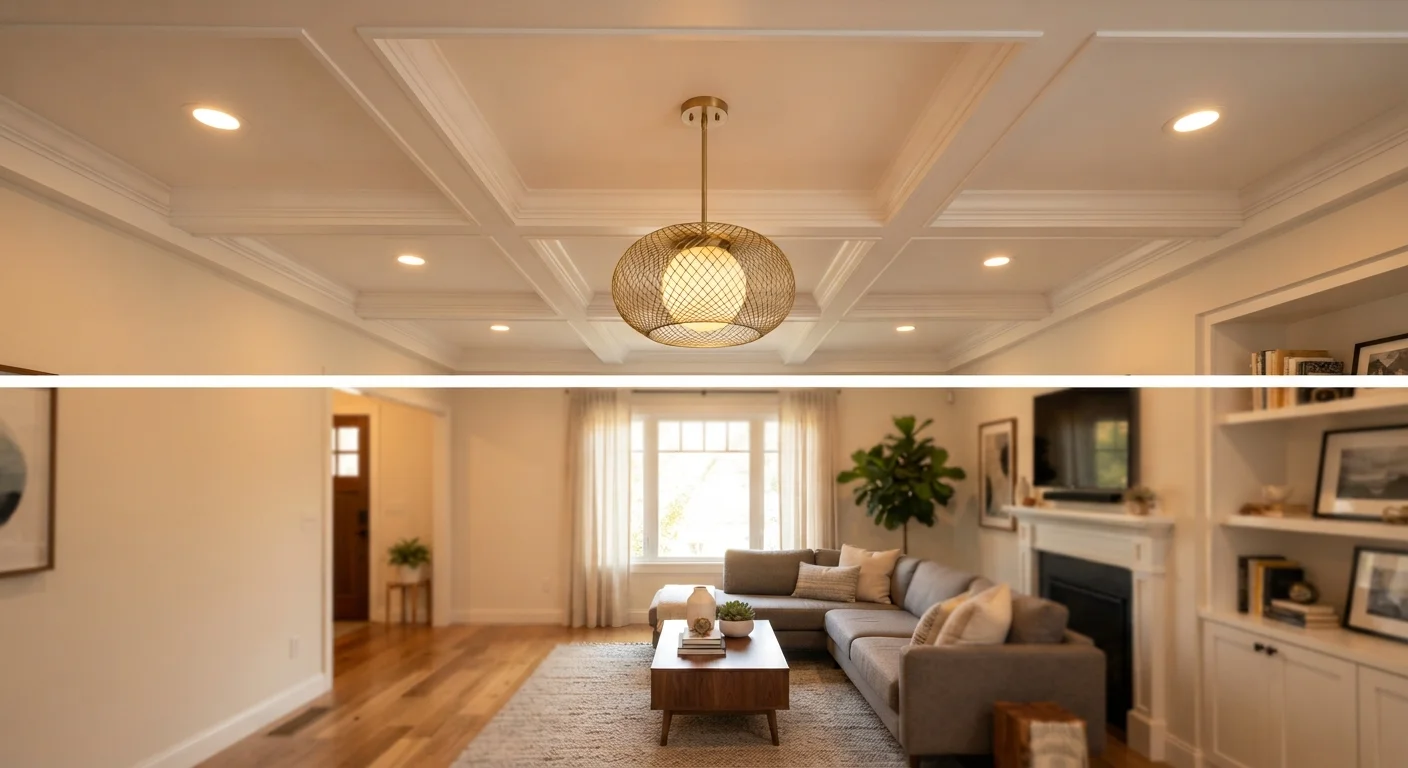
Option A
Recessed Lighting
The flush, built-in option for a clean ceiling look.
Best for: Homeowners with accessible attic space or open joist bays who want a streamlined, unobtrusive ceiling appearance.
Option B
Surface-Mount Fixtures
The straightforward, versatile choice for most ceilings.
Best for: Renters, those with finished ceilings or no attic access, and anyone wanting a simpler installation without cutting into drywall.
What Each Setup Actually Requires
At first glance, recessed lights and surface-mount fixtures seem like a simple style decision. In practice, they represent very different installation projects - and the wrong choice for your ceiling can mean unexpected costs or code issues.
Recessed lighting (also called can lights or pot lights) is installed inside the ceiling cavity. Installing them requires cutting circular holes in drywall, running electrical wire through the joist bays, and - critically - having enough space above the ceiling to work. In most cases, that means either an accessible attic or an open floor cavity above. For ceilings with insulation directly above them, you must use fixtures rated IC (Insulation Contact), which are designed to safely touch insulation without becoming a fire hazard.
Surface-mount fixtures mount directly onto the ceiling surface, supported by an electrical box that's already in place (or one you add). There's no ceiling cutting beyond a standard round or octagonal box hole. Because the fixture sits on the surface rather than inside it, installation is largely independent of what's above your ceiling - making these fixtures workable on concrete ceilings, drop-ceiling tiles, or anywhere with limited above-ceiling access.
| Criterion | Recessed Lighting | Surface-Mount Fixtures |
|---|---|---|
| Ceiling modification required | Yes - holes cut in drywall | Minimal - standard box hole only |
| Above-ceiling access needed | Usually yes (attic or open cavity) | No |
| Insulation compatibility | Requires IC-rated fixture | Not a concern |
| Typical DIY difficulty | Moderate to high | Low to moderate |
| Air sealing concerns | Yes - can leak conditioned air | None |
| Light distribution | Directional, requires spacing plan | Broader spread from single point |
| Suitable for concrete ceilings | Rarely practical | Yes, with correct anchors |
| LED compatible | Yes | Yes |
Installation Complexity and Ceiling Compatibility
Recessed lighting installation involves several steps that go beyond typical fixture swaps: cutting precise holes, fishing wire between joist bays (sometimes through insulation or fire blocking), securing the housing to joists or using remodel-style clips, and ensuring the fixture is flush and level. First-time installers often underestimate how much time the wiring alone can take. Running new circuits always requires a permit and, in many jurisdictions, a licensed electrician - check your local building department before starting.
Surface-mount installation, by contrast, is one of the more beginner-friendly electrical tasks in a home. If an electrical box is already present - which it will be if you're replacing an existing light - the job is mostly mechanical: attach the mounting bracket, connect the wires (black to black, white to white, ground to ground), and secure the fixture canopy. The entire process can take under an hour for most homeowners comfortable with basic electrical safety.
Permits and Electrical Code
Adding new recessed lighting to a circuit - or running a brand-new circuit - typically requires an electrical permit in most US jurisdictions. Working without one can create problems when you sell your home or file an insurance claim. Even if you're comfortable with DIY electrical work, check with your local building department first. Many areas require that new circuit work be inspected by a licensed electrician.
One often-overlooked factor: air sealing. Recessed light housings create holes in the ceiling plane, and standard (non-airtight) cans can allow conditioned air to escape into the attic, reducing your home's energy efficiency. Look for AT (airtight) rated fixtures if energy performance matters - or plan to seal around them during installation.
Energy Use, Light Quality, and Long-Term Considerations
Both fixture types are fully compatible with LED bulbs, which use significantly less energy than older incandescent or halogen lamps. That said, there are some meaningful differences in how they perform over time.
Recessed fixtures tend to concentrate light downward in a cone pattern, which can create bright spots and darker areas between fixtures if spacing isn't planned carefully. Using multiple cans requires careful layout planning - a general guideline is to space them roughly half their beam spread apart, though room shape and ceiling height affect this. Surface-mount fixtures, especially those with diffuser panels or globe shades, tend to spread light more broadly from a single point.
75%
Energy savings vs. incandescent bulbs
According to the U.S. Department of Energy, LED bulbs use about 75% less energy than traditional incandescent lighting and last significantly longer.
IC + AT
Key ratings for safe recessed installs
Fixtures installed where insulation is present should carry both IC (Insulation Contact) and AT (Airtight) ratings to prevent fire risk and minimize energy loss.
From a maintenance standpoint, surface-mount fixtures are easier to access for bulb changes and cleaning. Recessed fixtures - especially those with trim rings that clip into place - can be fussier to service, and some integrated LED models aren't designed for bulb replacement at all.
If you're weighing other structural upgrades alongside your lighting project, the same principle of matching the solution to your specific space applies. Just as we explore in our raised beds vs. in-ground planting comparison, the right setup depends on the constraints and goals of your particular environment - not just on what looks appealing in a showroom.
This article is for general informational purposes only. Electrical work involves real safety risks; always follow local codes, turn off circuit breakers before working on wiring, and consult a licensed electrician when in doubt about the scope or safety of a project.
The content provided on our blog site traverses numerous categories, offering readers valuable and practical information. Readers can use the editorial team’s research and data to gain more insights into their topics of interest. However, they are requested not to treat the articles as conclusive. The website team cannot be held responsible for differences in data or inaccuracies found across other platforms. Please also note that the site might also miss out on various schemes and offers available that the readers may find more beneficial than the ones we cover.