

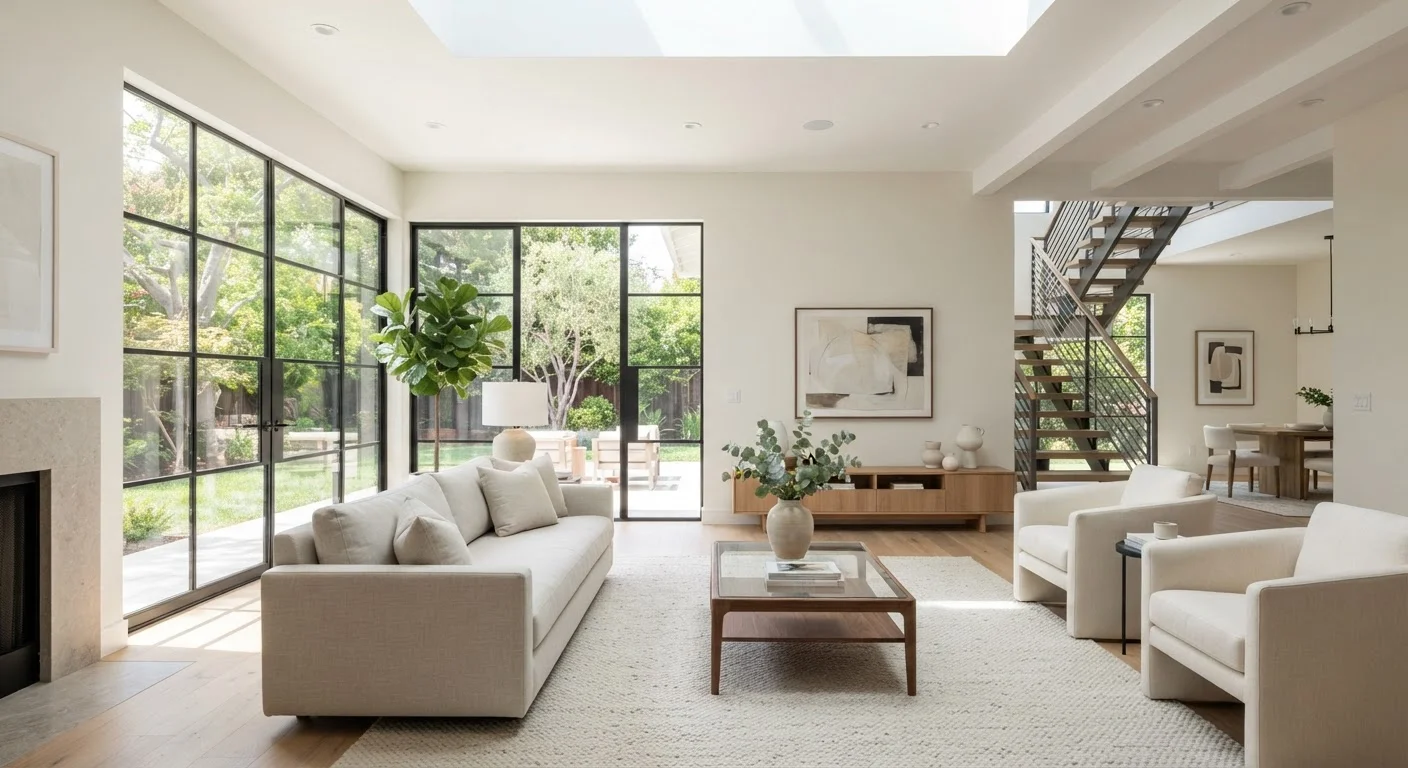
Where the White Ceiling Rule Comes From
The advice to paint ceilings white is one of the most repeated guidelines in home decorating, and it has a legitimate foundation. White reflects more light than any other color, and when a ceiling bounces light back into a room, the space tends to feel more open and airy. In rooms with low ceilings or limited natural light, this effect can be genuinely useful.
The rule also has roots in practical simplicity. White ceiling paint is widely available, inexpensive, and pairs neutrally with almost any wall color - which made it a sensible default for builders and landlords alike. Over decades, that practical default calcified into a design "rule" that homeowners now treat as universal truth.
The problem is that design spaces are rarely universal. Room shape, ceiling height, wall color, trim color, and available natural light all interact to create the final visual impression. A principle that works well in one context can produce the opposite effect in another.
Myths and Facts About Ceiling Color
Before making decisions about your ceiling, it helps to understand which commonly held beliefs hold up - and which ones don't. The following myth-fact pairs address the most persistent misconceptions homeowners encounter.
Myth
Painting your ceiling white will always make the room feel bigger.
Fact
White helps reflect light, but the sense of spaciousness depends on the relationship between ceiling, wall, and trim colors - not ceiling color alone.
When walls are very dark and the ceiling is stark white, the high contrast can actually draw the eye to the boundary between wall and ceiling, emphasizing the room's edges rather than dissolving them. A ceiling color that closely matches or subtly complements the wall color tends to blur that boundary and create a more expansive feel in many cases.
Myth
The ceiling should always be lighter than the walls.
Fact
Darker ceilings are a well-established design technique that many professional interior designers use intentionally to add depth and warmth.
Painting a ceiling one or two shades darker than the walls - especially in rooms with tall ceilings - can ground a space and make it feel more purposefully designed. This approach is commonly used in dining rooms, studies, and bedrooms. The effect works best when the wall-to-ceiling transition is clean and the room has adequate lighting at the wall level.
Myth
Ceiling paint sheen doesn't matter - flat white is always the right choice.
Fact
Ceiling sheen affects how light behaves in the room and whether imperfections are visible. The right sheen depends on the ceiling's condition and the room's function.
Flat paint minimizes the appearance of surface flaws - which is why it is commonly recommended for ceilings. However, in high-humidity rooms like kitchens and bathrooms, a flat finish can be difficult to clean and may absorb moisture. In those rooms, an eggshell or satin finish provides more durability. In pristine rooms with smooth ceilings, a very low-sheen satin can add a subtle luminosity that flat paint cannot.
Myth
The ceiling color has little impact on how wall colors look.
Fact
Ceiling color reflects light downward and significantly influences how wall colors and furnishings appear throughout the day.
Paint reflects its color onto surrounding surfaces through a process called color bounce. A yellow-tinted ceiling casts a warm light that shifts cool blues on the walls toward green. A stark blue-white ceiling can cool down warm wall tones in ways that weren't expected from looking at paint chips. When selecting wall colors, it is worth sampling them under the existing ceiling color - or your intended new one - rather than evaluating them in isolation.
When a Non-White Ceiling Actually Works Better
There are situations where choosing a color other than white produces a more intentional, livable result.
- Rooms with very high ceilings: A soaring ceiling in a narrow room can feel cold and cavernous. Painting it a warm mid-tone - even a soft greige or dusty blue - visually lowers it just enough to make the space feel proportional and comfortable rather than echoey.
- Rooms meant to feel intimate: Dining rooms, home libraries, and bedrooms often benefit from a cozier atmosphere. A ceiling painted two to three shades deeper than the walls creates an enveloping effect that many people find restful rather than oppressive.
- Rooms with strong natural light: If your space receives direct sunlight for much of the day, a pure white ceiling can produce harsh glare. An off-white or soft warm tone diffuses the light more gently without sacrificing brightness.
Don't Skip the Sample Step
Ceiling paint is one of the most labor-intensive surfaces to repaint, so committing to the wrong color is a costly mistake. Paint at least one large sample patch on the ceiling itself and observe it at different times of day - morning, midday, and evening under artificial light. Colors shift significantly depending on light source and angle.
The key in all of these scenarios is intention. Choosing a non-white ceiling color should be a deliberate design decision based on how the room functions, not a default. Test a large sample patch - at least 12 by 12 inches - on your actual ceiling before committing, since ceiling paint looks considerably different overhead than it does on a vertical surface or paint chip.
For more on getting a clean, professional result regardless of color, see our guide to interior painting techniques - the same principles of prep and execution apply to ceilings as they do to walls.
The content provided on our blog site traverses numerous categories, offering readers valuable and practical information. Readers can use the editorial team’s research and data to gain more insights into their topics of interest. However, they are requested not to treat the articles as conclusive. The website team cannot be held responsible for differences in data or inaccuracies found across other platforms. Please also note that the site might also miss out on various schemes and offers available that the readers may find more beneficial than the ones we cover.