

Why Fastener Choice Matters
Walk into any hardware store and you'll find entire aisles dedicated to fasteners - the small but essential hardware that holds your home together. Picking the wrong one doesn't just mean a loose shelf; it can mean a stripped hole, a cracked wall, or a fixture that fails entirely. Whether you're hanging a mirror, building a deck frame, or anchoring a bookcase to drywall, understanding fastener basics is one of the most practical skills a homeowner can have.
If you're new to home improvement overall, see our first-timer's introduction to home improvement for a broader foundation before you start any project.
| Screw vs. nail holding strength | Screws resist pull-out forces significantly better than nails of the same size (General carpentry best practice) |
| Stud spacing (standard US framing) | 16 inches on center (some homes use 24 inches) (International Residential Code (IRC)) |
| Typical drywall thickness | ½ inch (most walls); ⅝ inch (ceilings, fire-rated walls) (Standard residential construction) |
| Anchor weight ratings | Vary widely - from 10 lbs (plastic plugs) to 100+ lbs (toggle bolts) (Manufacturer specifications vary by product) |
| Most common screw drive type | Phillips (#2) and square-drive (Robertson) for most home projects (General hardware industry standard) |
Screws: The Everyday Workhorse
Screws are threaded fasteners designed to be driven into a material - wood, metal, drywall, or masonry - using a screwdriver or drill. Unlike nails, their helical threads grip surrounding material tightly, making them far easier to remove and generally stronger against pull-out forces.
Common Screw Types
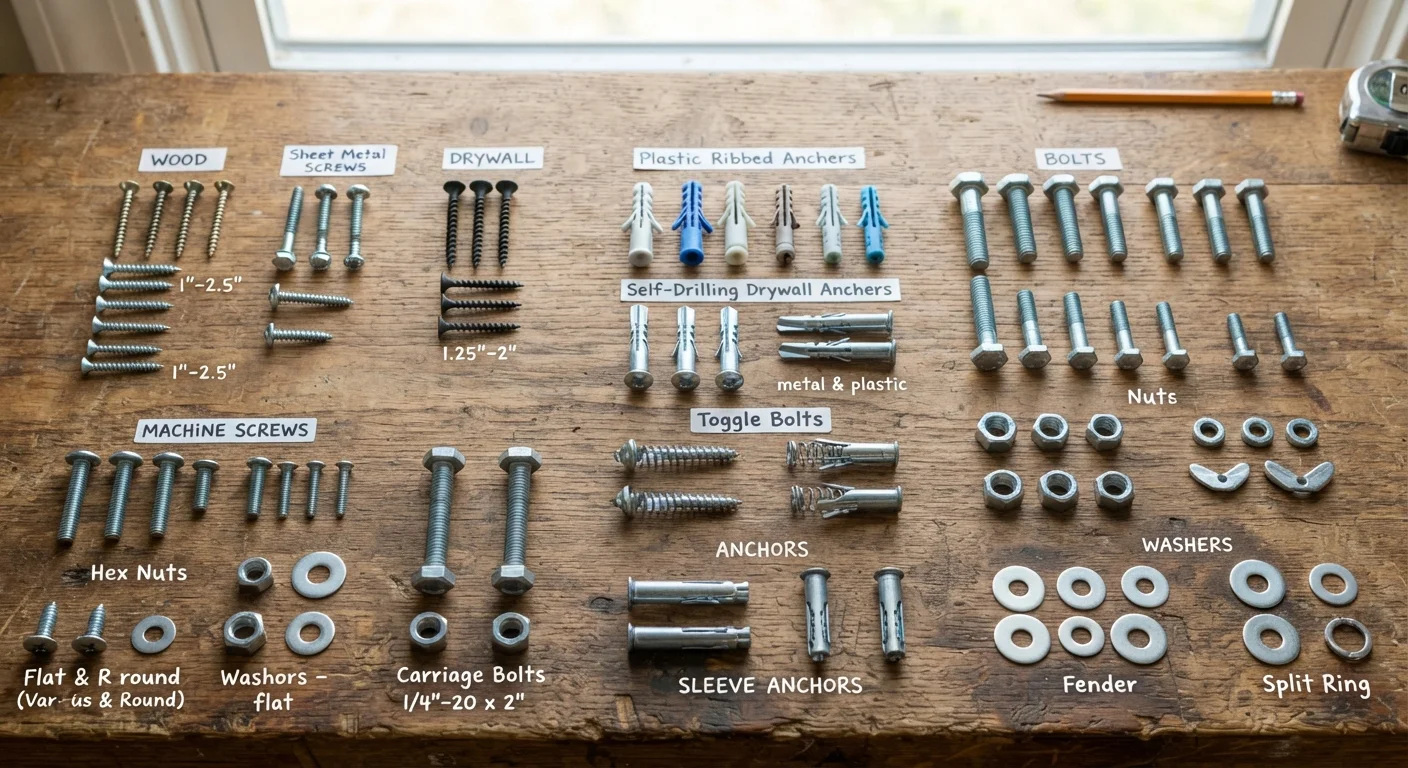
- Wood screws: Tapered shank and coarse threads designed for wood-to-wood connections. Use these for furniture assembly, cabinet installation, and general carpentry.
- Drywall screws: Fine-threaded and phosphate-coated for corrosion resistance. Specifically designed to attach drywall panels to wood or metal studs - not a general-purpose screw.
- Deck screws: Coated for exterior moisture resistance. Use for decking boards and outdoor lumber projects.
- Sheet metal screws: Self-tapping, with threads running the full length of the shank. Use when fastening thin metal panels or HVAC ducting.
When choosing screw length, a general rule of thumb is that roughly two-thirds of the screw should penetrate the base material being fastened into.
Thread pitch
The spacing between the helical ridges (threads) on a screw or bolt. Coarse threads grip wood and soft materials well; fine threads are used for metal and precision applications.
Shear force
A force that acts parallel to a fastener's length, trying to slide two joined materials sideways past each other. Bolts and carriage bolts resist shear forces well.
Pull-out force
The force required to pull a fastener straight out of the material it's embedded in. Screw threads increase resistance to pull-out compared to nails.
Substrate
The base material that a fastener is being driven into - for example, wood, drywall, concrete, or metal. Choosing the right fastener depends heavily on substrate type.
Self-tapping
A screw capable of cutting its own threads as it is driven into a material, eliminating the need for a pre-tapped hole. Common in sheet metal and some plastic applications.
Lag screw
A large, heavy-duty wood screw with a hex head, driven with a wrench rather than a screwdriver. Used for structural wood connections that require significant holding strength.
Bolts and Nuts: Heavy-Duty Connections
Bolts differ from screws in a fundamental way: they pass through a material and are secured on the other side with a nut. This through-fastening creates a clamping force that resists both pull-out and shear forces - making bolts the right choice when joints bear real load.
Common Bolt Types
- Hex bolts: Six-sided head, tightened with a wrench. Used in structural connections, machinery, and metal-to-metal applications.
- Carriage bolts: Smooth, rounded head with a square neck that locks into wood as the nut is tightened. Common for deck railings and fence construction.
- Lag bolts (lag screws): Extra-large wood screws driven without a nut, typically with a hex head and wrench. Use to anchor ledger boards, heavy beams, or structural lumber.
Always pair bolts with the correct washer size to distribute load across a wider surface area and prevent the nut from digging into the material.
Anchors: Fastening Into Hollow or Weak Substrates
Anchors solve a specific problem: what do you do when there's no stud, solid wood, or stable material to fasten into? They expand, toggle, or sleeve inside a hollow wall or brittle surface to create a secure grip.
Check Weight Ratings Before You Install
Every wall anchor has a published weight rating, but that rating assumes correct installation into undamaged drywall of standard thickness. Overloading an anchor - or installing it into crumbling or water-damaged drywall - dramatically reduces its holding strength. When hanging anything heavy, such as large mirrors, shelving loaded with books, or mounted TVs, always prioritize finding a wall stud over relying on hollow-wall anchors alone.
Common Anchor Types
- Plastic expansion anchors: Basic ribbed plugs that expand as a screw is driven in. Best for light-duty tasks (picture hooks, small shelving brackets) in drywall or plaster.
- Toggle bolts: Feature spring-loaded wings that open behind the wall cavity. Capable of supporting moderate-to-heavy loads in hollow walls when installed correctly.
- Self-drilling drywall anchors (E-Z anchors): Drill directly into drywall without a pre-drilled hole. Good for medium-duty loads like towel bars or lightweight shelves.
- Concrete anchors (wedge or sleeve anchors): Designed for masonry and concrete. Require drilling with a hammer drill and a masonry bit before insertion.
Always respect the manufacturer's stated weight rating for any anchor. When in doubt, find the stud - a fastener driven into solid framing will almost always outperform a hollow-wall anchor.
Quick Selection Guide
Matching the fastener to the task doesn't require memorizing every variant - it mainly requires asking three questions: What materials am I joining? What load will this connection bear? Is there solid material to fasten into?
| Task | Best Fastener |
|---|---|
| Hanging a picture on drywall (no stud) | Plastic expansion anchor + wood screw |
| Assembling wood furniture | Wood screws |
| Mounting a TV bracket to studs | Lag screws or structural wood screws |
| Building a deck or fence | Carriage bolts + deck screws |
| Attaching shelving to concrete | Wedge or sleeve concrete anchors |
| Installing a heavy towel bar in drywall | Toggle bolts or self-drilling anchors |
16"
Standard stud spacing in US homes
Most American residential framing places wall studs 16 inches apart on center, per the International Residential Code.
3 Questions
Key decisions before choosing any fastener
Material type, load bearing requirement, and substrate availability determine the correct fastener in virtually every home project.
When a project involves structural connections - such as attaching a ledger board to a house or supporting overhead loads - consult local building codes and consider having the work reviewed by a qualified contractor. Structural failures can be dangerous and are rarely worth the savings from skipping professional guidance.
The content provided on our blog site traverses numerous categories, offering readers valuable and practical information. Readers can use the editorial team’s research and data to gain more insights into their topics of interest. However, they are requested not to treat the articles as conclusive. The website team cannot be held responsible for differences in data or inaccuracies found across other platforms. Please also note that the site might also miss out on various schemes and offers available that the readers may find more beneficial than the ones we cover.