

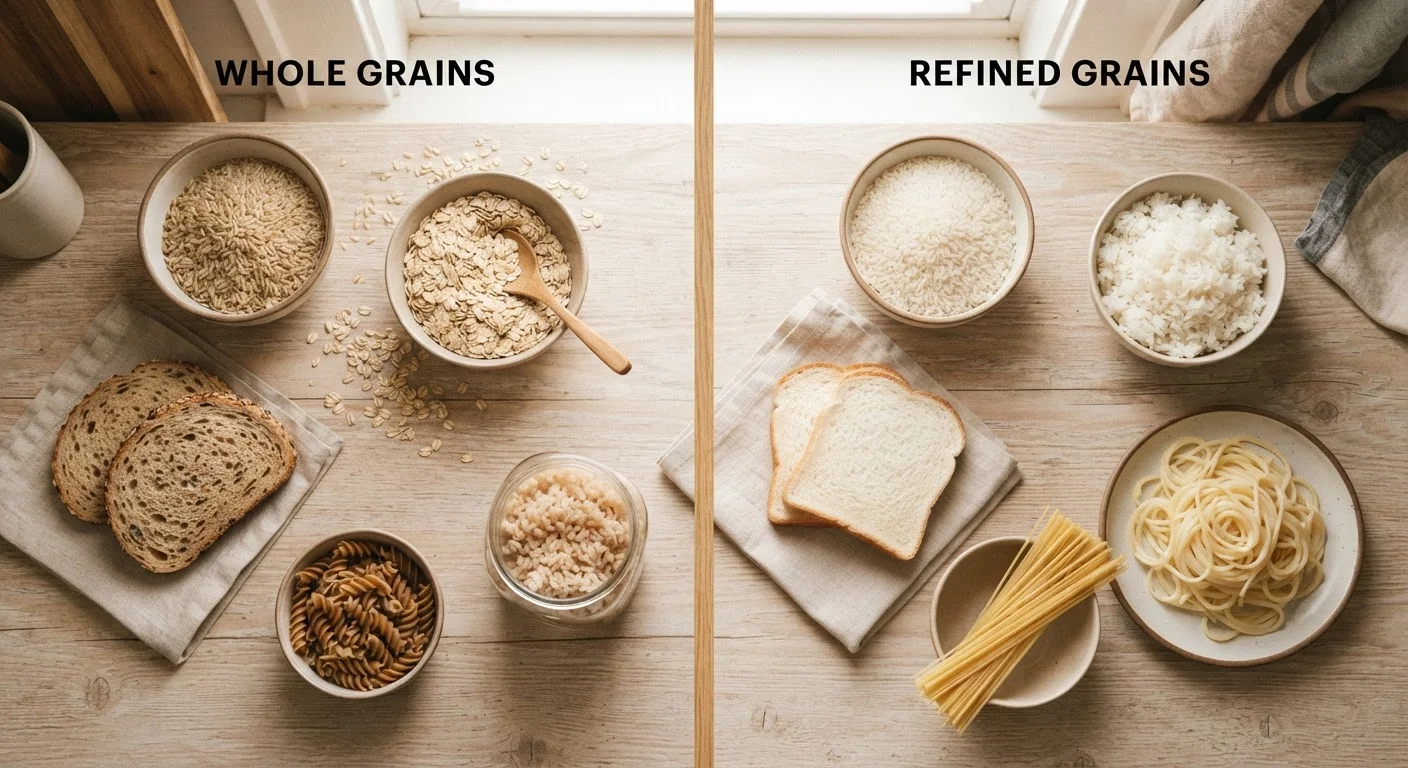
Option A
Whole Grains
The nutritionally complete, minimally processed option.
Best for: People seeking more fiber, vitamins, and long-term metabolic health benefits from their carbohydrate choices.
Option B
Refined Grains
The widely available, texture-optimized, partially stripped alternative.
Best for: Situations requiring longer shelf life, specific textures, or when enriched varieties are a dietary staple in otherwise balanced eating.
What Refining Actually Does to a Grain
A grain kernel has three parts: the outer bran, the nutrient-rich germ, and the starchy endosperm. Whole grains retain all three. Refined grains - white flour, white rice, most commercial bread - have had the bran and germ removed, leaving almost exclusively starch.
That milling process dramatically changes the nutritional profile. The bran is where most of the fiber lives. The germ carries vitamin E, B vitamins (thiamine, folate, niacin), and healthy fats. Strip both away and you're left with a product that digests quickly, has a longer shelf life, and a finer texture - but significantly less nutritional value.
Many refined grains sold in the U.S. are enriched, meaning a subset of nutrients (typically iron and certain B vitamins) are added back after processing. However, fiber - perhaps the most consequential loss - is rarely restored. Enrichment partially compensates, but it doesn't replicate what a whole grain naturally provides.
| Criterion | Whole Grains | Refined Grains |
|---|---|---|
| Parts of kernel retained | Bran, germ, and endosperm | Endosperm only |
| Fiber content | High | Low (rarely restored) |
| Vitamins & minerals | Naturally rich (B vitamins, vitamin E, iron) | Mostly removed; some re-added via enrichment |
| Blood sugar response | Slower, more gradual rise | Faster, sharper rise |
| Shelf life | Shorter (oils in germ can go rancid) | Longer |
| Texture & palatability | Denser, chewier | Lighter, softer |
| Chronic disease association | Lower risk in research | Higher risk with heavy intake |
What the Research Actually Shows
The evidence linking whole grain consumption to health outcomes is extensive and consistent. Studies published in major peer-reviewed journals, as well as reviews cited by the American Heart Association and the Harvard T.H. Chan School of Public Health, associate higher whole grain intake with:
- Reduced risk of cardiovascular disease
- Lower rates of type 2 diabetes
- Improved digestive health and microbiome diversity
- More stable blood glucose responses compared to refined grains
The fiber in whole grains slows the digestion of carbohydrates, which moderates the rise in blood sugar after eating. This glycemic effect is one reason whole grains appear protective against insulin resistance over time.
3 servings/day
Whole grain intake linked to reduced heart disease risk
Research synthesized by the Whole Grains Council and cited in multiple cardiovascular health reviews suggests this level of intake is associated with measurable risk reduction.
~5%
Americans meeting whole grain recommendations
Dietary intake data from national nutrition surveys consistently shows the vast majority of U.S. adults fall significantly short of the recommended whole grain target.
25%
Lower type 2 diabetes risk with higher whole grain intake
A widely cited meta-analysis published in the journal Nutrients found this approximate risk reduction among people with the highest whole grain consumption compared to the lowest.
It's worth noting that most large studies are observational - meaning they show associations, not definitive cause and effect. Diet is complex, and people who eat more whole grains often have other health-supporting habits too. Still, the breadth and consistency of findings across different populations makes the relationship difficult to dismiss.
For a broader look at eating frameworks that incorporate whole grains as a foundation, see our guide on eating patterns backed by actual research.
How to Make Practical Swaps Without Overhauling Everything
The U.S. Dietary Guidelines recommend that at least half of all grain servings be whole grains - yet most Americans fall well short of that target. Closing that gap doesn't require dramatic dietary changes.
Effective, low-friction strategies include:
- Choosing oatmeal or whole grain cereal instead of processed breakfast cereals
- Swapping white rice for brown rice, farro, barley, or quinoa
- Using whole wheat bread or wraps in place of white versions
- Trying whole wheat pasta - newer varieties have improved considerably in texture and taste
Reading labels matters here. Words like "multigrain" or "made with whole grains" don't guarantee a product is predominantly whole grain. Look for whole grain or whole wheat listed as the first ingredient on the label. Our guide to smarter grocery shopping habits covers label-reading strategies in more depth.
A Note on Gluten and Grain Sensitivity
Many whole grains - including wheat, barley, and rye - contain gluten. For people with celiac disease or non-celiac gluten sensitivity, whole grain options like oats (certified gluten-free), brown rice, quinoa, and buckwheat are naturally gluten-free alternatives. If you suspect a gluten-related condition, consult a healthcare provider before making significant dietary changes.
If you're exploring a plant-focused diet - where grains often play a larger role - it's worth understanding how to select them wisely. Our article on plant-based eating essentials addresses what to plan for when grains become a bigger part of your plate.
This article provides general nutrition information for educational purposes and is not a substitute for personalized advice from a registered dietitian or qualified healthcare professional.
The content provided on our blog site traverses numerous categories, offering readers valuable and practical information. Readers can use the editorial team’s research and data to gain more insights into their topics of interest. However, they are requested not to treat the articles as conclusive. The website team cannot be held responsible for differences in data or inaccuracies found across other platforms. Please also note that the site might also miss out on various schemes and offers available that the readers may find more beneficial than the ones we cover.