
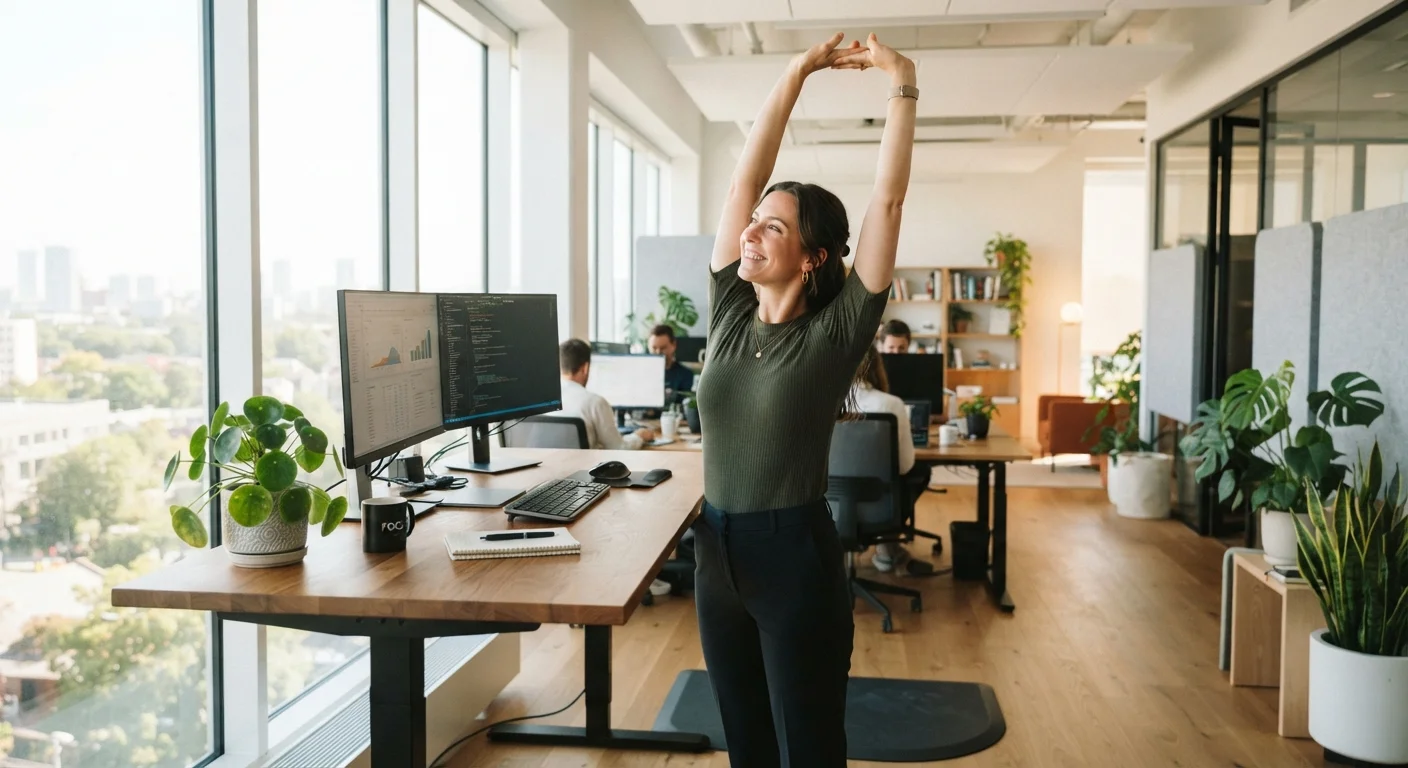
Why Sitting All Day Is Worth Taking Seriously
Most American adults spend the majority of their waking hours seated - at a desk, in a car, or on a couch. Research published in journals such as the Annals of Internal Medicine has linked prolonged sedentary time to increased risks of cardiovascular disease, type 2 diabetes, and all-cause mortality, independent of whether a person exercises outside of work. In other words, a 30-minute morning run does not fully cancel out eight hours of sitting.
That doesn't mean desk workers are doomed. The evidence also shows that breaking up sitting time with even brief movement - two to five minutes every hour - can meaningfully offset some of these risks. The challenge is building habits that hold up against back-to-back meetings, deadlines, and the sheer inertia of a seated routine. The strategies below are practical, low-barrier, and designed for real workdays rather than ideal ones.
Start With One Change, Not Six
When building new movement habits, resist the urge to overhaul your entire routine at once. Research on behavior change consistently shows that adopting one new habit at a time leads to better long-term adherence than attempting multiple changes simultaneously. Pick the single strategy most compatible with your workday and make it automatic before adding another.
Practical Ways to Move More at Your Desk Job
Set a recurring movement alarm
The simplest intervention is also one of the most evidence-supported: set an alarm or calendar reminder to stand and move for two to five minutes every 60 to 90 minutes. You don't need a destination - walk to the kitchen, do a few shoulder rolls, or pace while reviewing notes. Over an eight-hour workday, this adds up to 16-40 minutes of light movement that would otherwise be zero.
Smartphone alarms, smartwatch reminders, and free apps like Move Reminder or built-in screen-time tools all work. The key is making the cue automatic rather than relying on willpower mid-task.
A two-minute break every hour adds up to over 16 minutes of daily movement at no cost.
Use walking meetings strategically
One-on-one phone calls and audio-only check-ins are ideal candidates for walking meetings. Swapping even two or three seated meetings per week for walking versions can add several thousand extra steps - without requiring any time outside of your existing schedule.
Walking meetings tend to work best for brainstorming, status updates, and informal conversations rather than presentations or collaborative document editing. Let the other participant know in advance so they can prepare accordingly.
Walking during calls requires no extra time and can meaningfully increase your daily step count.
Try a standing desk or improvised alternative
Height-adjustable desks allow workers to alternate between sitting and standing throughout the day. Research suggests that replacing two to four hours of seated work with standing reduces blood sugar spikes after meals and eases lower-back discomfort in some people - though standing all day creates its own problems, including leg fatigue.
If a sit-stand desk isn't in your budget or workspace, a stable stack of books, a firm box, or a raised kitchen counter can serve as a temporary standing surface for a laptop. The goal is alternation, not elimination of sitting.
Alternating between sitting and standing - not standing all day - is the evidence-backed approach.
Add micro-exercises to natural transition points
Transition moments - finishing a task, waiting for a file to load, heading to the bathroom - are natural anchors for brief movement. Calf raises while standing at a printer, wall stretches before sitting back down, or 10 bodyweight squats before a video call are all low-effort additions that require no extra time blocks in your calendar.
Attaching a new habit to an existing routine (known in behavioral science as "habit stacking") significantly improves follow-through compared to treating movement as a standalone task.
Anchoring movement to existing routines - not carving out new time - is the key to habit stacking.
Walk or bike for part of your commute
For workers who commute, building movement into the travel itself is one of the highest-leverage changes available. Parking several blocks away, getting off public transit one stop early, or cycling part of the route can add 15-30 minutes of moderate-intensity activity without touching your actual workday schedule.
For remote workers, a short "fake commute" walk before and after work hours serves a dual purpose: it adds movement and creates a mental boundary between work and home life - a documented challenge for those working from home.
A short walk before and after remote work adds movement and a useful psychological boundary.
Redesign your workspace to require more movement
Small environmental changes make movement the path of least resistance. Placing your printer in another room, keeping a water bottle at your desk that you refill frequently (rather than a large jug), or positioning your trash can across the room all create low-effort reasons to stand and walk throughout the day.
This approach - altering the physical environment rather than relying on motivation - draws from behavioral economics research on choice architecture and tends to be more durable than willpower-based strategies. If you're thinking about workspace layout more broadly, some of the principles behind making small rooms work can also apply to optimizing a home office setup.
Redesigning your environment to require movement is more durable than relying on daily motivation.
If you're also thinking about how to structure other demanding parts of a busy schedule, the approach to movement mirrors what works for productivity: small, protected blocks of time compound over weeks. The same logic applies whether you're building a study routine around a full-time schedule or working movement into a workday.
Remote vs. Office Workers: Different Challenges
Remote workers often face more unbroken sedentary time than office workers because incidental movement - walking to a meeting room, chatting with a colleague across the floor - disappears entirely. If you work from home, the strategies above that build environmental friction (like placing your water refill station in another room) tend to be especially valuable. Office workers, by contrast, may have more natural interruptions but face social pressure to remain at their desks.
Making It Stick Over the Long Term
The most effective movement strategy is one you'll actually keep. That means choosing two or three of the options above - whichever fit your workspace, job type, and personality - rather than attempting to implement everything at once. Track your progress simply: a tally on a sticky note, an alarm on your phone, or a habit-tracking app all work equally well.
For workers who also exercise outside of work, combining regular workouts with reduced sitting throughout the day produces better health outcomes than either alone. If you're weighing your options for structured exercise, consider reading about home workouts vs. the gym to find an approach that fits your life alongside these daily movement habits.
This article is for general informational and educational purposes only and does not constitute medical advice. Consult a qualified healthcare professional before making significant changes to your physical activity level, especially if you have an existing health condition.
The content provided on our blog site traverses numerous categories, offering readers valuable and practical information. Readers can use the editorial team’s research and data to gain more insights into their topics of interest. However, they are requested not to treat the articles as conclusive. The website team cannot be held responsible for differences in data or inaccuracies found across other platforms. Please also note that the site might also miss out on various schemes and offers available that the readers may find more beneficial than the ones we cover.