
Our Verdict
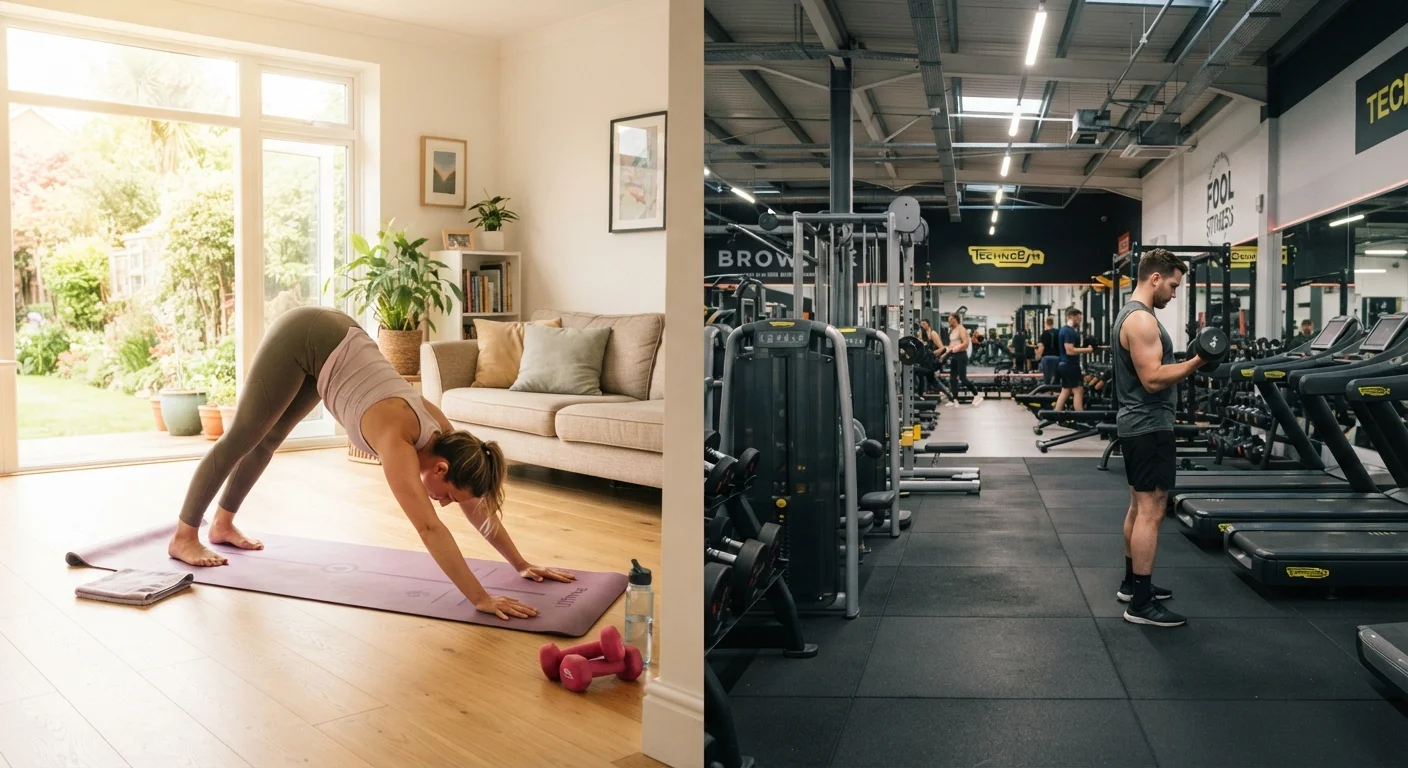
Home workouts and gym training are both legitimate, effective paths to better fitness. The gym wins on equipment range and structured environment; home wins on convenience and zero cost per session. What matters most is showing up consistently - and whichever setting makes that easier for you is the right one.
Home workouts suit budget-conscious or schedule-stretched individuals; gyms are ideal for those who need equipment variety, coaching access, or external accountability to stay on track.
Why This Decision Matters More Than Most People Think
Choosing where to exercise isn't a minor logistical question - it can determine whether you actually work out at all. Research consistently shows that adherence, not intensity, is the strongest predictor of long-term fitness outcomes. A perfectly designed program at a gym you rarely visit will always underperform a modest routine done regularly at home.
The good news: both settings are capable of producing meaningful health improvements. The U.S. Department of Health and Human Services recommends at least 150 minutes of moderate-intensity aerobic activity per week for most adults, along with muscle-strengthening activity on two or more days. That target is achievable in either a gym or a living room. What follows is an honest accounting of where each option helps - and where it falls short.
The Case for Working Out at Home
Home training has moved well beyond jumping jacks and push-ups. Resistance bands, adjustable dumbbells, pull-up bars, and bodyweight programming can cover the major movement patterns - push, pull, hinge, squat, and carry - that form the foundation of most sound fitness plans. For a deeper look at how to structure those movements, see our plain-language guide to resistance training.
Zero commute means fewer barriers to showing up
Eliminating travel time removes one of the top reasons people skip workouts. When a session is as close as your living room, fitting it into a busy day becomes significantly more practical.
No ongoing membership costs
After any upfront equipment investment, home training is essentially free per session. For budget-conscious individuals, this removes a recurring financial commitment that can become a source of stress.
Complete schedule flexibility
Home workouts can happen at 6 a.m. or 10 p.m., on holidays, or during a lunch break - no hours of operation, no waiting for equipment, no planning around class schedules.
Privacy and comfort for beginners
Many people starting out feel self-conscious exercising in public. Training at home removes that social pressure entirely, which can support consistency in the early months of building a habit.
The convenience factor is genuinely significant. Removing the commute eliminates one of the most commonly cited barriers to exercise. For people with desk-based jobs, pairing a short home session with other movement habits can meaningfully raise daily activity levels - strategies worth exploring in our piece on moving more with a desk job.
The Case for the Gym
A well-equipped gym offers something a home setup rarely can: a dedicated environment with no domestic distractions, a broad range of load and equipment options, and - in many facilities - access to qualified fitness professionals. For people learning to train, or those pursuing specific strength or conditioning goals, that infrastructure matters.
Limited equipment restricts progressive overload
Advancing strength over time requires progressively heavier loads or more complex movements. Without a range of weights or machines, home trainers must use creative programming workarounds that not everyone is equipped to design.
Gym memberships add a recurring financial cost
Monthly membership fees vary widely by facility type. For individuals on tight budgets, the ongoing expense can become a barrier - or a source of guilt when attendance is inconsistent.
Commute time adds friction to regular attendance
A gym that takes 20-30 minutes each way can effectively add an hour or more to each workout session, making it harder to sustain frequency during busy or stressful periods.
Home distractions can undermine session quality
Children, household chores, notifications, and the general pull of domestic life make it genuinely harder to focus during a home workout than in an environment purpose-built for exercise.
Lacks built-in accountability and coaching access
Gym environments often provide passive accountability - seeing others train, having staff present, or booking a class with a fixed time. Home exercisers must build these structures themselves, which requires consistent self-motivation.
The social dimension is worth taking seriously too. For many people, exercising around others creates accountability and energy that's genuinely hard to replicate alone. Group fitness classes and personal training sessions at a gym also provide structured progression - something that home trainers need to build deliberately on their own. If you're weighing cardio approaches within either setting, our comparison of HIIT vs. steady-state cardio can help you think through effort and recovery trade-offs.
What the Evidence Actually Says
150 min
Weekly aerobic activity recommended for adults
According to the U.S. Department of Health and Human Services Physical Activity Guidelines for Americans, most adults should aim for at least 150 minutes of moderate-intensity aerobic activity per week.
~50%
Adults who meet aerobic activity guidelines
CDC data indicates that roughly half of U.S. adults meet federal aerobic activity guidelines, suggesting the primary challenge is adherence rather than access to any specific exercise setting.
2x/week
Minimum muscle-strengthening days recommended
Federal physical activity guidelines recommend muscle-strengthening activities on two or more days per week - a target achievable with bodyweight exercises at home or resistance equipment at the gym.
Studies comparing home-based and gym-based exercise programs generally find comparable fitness outcomes when participants in both groups are similarly motivated and follow structured plans. A frequently cited finding in exercise science is that dropout rates - not programming - account for most of the difference in real-world results between settings.
One area where gyms hold a measurable edge is progressive overload for strength training. Having access to heavier loads and a wider range of equipment makes it easier to continue challenging muscles as they adapt. Home trainers can achieve this too - through tempo manipulation, increased volume, and resistance band progressions - but it requires more planning. If building an aerobic base is the priority, lower-intensity approaches like Zone 2 cardio are highly accessible at home with nothing more than a pair of walking shoes.
A Note on Equipment Costs at Home
Building a capable home gym doesn't require a large upfront investment. A set of resistance bands, a few adjustable dumbbells, and a pull-up bar can cover most fundamental movement patterns for a fraction of annual gym membership costs. However, those who want to pursue heavier barbell training or specialized cardio equipment will face substantially higher setup costs. It's worth being realistic about what your fitness goals actually require before purchasing equipment.
Making the Choice That Fits Your Life
Rather than treating this as a binary decision, many people benefit from a hybrid approach - using home sessions during high-pressure weeks and the gym when time and energy allow. The flexibility of that model, much like the trade-offs explored in our look at learning entirely online, is both its strength and its challenge: it requires self-direction.
A few honest questions can guide your decision: Do you have a realistic home space to exercise without constant interruption? Can you afford a gym membership without financial stress? Do you need a coach's eye to learn new movements safely, or are you comfortable self-directing with quality online resources? Is the commute to your nearest gym genuinely manageable three or more times per week?
For balanced weekly programming regardless of setting, our guide on balancing strength training and cardio offers a practical framework.
This article is for general informational and educational purposes only and is not a substitute for professional medical or fitness advice. Consult a qualified healthcare provider or certified fitness professional before beginning any new exercise program, especially if you have existing health conditions or injuries.
The content provided on our blog site traverses numerous categories, offering readers valuable and practical information. Readers can use the editorial team’s research and data to gain more insights into their topics of interest. However, they are requested not to treat the articles as conclusive. The website team cannot be held responsible for differences in data or inaccuracies found across other platforms. Please also note that the site might also miss out on various schemes and offers available that the readers may find more beneficial than the ones we cover.