

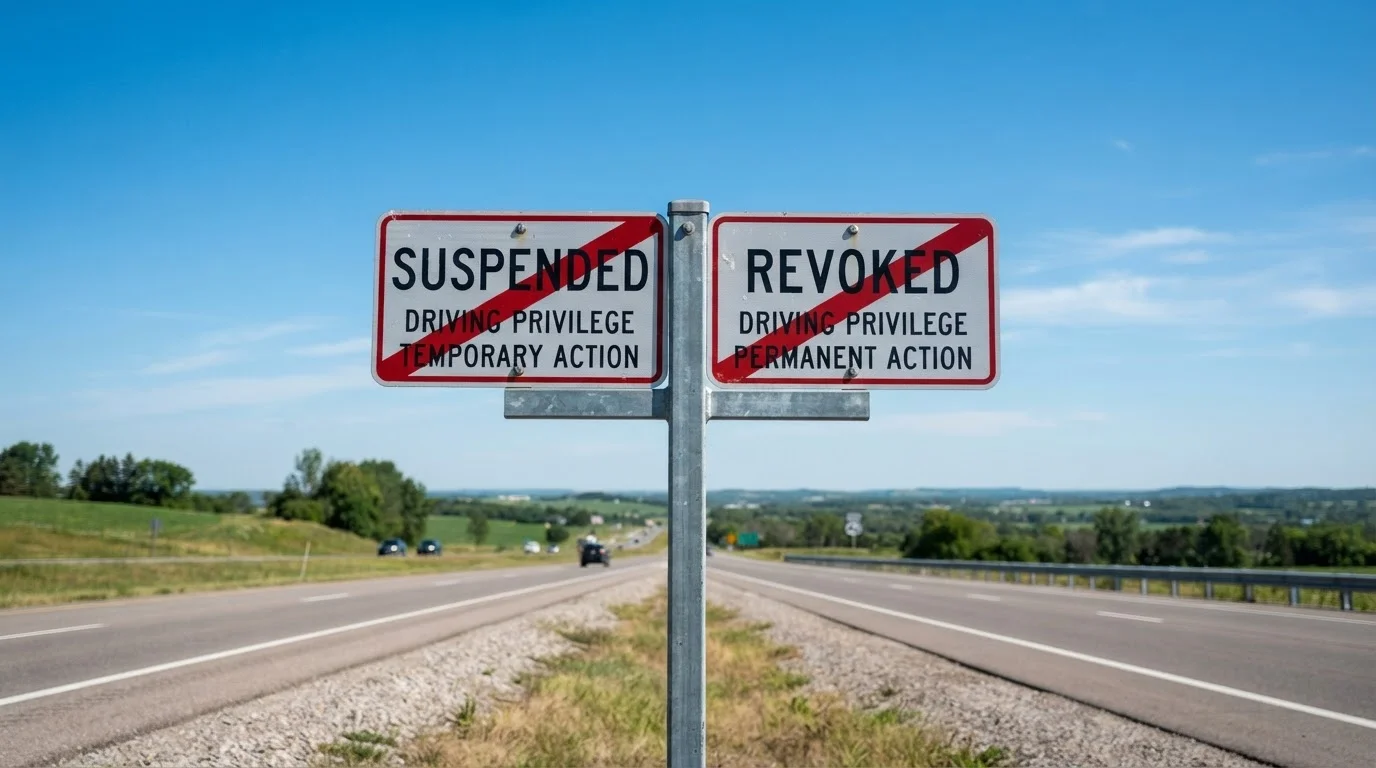
Option A
Suspended License
A temporary loss of driving privileges with a defined path back.
Best for: Understanding what happens when a driver accumulates violations or misses a court deadline - and how to restore their license.
Option B
Revoked License
A formal termination of driving privileges requiring reapplication.
Best for: Understanding the consequences of serious offenses like DUI or vehicular manslaughter, where reinstatement is not automatic.
What Is a License Suspension?
A license suspension is a temporary withdrawal of your driving privileges. The key word is temporary - your license is not gone permanently. Instead, it is placed on hold until you satisfy specific conditions set by your state's department of motor vehicles (DMV) or a court.
Common reasons for suspension include:
- Accumulating too many points on your driving record from traffic violations (see how the point system works)
- Failing to pay traffic fines or court fees
- Missing a required court appearance
- Driving without insurance or letting your insurance lapse
- Failure to pay child support (in many states)
Once you fulfill the required conditions - paying fines, completing a driving course, or waiting out a mandatory suspension period - your license can be reinstated. States typically charge a reinstatement fee, and some require an SR-22 certificate (a form of high-risk insurance filing) before restoring driving privileges.
| Criterion | Suspended License | Revoked License |
|---|---|---|
| Nature of action | Temporary hold on privileges | Full termination of license |
| Automatic end date | Often yes, or upon compliance | No - requires reapplication |
| Common causes | Points, unpaid fines, no insurance | DUI, vehicular manslaughter, felony use |
| Reinstatement process | Meet conditions, pay fee, file SR-22 | Reapply, retest, possible hearing |
| Severity of offense | Minor to moderate violations | Serious or repeated major violations |
| Permanent outcome possible? | Rarely | Yes, in extreme cases |
What Is a License Revocation?
A license revocation is a complete termination of your driving privileges. Unlike a suspension, there is no automatic restoration date. Your license ceases to exist as a valid document, and you must go through a formal reapplication process - which may include written exams, road tests, and hearings - before you can drive legally again.
Revocations are reserved for the most serious driving offenses, including:
- Driving under the influence (DUI) or driving while intoxicated (DWI), especially repeat offenses
- Vehicular manslaughter or negligent homicide involving a vehicle
- Habitual reckless driving or repeated serious violations
- Fleeing the scene of an accident involving injury or death
- Using a vehicle to commit a felony
Even after the mandatory revocation period ends, reinstatement is not guaranteed. States may require you to demonstrate rehabilitation, pass examinations, and maintain clean driving behavior over a probationary period. Some serious offenders may face permanent revocation with no path to reinstatement.
1 in 7
U.S. drivers with a suspended or revoked license
Research from the AAA Foundation for Traffic Safety has estimated that roughly one in seven U.S. drivers operates with a suspended or revoked license at some point.
~75%
Of suspended drivers who continue driving
Studies have found the majority of drivers with suspended licenses continue to drive, significantly increasing crash risk and legal exposure for themselves and others.
Why the Distinction Matters - and What to Do Next
The practical difference between suspension and revocation is significant. If your license is suspended, you have a roadmap back: identify the conditions, fulfill them, pay applicable fees, and apply for reinstatement. If your license is revoked, you are effectively starting over - there is no shortcut, and the process can take months or years depending on the offense and your state's laws.
In both cases, driving while your license is suspended or revoked is a serious criminal offense. Penalties can include fines ranging into the thousands of dollars, additional suspension periods, and even jail time in many states. Law enforcement can easily check license status at a traffic stop.
State Laws Vary Significantly
Each state sets its own rules for what triggers a suspension versus a revocation, how long each lasts, and what reinstatement requires. What leads to revocation in one state may only cause a suspension in another. Always check with your specific state's DMV for accurate, current requirements - procedures and fees differ widely across the country.
If you are unsure of your license status, contact your state's DMV directly or check their online portal. An attorney who specializes in traffic law can also help you navigate reinstatement hearings, especially following a revocation.
The content provided on our blog site traverses numerous categories, offering readers valuable and practical information. Readers can use the editorial team’s research and data to gain more insights into their topics of interest. However, they are requested not to treat the articles as conclusive. The website team cannot be held responsible for differences in data or inaccuracies found across other platforms. Please also note that the site might also miss out on various schemes and offers available that the readers may find more beneficial than the ones we cover.