

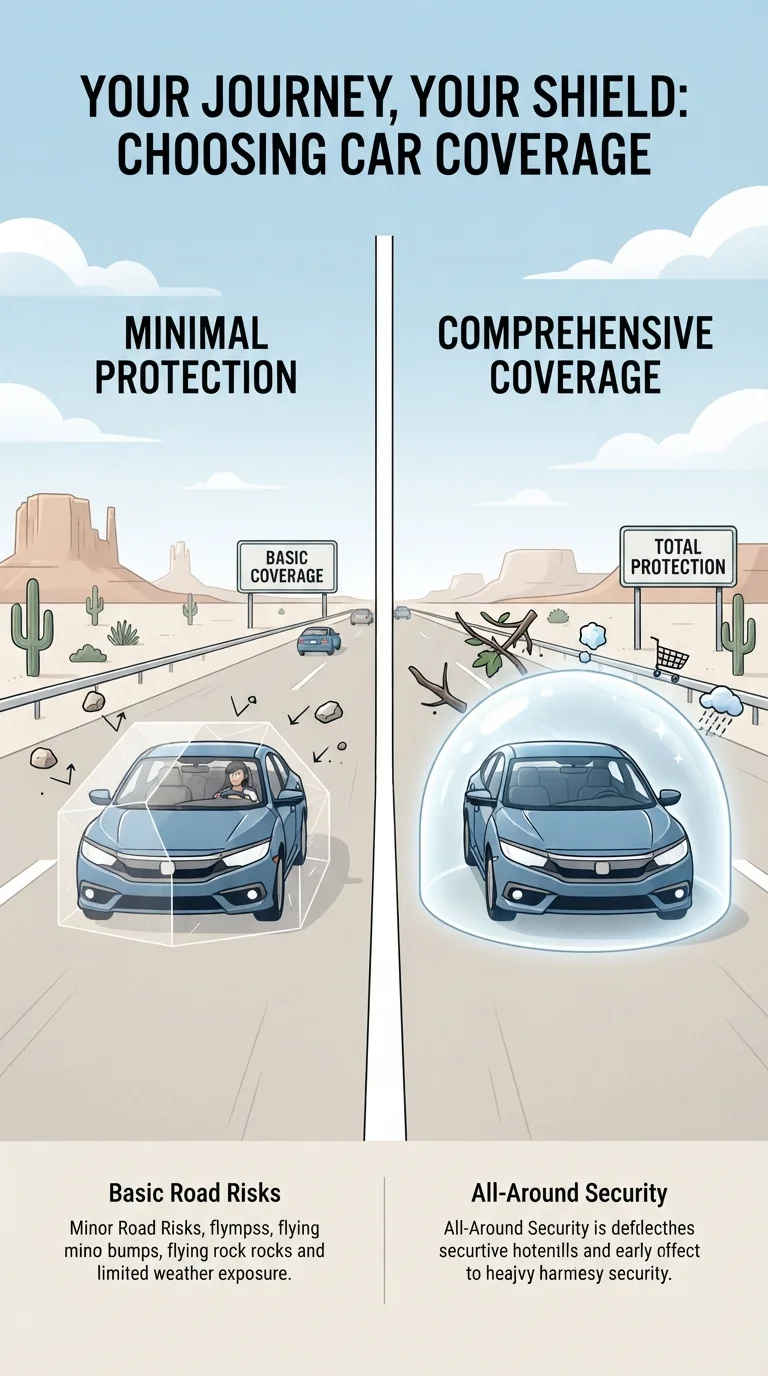
Option A
Liability-Only Coverage
The legally required minimum - covers others, not your vehicle.
Best for: Drivers who own older, lower-value vehicles outright and can self-fund repair or replacement costs.
Option B
Full Coverage
Broader protection that extends to your own car in most scenarios.
Best for: Drivers with newer, higher-value vehicles - especially those with an active auto loan or lease.
What Each Coverage Type Actually Does
Before weighing costs and trade-offs, it helps to be precise about what these terms cover - and what they don't.
Liability-only coverage is the legally mandated floor in virtually every U.S. state. It pays for bodily injury and property damage that you cause to other people in an at-fault accident. It does not pay for damage to your own car or your own medical bills. States set minimum liability limits, but those minimums are often low enough that a serious accident could leave you exposed to lawsuits beyond the policy limit.
Full coverage is an informal term - it isn't a single product but rather a combination of coverages typically including liability plus collision (damage to your vehicle from an accident regardless of fault) and comprehensive (damage from non-collision events such as theft, hail, flooding, or a fallen tree). Many policies also bundle in uninsured/underinsured motorist protection and medical payments coverage, though these vary by state and insurer.
| Criterion | Liability-Only | Full Coverage |
|---|---|---|
| Covers damage to others | Yes | Yes |
| Covers your own vehicle (collision) | No | Yes |
| Covers theft, weather, fire | No | Yes (comprehensive) |
| Required by law | Yes (minimum required) | No (except for loans/leases) |
| Required by lenders/lessors | No | Yes |
| Typical monthly premium | Lower | Higher |
| Out-of-pocket risk if car is totaled | Full replacement cost | Deductible only |
Understanding this distinction matters because the financial consequences of your choice fall entirely on your own vehicle - and your own wallet - if you carry only liability.
The Financial Calculation: When Each Option Makes Sense
The decision between these two tiers ultimately comes down to a straightforward risk assessment. Ask yourself: If my car were totaled or stolen tomorrow, could I replace it without insurance proceeds?
A commonly cited rule of thumb is to compare the annual cost of collision and comprehensive coverage against the current market value of your vehicle. If the combined premium for those add-ons approaches or exceeds roughly 10% of the car's value each year, dropping to liability-only becomes worth evaluating - particularly once you factor in the deductible you'd pay before coverage kicks in anyway.
~47%
U.S. drivers carrying only minimum required coverage
Estimates from insurance industry research suggest nearly half of American drivers carry at or near state minimum liability limits, leaving their own vehicles unprotected.
$4,700+
Average collision claim payout
According to Insurance Information Institute data, the average collision insurance claim has exceeded $4,700, illustrating the real financial exposure of going uninsured for your own car.
Vehicle age and depreciation play a large role here. A car that was worth $28,000 three years ago may now be valued closer to $16,000 by most market benchmarks. That shift meaningfully changes the math. You can look up estimated vehicle values through resources like the National Automobile Dealers Association (NADA) guides or Kelley Blue Book to get a realistic figure.
Your personal financial cushion matters equally. If you have a dedicated emergency or sinking fund that could absorb a vehicle replacement, self-insuring the car itself is more defensible. For more on building that kind of reserve, see how a sinking fund works - a strategy well-suited to irregular costs like this.
Loan, Lease, and Lender Requirements
One factor that removes the choice entirely: financing or leasing. If you have an outstanding auto loan or are driving a leased vehicle, the lender or lessor holds a financial interest in the car. They will almost universally require full coverage - including comprehensive and collision - as a contractual condition.
If you allow your full coverage to lapse on a financed vehicle, the lender can legally purchase what's called force-placed insurance on your behalf and charge the premium to your loan balance. Force-placed insurance typically protects only the lender's interest (not yours) and costs significantly more than standard market-rate coverage.
Force-Placed Insurance: A Costly Gap-Filler
If you drop full coverage while still carrying a loan, lenders can impose force-placed (also called lender-placed) insurance on your account. This coverage protects only the lender's financial interest - not your equity in the vehicle. Premiums for force-placed insurance are frequently several times higher than standard market rates, and the cost is added directly to your loan balance.
Once your loan is paid off, the requirement disappears - and that's often the natural moment to reassess whether maintaining full coverage still makes financial sense given the vehicle's current value.
Practical Factors Beyond Vehicle Value
Vehicle value and loan status are the primary drivers, but a few additional factors deserve consideration:
- Where you park and drive: Drivers in areas with higher rates of vehicle theft, hail events, or flood risk get more value from comprehensive coverage than those in lower-risk environments.
- Your driving record: A clean record typically earns lower premiums, making full coverage more affordable. If your record carries recent incidents, premiums rise - but so does the statistical argument for keeping the protection.
- Deductible level: Full coverage doesn't mean zero out-of-pocket. You choose a deductible - the amount you pay before the insurer pays - when you set up the policy. A higher deductible lowers your premium but requires more savings on hand.
- Replacement transportation: If losing your vehicle for several weeks while saving to buy another would create serious hardship, full coverage (which can enable faster repair or replacement) has additional value beyond the dollar figures.
For a broader look at managing auto expenses across the year, strategies for controlling annual car costs covers how insurance fits alongside maintenance and fuel decisions.
This article provides general information about auto insurance coverage types and is not a substitute for personalized advice from a licensed insurance professional. Coverage requirements, terms, and availability vary by state and insurer - always review your own policy documents and consult a licensed agent with questions specific to your situation.
The content provided on our blog site traverses numerous categories, offering readers valuable and practical information. Readers can use the editorial team’s research and data to gain more insights into their topics of interest. However, they are requested not to treat the articles as conclusive. The website team cannot be held responsible for differences in data or inaccuracies found across other platforms. Please also note that the site might also miss out on various schemes and offers available that the readers may find more beneficial than the ones we cover.