

Why Yellowstone Myths Spread So Easily
Yellowstone National Park draws around four million visitors a year, and with that crowd comes a surprisingly stubborn collection of myths. Some are harmless misunderstandings; others have sent tourists to the hospital. The park's sheer scale, otherworldly geology, and iconic status make it easy for half-truths to travel faster than the facts.
Whether you're planning your first trip or your fifth, getting the real story matters — for your safety, your expectations, and your ability to truly appreciate what you're seeing. Much like the common myths that keep Americans from traveling abroad, Yellowstone's misconceptions are often rooted in outdated information or cultural shorthand that doesn't hold up to scrutiny.
Myth
Old Faithful erupts like clockwork every 60 minutes.
Fact
Old Faithful's eruption intervals currently range from about 60 to 110 minutes, and each interval depends on the duration of the previous eruption.
The "clockwork" reputation dates back to early park reports, but Old Faithful has never been perfectly regular. Rangers can predict the next eruption within about a 10-minute window based on how long the last one lasted — shorter eruptions lead to shorter waits, longer ones to longer waits. The average interval has also gradually lengthened over the decades, likely related to seismic activity. Check the prediction board at the visitor center for the most accurate timing before you set up camp on the benches.
Myth
You can touch or walk near the colorful hot springs — they just look intense.
Fact
Yellowstone's thermal pools reach temperatures exceeding 200°F and are often highly acidic. They have caused severe burns and deaths.
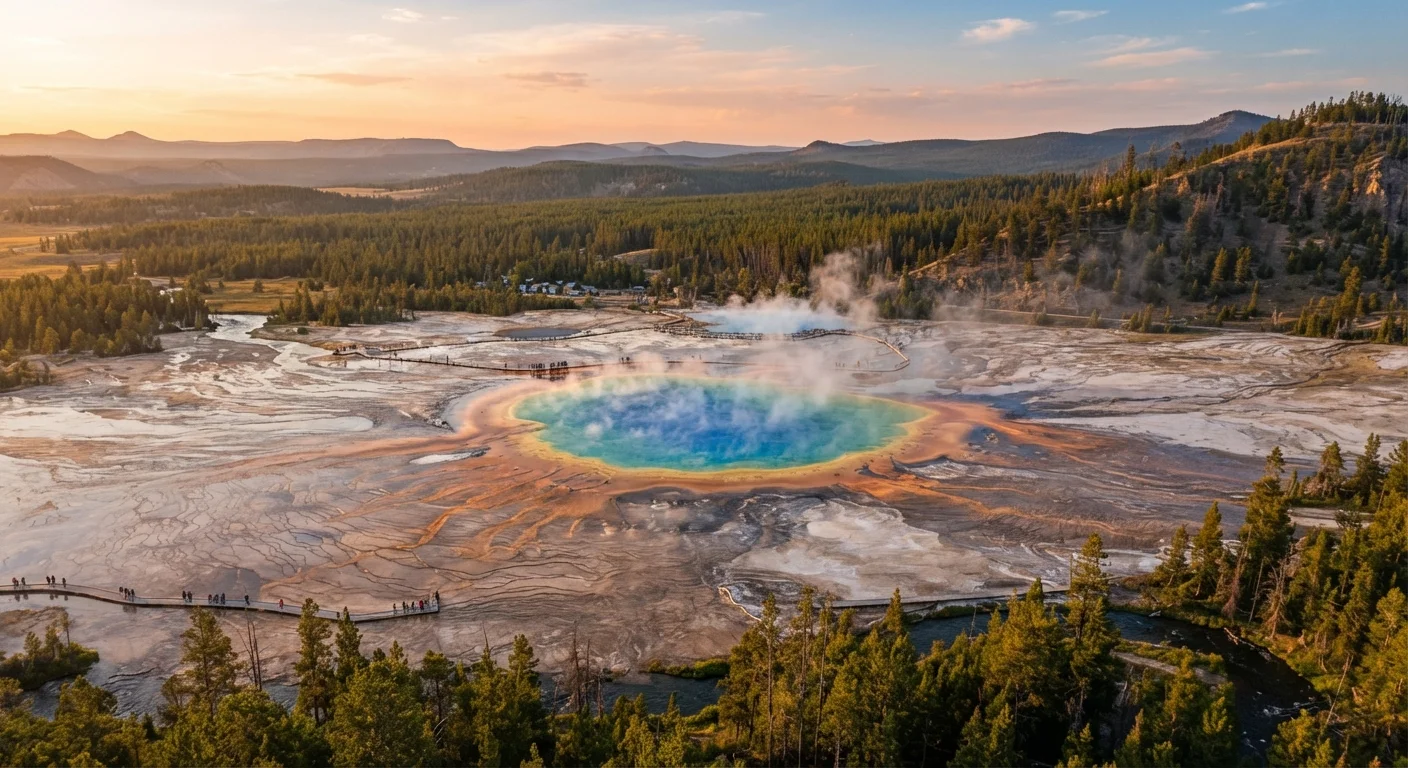
The brilliant colors in springs like Grand Prismatic come from heat-loving microorganisms called thermophiles — not from anything gentle or touchable. The water itself can be near or above boiling, and the crust around thermal features is often paper-thin and can collapse without warning. The park's boardwalks and designated trails exist for a critical reason: people have died falling into hot springs, including in documented incidents within Grand Prismatic's basin. Staying on marked paths is non-negotiable, not optional.
Myth
Yellowstone's supervolcano is overdue for a massive eruption.
Fact
The U.S. Geological Survey (USGS) states there is no evidence of an impending supereruption, and the odds in any given year are extremely low.
The Yellowstone Volcano Observatory, run by the USGS, monitors the caldera continuously with seismographs, GPS, and gas sensors. Scientists assess the probability of a caldera-forming eruption in any given year at approximately 1 in 730,000. The concept of "overdue" misunderstands how geology works — volcanic systems don't follow calendars. Smaller hydrothermal explosions (steam blasts) are far more likely than a supereruption, though still rare. The USGS publishes regular updates and would be the authoritative source if conditions ever meaningfully changed.
Myth
Bison are slow, docile animals that are safe to approach for photos.
Fact
Bison are unpredictable, fast, and responsible for more injuries in Yellowstone than any other animal. The park requires visitors to stay at least 25 yards away.
An adult bison can weigh over 2,000 pounds and sprint up to 35 mph — faster than a horse over short distances. They can pivot and charge with almost no warning. The National Park Service reports that bison injure more visitors at Yellowstone than bears do, largely because tourists underestimate them. The required distance is 25 yards (about the length of two school buses) for bison and elk, and 100 yards for bears and wolves. These aren't suggestions — violations can result in fines and, more importantly, serious injury.
Myth
Yellowstone is small enough to cover in a single day trip.
Fact
Yellowstone spans approximately 2.2 million acres — larger than Rhode Island and Delaware combined — and major attractions are spread hours apart by road.
Many first-time visitors are shocked to discover they've driven two hours and still haven't left the park. The Grand Loop Road, which connects the major attractions, is 142 miles long. Add wildlife traffic jams (common and unpredictable), geyser wait times, and the sheer walking involved at each stop, and a single day barely scratches the surface. Experienced park visitors typically recommend a minimum of three to five days to visit the major regions without feeling rushed. Plan overnight stays in or near the park, and book well in advance — lodging fills up months ahead during summer.
What the Numbers Actually Tell Us
The facts about Yellowstone are striking enough on their own — no embellishment needed. Here's what the data reveals about this extraordinary place.
~10,000
Hydrothermal features in the park
Yellowstone contains roughly half of the world's known geothermal features, according to the National Park Service.
4M+
Annual park visitors
Yellowstone consistently attracts over four million visitors per year, making crowd management and safety education a constant priority.
2.2M
Acres of protected land
The park's vast acreage spans portions of Wyoming, Montana, and Idaho, encompassing diverse ecosystems from geothermal basins to dense forests.
Understanding these numbers helps put the myths in context. When you realize the park holds half the world's active geothermal features, it becomes clear why casual, unguided wandering off trail is genuinely dangerous — not just a bureaucratic rule designed to spoil the fun.
Wildlife Encounters Can Turn Dangerous Fast
Every year, visitors are injured in Yellowstone because they got too close to wildlife. Bears, bison, elk, and wolves are wild animals operating on instinct — not photo props. Carry bear spray, know how to use it, and always maintain the required distances. If an animal changes its behavior because of your presence, you are already too close.
Visiting Yellowstone With Clear Eyes
The best Yellowstone trip starts with accurate expectations. The park rewards visitors who respect its scale and power — those who plan, stay on boardwalks, carry bear spray (and know how to use it), and embrace the fact that nature doesn't run on a schedule.
If debunking myths about beloved destinations is your thing, the same spirit applies to everyday life back home. It turns out that popular lawn care advice is riddled with myths too — and getting those wrong wastes real time and money. Skepticism is a useful travel companion, wherever you're headed.
Come curious, come informed, and Yellowstone will absolutely deliver on every one of the extraordinary things it legitimately promises.
The content provided on our blog site traverses numerous categories, offering readers valuable and practical information. Readers can use the editorial team’s research and data to gain more insights into their topics of interest. However, they are requested not to treat the articles as conclusive. The website team cannot be held responsible for differences in data or inaccuracies found across other platforms. Please also note that the site might also miss out on various schemes and offers available that the readers may find more beneficial than the ones we cover.