

Why Currency Exchange Trips Up So Many Travelers
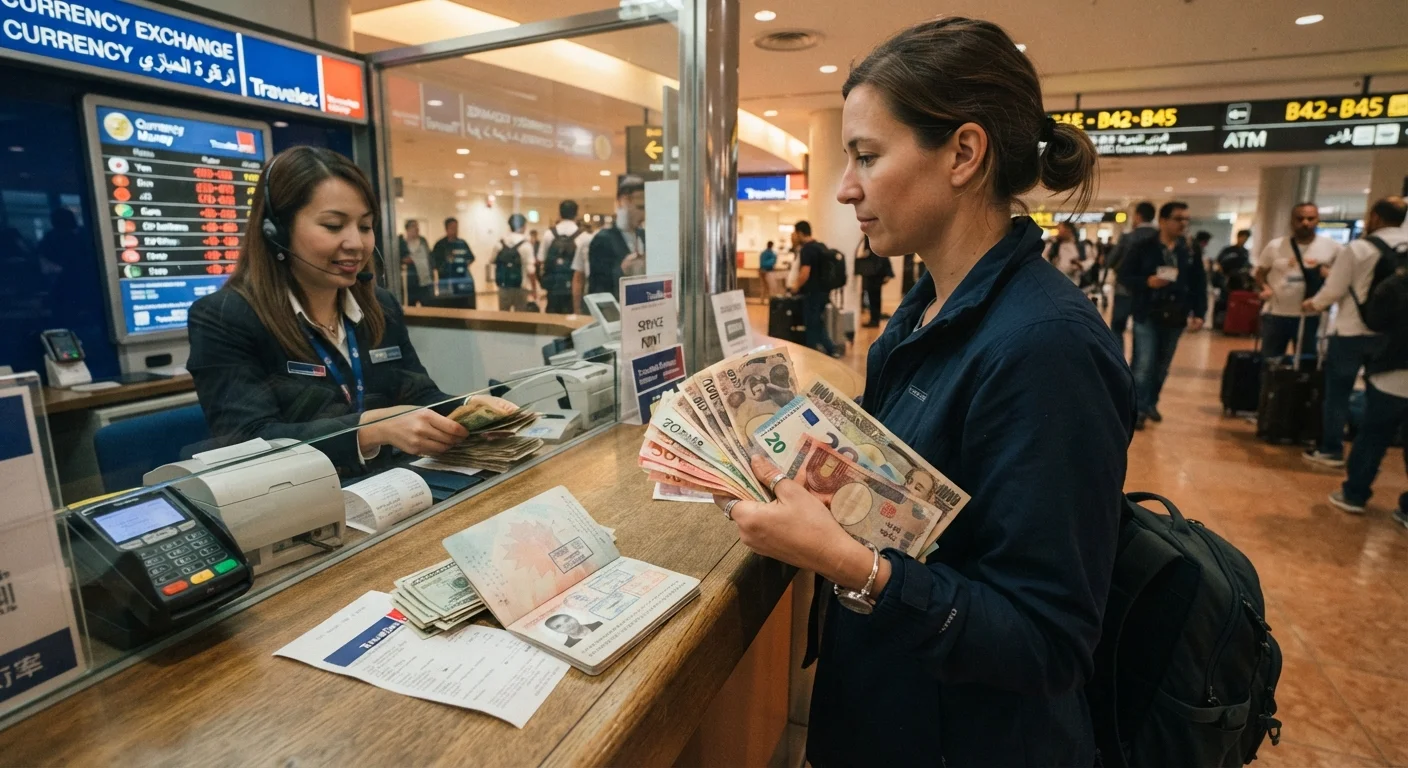
Currency exchange is one of those travel logistics that looks simple until it quietly drains your budget. Most Americans don't realize how wide the gap can be between the real exchange rate — called the interbank rate or mid-market rate — and the rate they're actually offered at a kiosk, hotel desk, or even an ATM. That gap is pure profit for whoever is handling the conversion.
The interbank rate is the rate banks use when trading currency with each other. It's the benchmark you'll see on Google or a currency app. Consumers almost never get that rate — but knowing it exists gives you a measuring stick to evaluate any deal you're offered. If you're planning your first overseas trip, our first-timer's international travel primer covers the broader logistics of landing abroad with confidence.
3–15%
Typical markup at airport currency exchange kiosks
Industry observers and consumer finance educators commonly cite airport kiosk markups in this range above the mid-market interbank rate.
3–7%
Added cost of dynamic currency conversion
Payment industry analyses have found DCC markups typically fall in this range compared to standard card network conversion rates.
The Three Places Americans Lose the Most Money
Airport exchange kiosks are notorious for unfavorable rates and high fees. They're convenient and prominently placed — which is exactly why they can afford to offer poor value. If you need a small amount of local currency immediately on arrival, limit what you exchange there to cover just your first taxi or transit fare.
Hotel front desks are a similar story. The convenience premium is built right into the rate, and there's rarely any transparency about fees. Most hotels do not post their exchange rates publicly.
Dynamic currency conversion (DCC) is arguably the sneakiest trap. When you pay by card abroad and a cashier or ATM asks whether you'd like to pay in U.S. dollars instead of the local currency, that offer is DCC. It sounds helpful — you see a familiar dollar amount — but the conversion rate is set by the merchant's payment processor, not your bank, and it's almost always worse. Always choose to pay in the local currency. Your card's network rate will be more favorable in nearly every case.
How to Spot a DCC Offer
Dynamic currency conversion is sometimes presented as a courtesy, but it's a revenue tool for the merchant. If a card terminal or ATM screen shows you an amount in U.S. dollars and asks you to confirm, look for a 'pay in local currency' option — it's usually there, just not highlighted. If a cashier verbally asks which currency you prefer, always say the local one. Getting into this habit takes about one trip to become automatic.
Best Practices for Handling Currency Abroad
Use a local ATM in your destination country to withdraw cash in the local currency.
Bank ATMs abroad typically use exchange rates tied to Visa or Mastercard's network rate, which is much closer to the interbank rate than any kiosk. Withdrawing a moderate, planned amount reduces the per-transaction fee impact.
Always decline dynamic currency conversion (DCC) and pay in local currency.
DCC rates are set by the merchant's processor and routinely add a 3–7% markup over the network rate. Paying in local currency lets your card issuer handle the conversion, almost always at a better rate.
Notify your bank and credit card issuers before departing.
Banks flag international transactions as potentially fraudulent and may freeze your card mid-trip. A quick call or online alert prevents this and ensures uninterrupted access to funds abroad.
Carry a card with no foreign transaction fees for everyday purchases.
Many standard U.S. credit and debit cards charge a 1–3% foreign transaction fee on every purchase. Over a two-week trip, that adds up. Cards designed for travel — often from credit unions, certain banks, or travel-focused programs — waive this fee entirely.
Keep a small amount of local cash on hand at all times.
Many local markets, small restaurants, transit systems, and rural vendors abroad are cash-only. Being entirely reliant on cards in unfamiliar countries creates real friction and occasional emergencies.
A well-rounded approach combines a little advance planning at home with smart choices on the ground. For a deeper look at how to structure your entire trip financially and logistically, see the complete framework for planning an international trip from the U.S..
Quick Actions You Can Take Before You Fly
Many of the common financial stumbles abroad — frozen cards, surprise fees, bad conversion rates — are entirely avoidable with a bit of preparation at home. Americans often assume that the financial system will just work the way it does domestically. It mostly does, but the details matter. Cultural and practical assumptions Americans carry overseas extend into money habits too, so it's worth thinking critically before you go.
“The single most important financial habit for international travelers is knowing the real exchange rate before any transaction. Once you have that number, every offer you receive is easy to evaluate.”
— Consumer Financial Protection Bureau, U.S. federal agency providing consumer financial education
The content provided on our blog site traverses numerous categories, offering readers valuable and practical information. Readers can use the editorial team’s research and data to gain more insights into their topics of interest. However, they are requested not to treat the articles as conclusive. The website team cannot be held responsible for differences in data or inaccuracies found across other platforms. Please also note that the site might also miss out on various schemes and offers available that the readers may find more beneficial than the ones we cover.