

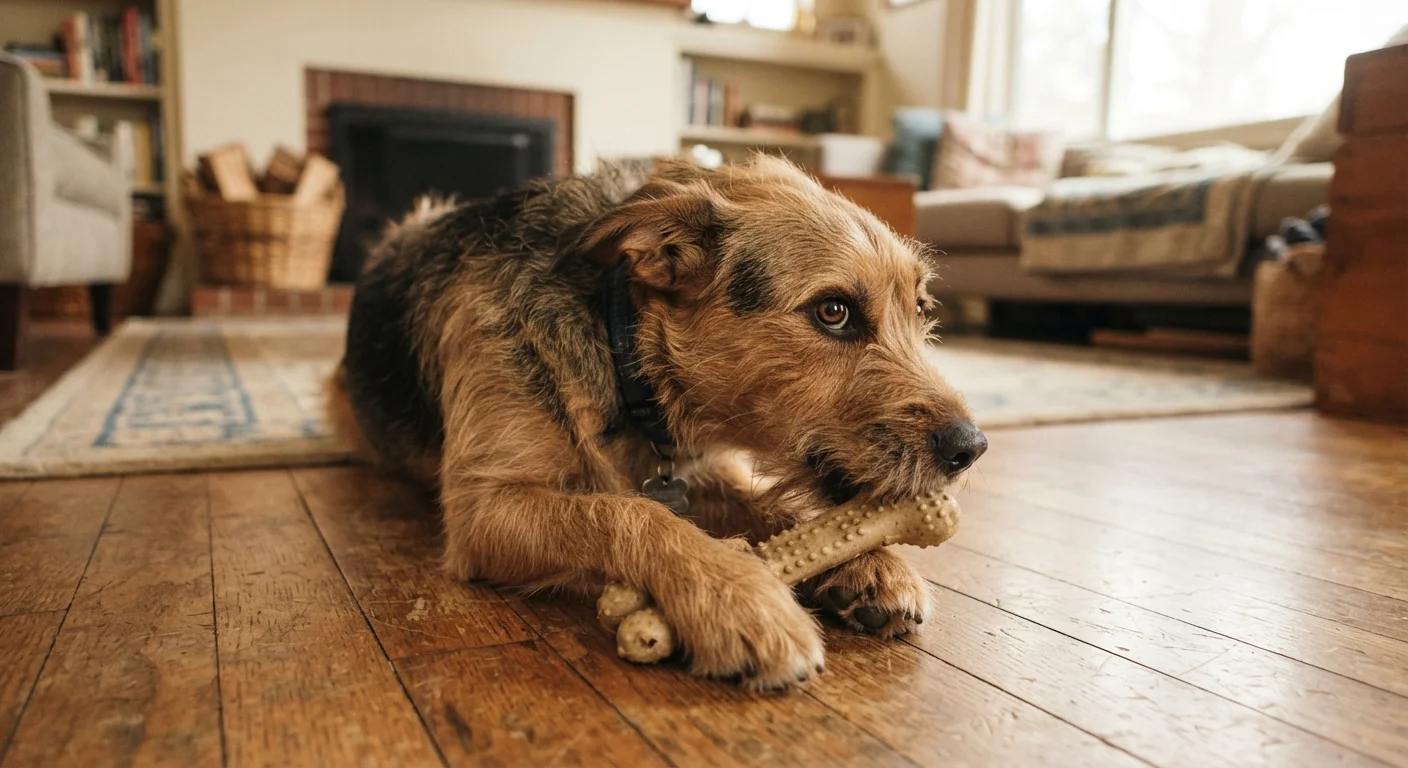
What Resource Guarding Actually Looks Like
Resource guarding follows a recognizable escalation pattern. Most dogs start with subtle signals that are easy to miss — a dog that goes very still over its food bowl, a hard stare, or a slight lip curl. These are early warnings. If those signals are ignored, the dog typically moves to more obvious ones: a low growl, snapping in the air, or lunging without contact. A bite is the final escalation when all prior communication has failed.
Common resources dogs guard include:
- Food and food bowls — the most frequently reported trigger
- High-value chews such as rawhides, bones, or bully sticks
- Toys, especially those the dog has been carrying or playing with
- Resting spots — a couch cushion, dog bed, or a favorite corner
- People — some dogs guard one family member from others
The behavior can be directed at other dogs, unfamiliar people, or family members. It is not a sign that the dog has a flawed personality; it reflects an instinct that helped wild ancestors survive. Understanding this framing makes it easier to respond calmly rather than reactively.
Guarding Is a Spectrum, Not a Switch
Not all resource guarding looks dramatic. A dog that eats faster when you walk by, or positions its body between you and a toy, is showing mild guarding. These subtle signals deserve attention early — they are easier to address before they escalate. If you are unsure whether what you are seeing is guarding, a brief video shared with your veterinarian or a certified trainer can help clarify.
Why Dogs Guard — The Behavioral Logic
Dogs guard because, from their perspective, it works. Growling makes a person step back, which removes the threat to the valued item. The dog learns that threatening behavior is effective, and that learning gets reinforced every time the strategy succeeds.
Early-life experience plays a significant role. Dogs that had to compete for food as puppies, experienced food insecurity in a shelter environment, or were previously punished for growling (causing them to skip warning signals and go straight to biting) often guard more intensely. That said, dogs from stable, well-resourced environments can develop the behavior too — it is fundamentally an instinct, not purely a product of neglect.
Sudden onset of guarding in an adult dog that never showed it before can signal a medical issue such as pain, hormonal imbalance, or cognitive changes. This is worth flagging to a veterinarian before assuming it is purely behavioral. See our article on behavior changes that may signal a health issue for more guidance on when to involve your vet.
How to Respond Safely in the Moment
If your dog is actively guarding, the priority is de-escalation — not correction.
- Do not reach for the item. Approaching a guarding dog directly increases the risk of a bite. Give the dog space.
- Avoid punishment. Scolding or physically correcting a growling dog suppresses the warning signal without addressing the underlying anxiety. A dog that learns not to growl may still bite — just without warning. This is one of the ways well-meaning owners can accidentally make behavior worse.
- Use a trade-up. Offer something of higher value — a piece of chicken, a favorite treat — in a neutral space away from the guarded item. When the dog moves toward you, calmly retrieve the object.
- Manage the environment. Until the behavior is addressed through training, limit access to high-trigger items when children or guests are present. Prevention is not failure — it is responsible ownership.
Teach a Reliable 'Drop It' or 'Leave It'
Training a solid 'drop it' cue before a guarding situation arises gives you a safe, practiced tool to use in the moment. Start with low-value items and pair the cue with a reward your dog loves. Practice regularly so the behavior is reliable when it matters most.
Building Long-Term Safety Through Behavior Modification
Consistent desensitization and counter-conditioning are the evidence-supported approaches for reducing resource guarding over time. The goal is to change the dog's emotional response so that a person approaching its food bowl predicts something good, not a threat.
A simple starting exercise: while your dog eats from its bowl, walk past and drop a high-value treat near the bowl without reaching in. Repeat this daily. Gradually, your dog learns that your approach means something good is arriving — not that something is being taken away. This shifts the emotional association from threat to anticipation.
Formal redirection-based training without punishment can accelerate this process significantly. A certified professional dog trainer (CPDT-KA) or a veterinary behaviorist is the right resource for moderate-to-severe guarding, multi-dog households where guarding causes conflict, or any case involving children.
~20%
Dogs showing food bowl guarding behavior
Research published in Applied Animal Behaviour Science found roughly 20% of surveyed dogs showed some level of resource guarding toward people around food bowls.
77%
Dog bites from dogs known to the victim
According to the American Veterinary Medical Association, the vast majority of dog bites involve a dog familiar to the person bitten, underscoring why household guarding must be taken seriously.
Predictable daily routines can also reduce the anxiety that fuels guarding. When a dog knows feeding happens at the same time and place each day, the urgency around food — and the need to defend it — often diminishes. Our article on how routine shapes pet behavior explains why structure has such a meaningful effect on a dog's sense of security.
This article is for general educational purposes only and is not a substitute for professional veterinary or certified animal behavior guidance. If your dog's guarding behavior is severe, escalating, or poses a safety risk, consult a licensed veterinary behaviorist or certified professional dog trainer.
Frequently Asked Questions
Not necessarily. Resource guarding is a normal canine survival behavior and does not mean your dog is generally aggressive. Many otherwise friendly dogs guard specific items. However, guarding that escalates to biting or occurs without warning signals does require professional help.
No. Forcibly removing an item while your dog is guarding it often escalates the behavior and increases bite risk. It also breaks trust. A trade-up approach — offering something better in exchange — is both safer and more effective.
It can be significantly reduced and managed through consistent behavior modification, but the instinct may never fully disappear. The goal is to lower the intensity to a safe, livable level — not necessarily to eliminate the behavior entirely.
Yes, especially if children or visitors regularly enter your home. A dog that guards from unfamiliar people can still bite. Managing the environment and working with a certified trainer is important even when the behavior is selective.
If guarding appears suddenly in a dog that never showed it before, a medical cause — such as pain, cognitive changes, or a thyroid issue — may be involved. A vet visit is a sensible first step before beginning any behavior work.
Any dog can guard, but dogs bred for independent work or those with food-motivated temperaments may show it more readily. Individual history, including food insecurity or past punishment, tends to have more influence than breed alone.
The content provided on our blog site traverses numerous categories, offering readers valuable and practical information. Readers can use the editorial team’s research and data to gain more insights into their topics of interest. However, they are requested not to treat the articles as conclusive. The website team cannot be held responsible for differences in data or inaccuracies found across other platforms. Please also note that the site might also miss out on various schemes and offers available that the readers may find more beneficial than the ones we cover.