

Start here
Why Starting Small Actually Works
Next
Know Where Your Money Goes First
Then
Choosing the Right Account to Hold Your Savings
When you're ready
Building an Emergency Fund While Managing Debt
Keep going
Habits That Keep the Momentum Going
Why Starting Small Actually Works
Most people who struggle to save aren't failing because of discipline—they're failing because they're waiting until they have enough to make saving feel worth it. That threshold rarely arrives. The real key is reducing friction and starting with whatever is available, even if it feels trivially small.
Behavioral research consistently shows that forming the habit—the automatic transfer, the monthly ritual of reviewing a balance—matters more than the dollar amount in the early stages. A $20 monthly deposit that you actually make beats a $200 goal you perpetually postpone. Over 12 months, that modest $20 becomes $240 plus interest, and more importantly, it becomes a routine you've already proven you can maintain.
For a broader understanding of how savings and debt management fit together, the complete overview of saving and debt management is a useful companion to this guide.
Set a Tiny, Specific First Goal
Rather than aiming for three months of expenses right away, pick a concrete near-term target—like saving $250 by a specific date. Small, achievable milestones create motivation and proof that the system works. Once you hit the first goal, set the next one.
Know Where Your Money Goes First
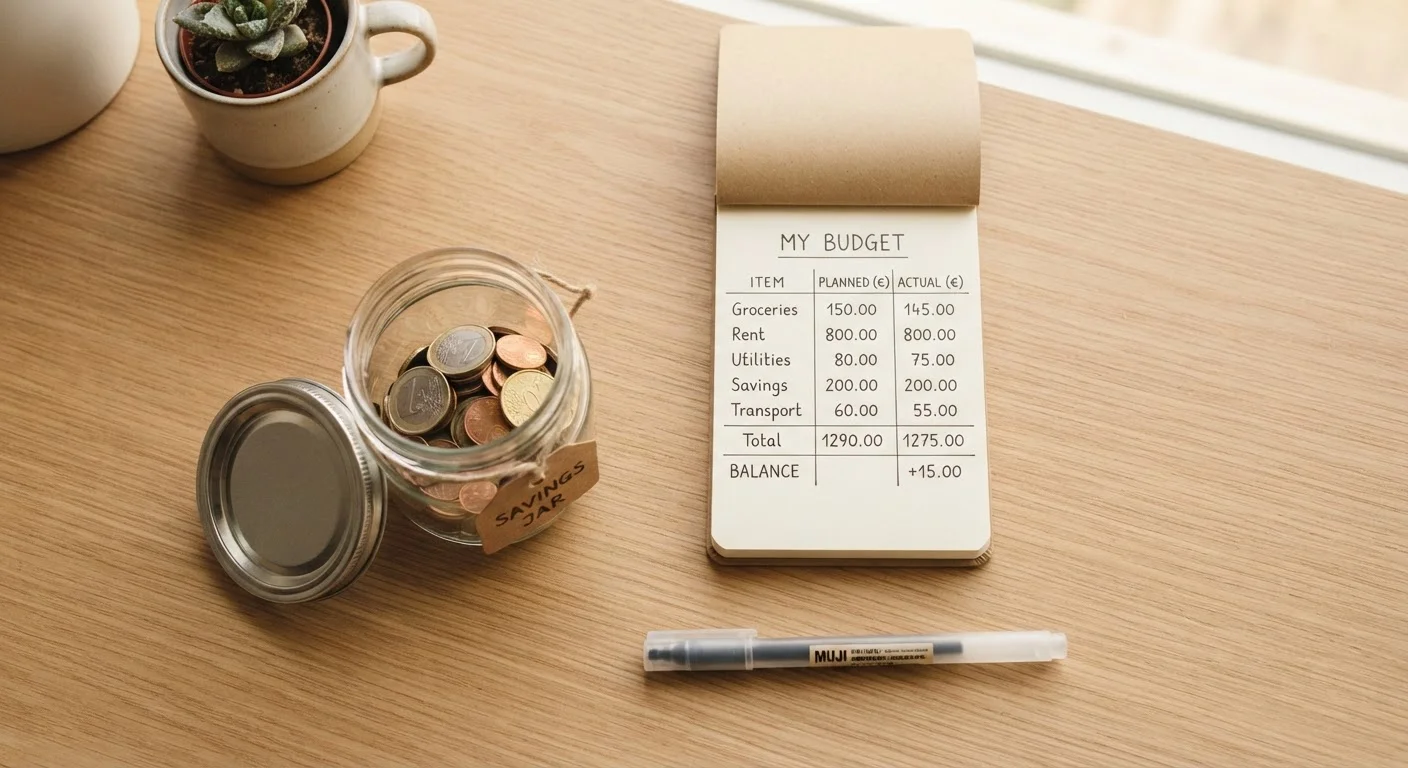
Before you can redirect money into savings, you need an honest picture of where it currently goes. This doesn't require complicated software—a bank statement and 20 minutes will do. Categorize your spending broadly: housing, food, transportation, subscriptions, dining out, and everything else.
Most people discover two things quickly: recurring subscriptions they've forgotten, and discretionary spending that's higher than they assumed. The goal isn't to judge either finding—it's to identify margin. Even a small margin can become savings.
If you want structure for this process, the Budgeting Basics hub covers practical approaches to tracking and planning your monthly spending from the ground up.
Emergency fund
A dedicated pool of money set aside for unexpected, necessary expenses—like a medical bill or car repair—so you don't have to borrow when something goes wrong.
Annual percentage yield (APY)
The real rate of return on a savings account over one year, including the effect of compounding interest. A higher APY means your savings grow faster.
Discretionary spending
Money spent on non-essential items—dining out, entertainment, subscriptions—that can often be reduced when you need to find room to save.
Automatic transfer
A scheduled, recurring movement of money from one bank account to another, set up in advance so saving happens without a manual decision each time.
FDIC insurance
A federal guarantee that protects deposits at insured banks up to $250,000 per depositor per institution, ensuring your savings are safe even if the bank fails.
Choosing the Right Account to Hold Your Savings
Where you keep savings matters. Leaving extra money in a checking account makes it too easy to spend. A separate, dedicated savings account creates a psychological and logistical barrier that protects your progress.
Two common options are traditional savings accounts and high-yield savings accounts (HYSAs). Traditional accounts, typically offered by large brick-and-mortar banks, tend to pay very low interest. HYSAs—frequently offered by online banks—generally pay significantly higher annual percentage yields (APYs), meaning your money grows faster for the same effort. Both types are insured by the FDIC up to $250,000 per depositor at member institutions.
For a detailed comparison of how these account types differ and what to consider when evaluating them, see our article on high-yield vs. traditional savings accounts.
APY Rates Change Over Time
High-yield savings account rates are variable and tied to broader interest rate conditions set by the Federal Reserve. The rate you see when opening an account may rise or fall over time. Always review current rates and account terms directly with any financial institution before making decisions.
Building an Emergency Fund While Managing Debt
One of the most common questions from new savers is whether it makes sense to save while carrying debt. The short answer: a small emergency fund generally makes sense regardless of debt load. Without any savings buffer, a single car repair or medical copay can force you back onto a credit card—adding to the debt you're trying to eliminate.
Most financial educators suggest a starter emergency fund target of $500 to $1,000 as a first milestone. This isn't a full safety net, but it covers many common unexpected expenses. Once that cushion exists, you can weigh how aggressively to split additional dollars between debt repayment and growing the fund further.
This trade-off has real nuance. If you're carrying high-interest debt, the math of paying it down can be compelling. Our article saving while in debt: does the math ever work? walks through the key factors to consider.
Don't Treat Your Emergency Fund as a General Account
An emergency fund works only if it's reserved for genuine emergencies. Using it for planned purchases or non-urgent expenses defeats its purpose and leaves you exposed when a real crisis hits. Keep it in a separate account and define in advance what qualifies as an emergency withdrawal.
Habits That Keep the Momentum Going
The mechanics of saving are straightforward; the challenge is consistency. Automation is the single most effective tool: set up a recurring transfer from checking to savings on the day you receive each paycheck. Even a small automatic transfer removes the temptation to spend first and save whatever's left—which is usually nothing.
Beyond automation, a monthly check-in of 10 to 15 minutes can identify whether your savings rate needs to adjust. Life changes—raises, new expenses, paid-off debts—all create opportunities to increase contributions incrementally. A 1% increase each time your take-home pay rises is nearly painless and compounds meaningfully over time.
For strategies that help a savings and budgeting routine stick beyond the first few months, habits that make a budget stick over the long run offers evidence-informed approaches to durable financial routines.
Once an emergency fund is solid and debt is under control, the natural next chapter is putting money to work for long-term goals. The Investing Essentials hub is a good place to begin exploring that path.
This article is for general informational and educational purposes only and does not constitute personalized financial, tax, or investment advice. Consult a qualified financial professional before making decisions specific to your situation.
Frequently Asked Questions
There is no minimum required to begin. Even $5 or $10 per paycheck builds the habit and grows over time. The consistency of saving matters more than the initial amount. As your income or expenses shift, you can increase contributions incrementally.
The answer depends on your interest rates and financial safety net. Most financial educators recommend building a small emergency fund first—even $500—before aggressively paying down debt. This buffer prevents you from taking on new debt when unexpected expenses arise. For a deeper look at the trade-offs, see our article on saving while in debt.
An emergency fund is money set aside exclusively for unplanned, necessary expenses like medical bills, car repairs, or job loss. A common starting target is $500 to $1,000, then working toward three to six months of essential living expenses. The right size depends on your job stability, household size, and existing financial obligations.
Deposits at FDIC-insured banks are protected up to $250,000 per depositor, per institution. Credit union accounts carry equivalent protection through the NCUA. This makes standard savings accounts one of the safest places to hold short-term savings.
Start by mapping every expense to find even small amounts that can be redirected. Reducing discretionary spending by even $20 to $40 a month creates a starting point. Automating a small transfer on payday—before you can spend it—is one of the most effective strategies for tight budgets.
Once you have a solid emergency fund, you can shift focus to paying down higher-interest debt more aggressively and, eventually, to long-term wealth building. Our guide on <a href="/money-finance/investing-essentials/starting-to-invest-when-you-have-no-idea-where-to-begin">getting started with investing</a> outlines practical first steps for beginners.
The content provided on our blog site traverses numerous categories, offering readers valuable and practical information. Readers can use the editorial team’s research and data to gain more insights into their topics of interest. However, they are requested not to treat the articles as conclusive. The website team cannot be held responsible for differences in data or inaccuracies found across other platforms. Please also note that the site might also miss out on various schemes and offers available that the readers may find more beneficial than the ones we cover.