

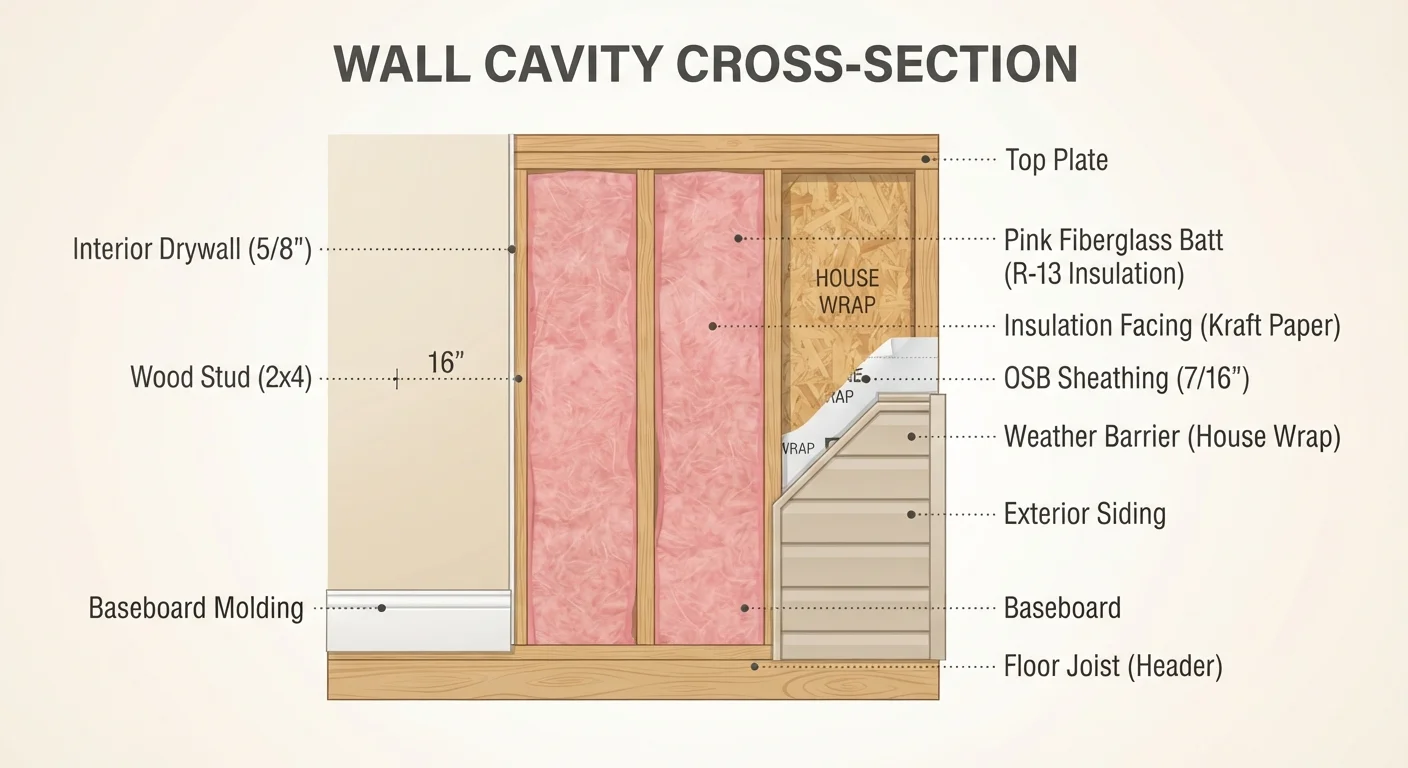
How R-Value Works
Think of R-value as a resistance rating for heat. Heat naturally moves from warm areas toward cooler ones - out of your home in winter, and into it in summer. Insulation slows that movement. The R-value number tells you exactly how much resistance a given material or layer provides against that heat flow.
Every insulation product sold in the U.S. is required to display its R-value on the label. A batt of fiberglass rated R-15 resists heat flow more than one rated R-11. When you see two products side by side, the higher number always means better thermal performance - all else being equal.
Importantly, R-values are additive. If you install R-19 insulation in a wall cavity and then add rigid foam board rated R-6 on the exterior, the combined assembly provides roughly R-25. This additive property makes it straightforward to plan layered insulation strategies.
Up to 20%
Energy saved by sealing and insulating
The U.S. Department of Energy estimates that homeowners can save up to 20% on heating and cooling costs by air sealing and adding insulation to recommended levels.
R-38 to R-60
Recommended attic R-value for most U.S. homes
According to DOE climate zone guidance, most American homes benefit from attic insulation in this range, with colder zones requiring values toward the higher end.
90%
Of U.S. homes are under-insulated
Industry estimates, including data cited by the North American Insulation Manufacturers Association, suggest the vast majority of existing American homes have less insulation than currently recommended.
Why It Matters for Your Home's Energy Efficiency
Insulation with the right R-value for your climate is one of the most cost-effective ways to reduce heating and cooling costs. When walls, attics, and floors are under-insulated, your HVAC system works harder and longer to maintain a comfortable temperature - driving up energy bills and wear on equipment.
The U.S. Department of Energy divides the country into eight climate zones, each with specific R-value recommendations for different parts of the home. A home in Minnesota, for example, will need significantly higher attic R-values than one in central Texas. Meeting or exceeding the recommended values for your zone helps your home hold its temperature more consistently.
Find Your Climate Zone First
Before buying any insulation, look up your climate zone using the U.S. Department of Energy's online zone map. Your zone determines the minimum recommended R-values for your attic, walls, floors, and crawl space. Installing to the right target - not just any improvement - gives you the best return on your investment.
Beyond comfort and cost, adequate insulation also reduces moisture-related problems. Properly insulated assemblies limit the temperature swings inside walls and ceilings that can cause condensation, mold growth, and structural damage over time.
Common Insulation Types and Their R-Values
Different insulation materials achieve different R-values per inch of thickness. Understanding these differences helps you choose the right product for each space:
- Fiberglass batts: Approximately R-2.9 to R-3.8 per inch. Widely available and easy to install in standard stud cavities.
- Mineral wool (rock wool) batts: Approximately R-3.0 to R-3.3 per inch. Also fire-resistant and effective at blocking sound.
- Blown-in cellulose: Approximately R-3.2 to R-3.8 per inch. Good for attics and existing wall cavities where batts can't be added easily.
- Spray foam (open-cell): Approximately R-3.5 to R-3.6 per inch. Seals air gaps as it expands.
- Spray foam (closed-cell): Approximately R-6.0 to R-7.0 per inch - the highest per-inch value of common options. Also acts as a vapor barrier.
- Rigid foam board: Approximately R-3.8 to R-6.5 per inch depending on type. Often used on exterior walls or basement walls.
When space is limited - such as in a shallow roof deck or a basement rim joist - a higher-R-per-inch product like closed-cell spray foam or rigid foam board can help you hit your target without losing square footage.
Key Mistakes That Reduce Effective R-Value
A product's labeled R-value assumes it is installed correctly. Several common errors can significantly reduce real-world performance:
- Compressing batt insulation
- Squishing a thick batt into a shallower cavity reduces its R-value proportionally. An R-19 batt compressed to fit a 2×4 wall cavity will perform closer to R-13.
- Leaving gaps and voids
- Even small gaps around pipes, wires, or at the edges of batts allow heat to bypass the insulation entirely. Careful fitting and sealing matters.
- Ignoring air sealing
- R-value measures resistance to conductive heat flow, not air movement. Air leaks through outlets, attic hatches, and penetrations can significantly undercut insulation performance. Air sealing and insulation work best together.
- Installing over wet surfaces
- Moisture trapped in or behind insulation degrades its performance and promotes mold. Always address moisture problems before insulating.
If you're planning a significant insulation upgrade - particularly in an attic, crawl space, or as part of a renovation - consider having a certified energy auditor assess your home first. They can identify where heat loss is greatest and recommend the most effective improvements for your specific situation.
Permits May Be Required for Major Insulation Work
In some jurisdictions, adding insulation as part of a larger renovation or energy upgrade project may require a building permit or inspection. Requirements vary by state, county, and project type. Check with your local building department before starting significant insulation work, and always hire licensed contractors for work involving electrical, gas, or structural components.
Frequently Asked Questions
The U.S. Department of Energy generally recommends R-38 to R-60 for attic insulation, depending on your climate zone. Homes in colder northern climates need higher values, while southern climates may need less. Check the DOE's zone map for your specific area.
Yes, in most cases stacking or layering the same insulation material roughly doubles the R-value, since R-values are additive. For example, two layers of R-19 batts together provide approximately R-38.
Yes. Insulation can lose effectiveness if it becomes wet, compressed, or damaged by pests. Periodically inspect insulation - especially in attics and crawl spaces - for moisture, settling, or gaps that reduce its rated performance.
Higher R-value provides better thermal resistance, but there are diminishing returns. Adding insulation beyond the recommended level for your zone delivers progressively smaller energy savings. Balance the cost of added insulation against the likely reduction in heating and cooling bills.
Windows are more commonly rated by U-factor, which measures how much heat passes through the glass - essentially the inverse of R-value. A lower U-factor means better insulating performance. Some window manufacturers also list an R-value equivalent.
The content provided on our blog site traverses numerous categories, offering readers valuable and practical information. Readers can use the editorial team’s research and data to gain more insights into their topics of interest. However, they are requested not to treat the articles as conclusive. The website team cannot be held responsible for differences in data or inaccuracies found across other platforms. Please also note that the site might also miss out on various schemes and offers available that the readers may find more beneficial than the ones we cover.