

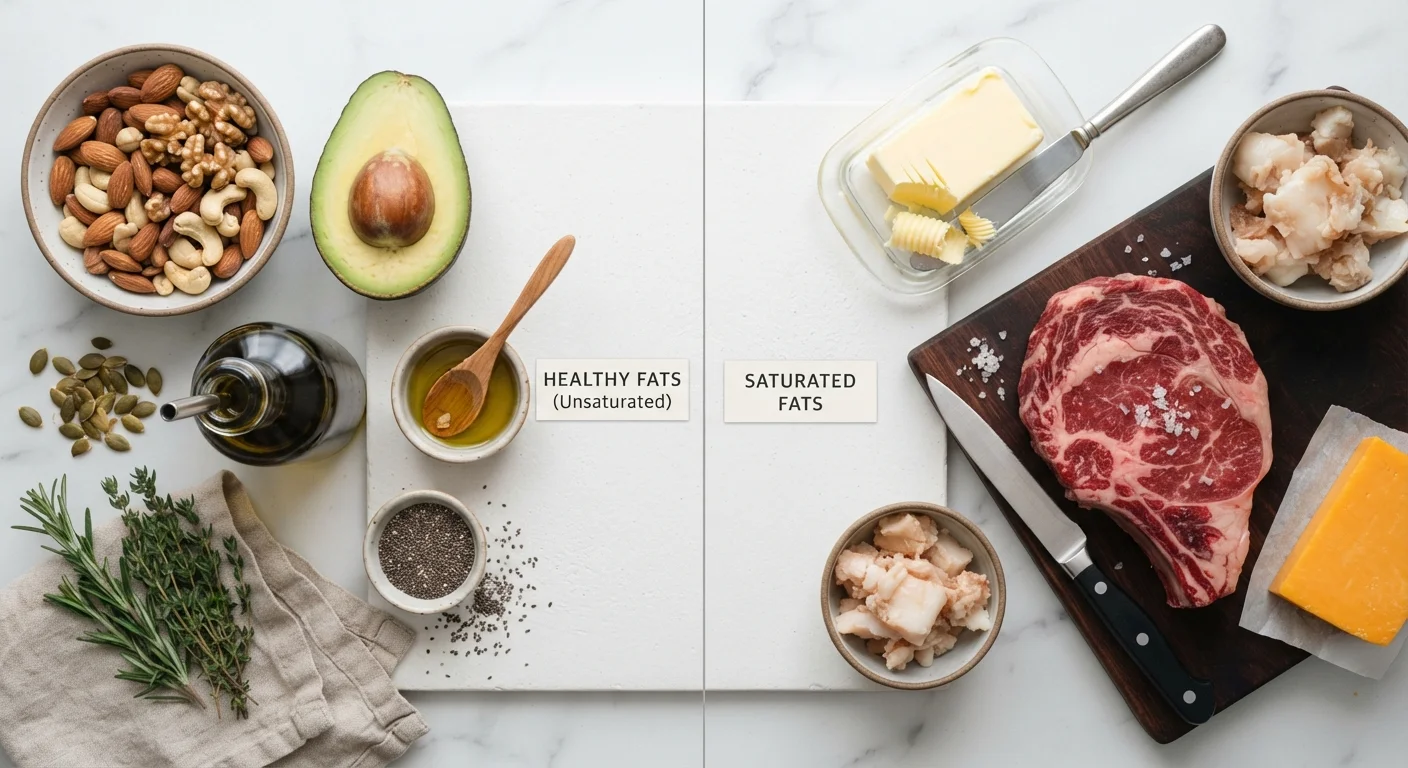
Option A
Saturated Fat
The solid, shelf-stable fat found mainly in animal products.
Best for: Understanding which fat types to moderate - especially for those managing cardiovascular risk factors.
Option B
Unsaturated Fat
The liquid, plant-forward fat with a stronger body of heart-health research.
Best for: Those looking to support cardiovascular and metabolic health through evidence-based dietary shifts.
What Makes These Fats Structurally Different
The core difference between saturated and unsaturated fat comes down to chemistry - specifically, the structure of their fatty acid chains. Saturated fats have no double bonds between carbon atoms; every carbon is "saturated" with hydrogen atoms. This structure makes them solid at room temperature. Think of butter left on a countertop or the white fat visible on a raw steak.
Unsaturated fats contain one or more double bonds in their carbon chains, creating a kinked molecular shape that keeps them liquid at room temperature. Olive oil and sunflower oil are familiar examples. Unsaturated fats are further divided into monounsaturated (one double bond) and polyunsaturated (multiple double bonds), a category that includes omega-3 and omega-6 fatty acids.
| Criterion | Saturated Fat | Unsaturated Fat |
|---|---|---|
| Structure | No double bonds; fully hydrogen-saturated | One or more double bonds in carbon chain |
| Physical state at room temp | Solid (e.g., butter, lard) | Liquid (e.g., olive oil, sunflower oil) |
| Main food sources | Meat, dairy, coconut oil, palm oil | Nuts, seeds, fish, plant oils, avocado |
| Effect on LDL cholesterol | Associated with increased LDL levels | Associated with lower LDL levels |
| Dietary guidance | Limit to <10% of daily calories (AHA/Dietary Guidelines) | Replace saturated fats with these where possible |
| Subtypes | No major subtypes | Monounsaturated and polyunsaturated (incl. omega-3/6) |
Common Food Sources of Each Fat Type
Saturated fat appears most heavily in animal-derived foods: fatty cuts of beef and pork, full-fat dairy products like cheese and butter, and processed meats. Tropical oils - including coconut oil and palm oil - are notable plant-based exceptions with significant saturated fat content.
Unsaturated fats are concentrated in plant oils (olive, canola, sunflower), avocados, most nuts and seeds, and fatty fish like salmon, mackerel, and sardines. The latter are especially rich in long-chain polyunsaturated omega-3 fatty acids, a category linked to cardiovascular and inflammatory benefits in multiple research reviews.
<10%
Recommended saturated fat limit (% daily calories)
The 2020-2025 Dietary Guidelines for Americans advise keeping saturated fat below 10% of total daily caloric intake.
~17%
Average saturated fat share of American calorie intake
Research published using NHANES data suggests many American adults consume saturated fat above recommended levels, largely from meat and dairy.
~30%
LDL reduction potential from dietary fat swaps
Some controlled studies show replacing saturated fat with polyunsaturated fat can reduce LDL cholesterol substantially, though individual results vary.
What the Research Actually Shows
The relationship between dietary fat and health has evolved considerably over the past few decades. Early nutrition science broadly vilified fat, but current evidence takes a more nuanced view: fat type matters more than fat quantity alone.
Major bodies including the American Heart Association and the 2020-2025 Dietary Guidelines for Americans consistently recommend limiting saturated fat to less than 10% of daily calories, based on evidence that high saturated fat intake is associated with elevated LDL (low-density lipoprotein) cholesterol - a recognized risk factor for cardiovascular disease. Replacing saturated fat with polyunsaturated fat has been shown in clinical trials to reduce LDL cholesterol levels and lower cardiovascular risk in population studies.
An important nuance: replacing saturated fat with refined carbohydrates does not appear to offer the same cardiovascular benefit. The substitution that matters is unsaturated fat, not processed starch or sugar. For broader context on dietary patterns with strong research backing, see eating patterns with actual research behind them, which explores how fat quality fits into frameworks like the Mediterranean and DASH diets.
The Whole-Diet Perspective Matters
Focusing solely on a single nutrient can be misleading. Research consistently shows that overall dietary patterns - not isolated fat intake - are the strongest predictors of long-term health outcomes. A diet rich in whole foods, vegetables, legumes, and minimally processed grains generally provides a healthful balance of fat types naturally. Consider speaking with a registered dietitian to evaluate your personal dietary pattern as a whole.
This article is for general informational and educational purposes only and is not a substitute for professional medical or dietary advice. Speak with a qualified healthcare provider or registered dietitian for guidance specific to your health situation.
The content provided on our blog site traverses numerous categories, offering readers valuable and practical information. Readers can use the editorial team’s research and data to gain more insights into their topics of interest. However, they are requested not to treat the articles as conclusive. The website team cannot be held responsible for differences in data or inaccuracies found across other platforms. Please also note that the site might also miss out on various schemes and offers available that the readers may find more beneficial than the ones we cover.