

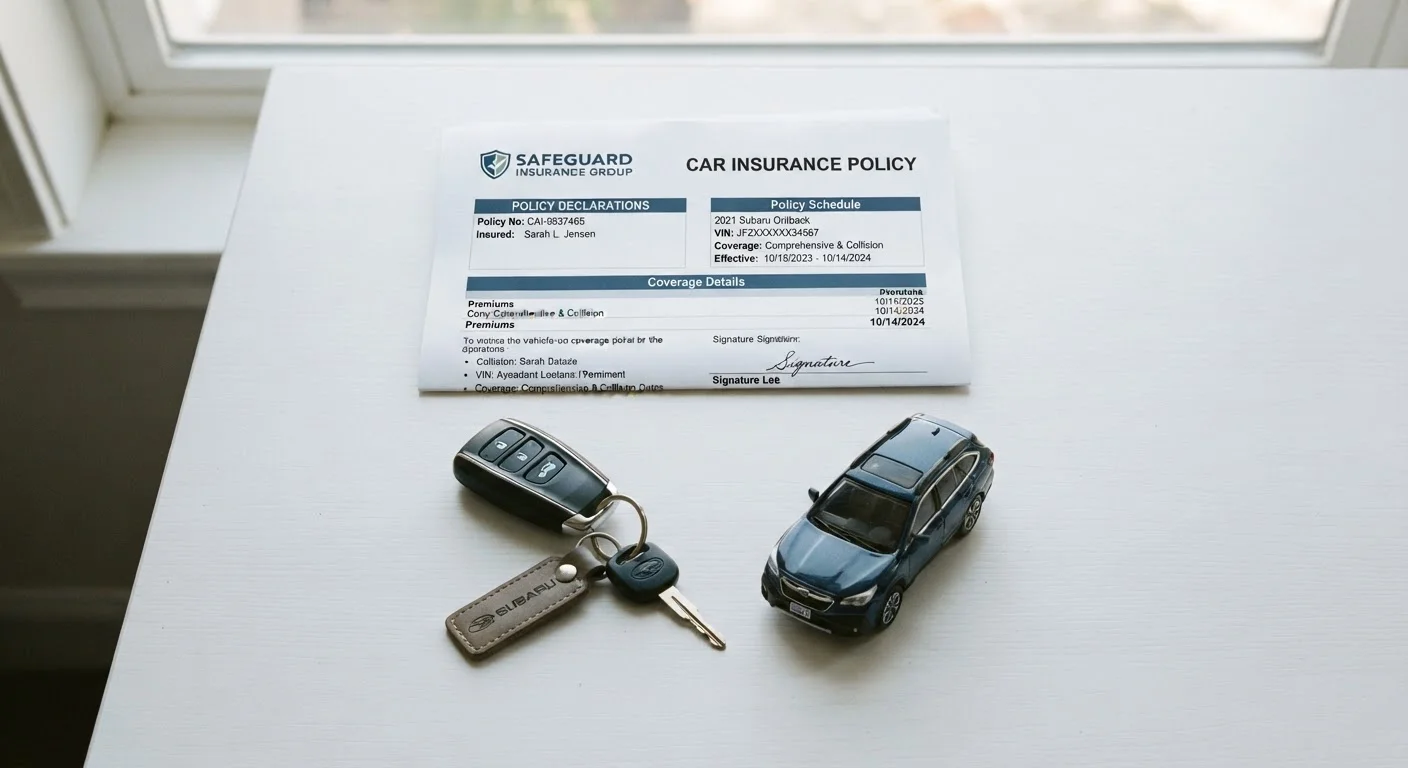
The Core Coverage Types Found in Most Policies
Auto insurance isn't one single product - it's a package of distinct coverage types, each protecting against a different risk. Understanding what each one does (and doesn't) cover is the foundation of making smart decisions about your policy.
Liability Coverage
Liability is the coverage required by law in most states. It's split into two parts: bodily injury liability, which pays for medical expenses, lost wages, and legal costs for people you injure in an accident you caused; and property damage liability, which pays to repair or replace another person's vehicle or property you damage. Liability coverage does not pay for your own injuries or your own vehicle.
Collision Coverage
Collision coverage pays to repair or replace your vehicle when it's damaged in an accident with another car or a stationary object - a guardrail, a parked car, or a pole, for example. It applies regardless of who was at fault. A deductible applies, meaning you pay the first portion of the repair bill.
Comprehensive Coverage
Comprehensive covers losses that aren't caused by a collision. Common examples include theft, vandalism, fire, flooding, hail damage, and striking an animal. Like collision, it carries a deductible. Lenders and leasing companies almost universally require both collision and comprehensive on financed vehicles.
~13%
U.S. drivers estimated to be uninsured
According to the Insurance Research Council, roughly one in eight drivers on American roads carries no auto insurance.
49 of 50
States requiring minimum liability coverage
Nearly every U.S. state mandates drivers carry at least a minimum level of liability insurance; specific minimums differ by state.
$500-$1,000
Common collision deductible range
Industry data shows most drivers choose deductibles in the $500-$1,000 range, balancing premium savings against out-of-pocket risk.
Additional Coverages That Fill the Gaps
Beyond the three main types, most policies offer - and some states require - additional protections worth understanding.
Uninsured and Underinsured Motorist Coverage
If you're hit by a driver who has no insurance, or whose policy limits aren't high enough to cover your losses, uninsured/underinsured motorist (UM/UIM) coverage steps in. It can cover your medical bills, lost wages, and in some states, vehicle damage. Many insurance professionals consider this one of the most valuable coverages to carry, given that a significant share of U.S. drivers operate without adequate insurance.
Medical Payments and Personal Injury Protection
Medical payments (MedPay) coverage pays for medical expenses for you and your passengers after an accident, regardless of fault. Personal injury protection (PIP) is a broader version required in so-called no-fault states; it typically covers medical bills, lost income, and certain other costs. The availability and requirement of PIP varies by state.
Gap Insurance
If you finance a new vehicle and total it shortly after purchase, your car's actual cash value - what the insurer pays - may be less than what you still owe on your loan. Gap insurance covers that difference. It's often offered through lenders and dealers but can also be added through your insurer.
Review Your Coverage When Your Car's Value Changes
As a vehicle ages and depreciates, the cost of carrying collision and comprehensive coverage may eventually exceed what the insurer would pay out in a total-loss scenario. Checking your car's current market value annually and comparing it to your coverage costs helps you decide whether adjusting your policy makes sense. For a full discussion of how to think through that trade-off, see liability-only vs. full coverage.
Reading Your Policy's Declarations Page
The declarations page (often called the "dec page") is the summary sheet at the front of your policy. It lists your name, vehicle, policy period, each coverage type you carry, the corresponding limits, and your deductibles. If you've ever wondered exactly what you're paying for, start there.
Coverage limits are typically written as three numbers for liability - for example, 25/50/25. This means $25,000 per person for bodily injury, $50,000 per accident for bodily injury, and $25,000 for property damage. State minimum limits are often low enough that a serious accident could expose you to out-of-pocket costs beyond what your insurer pays.
For a plain-language glossary of insurance and ownership terms, see our car ownership terms reference guide. To dig into the factors that influence what you pay for all of this coverage, learn about the variables that quietly raise your premium.
Common Misconceptions About What's Covered
Many drivers assume their personal auto policy automatically covers a vehicle used for rideshare driving or delivery work - it typically doesn't. Commercial or rideshare-specific endorsements are usually required. Similarly, personal belongings stolen from your car generally aren't covered by auto insurance; they'd fall under a homeowners or renters policy. For more on these and other common misunderstandings, see auto insurance myths that cost drivers real money.
This article provides general information about auto insurance concepts and is not a substitute for advice from a licensed insurance professional. Coverage availability, requirements, and terms vary by state and insurer. Always review your own policy documents and consult a licensed agent for guidance specific to your situation.
Frequently Asked Questions
Nearly every U.S. state requires drivers to carry at least a minimum level of liability insurance. New Hampshire is the main exception, though drivers there must still demonstrate financial responsibility. Specific minimums vary by state, so check your state's DMV for current requirements.
A deductible is the portion of a covered loss you pay before your insurer pays the remainder. For example, a $500 deductible on a $3,000 repair means you pay $500 and your insurer pays $2,500. Higher deductibles generally lower your monthly premium but increase your out-of-pocket cost when you file a claim.
No. Liability coverage only pays for damage or injuries you cause to other people and their property. To cover repairs to your own vehicle after an at-fault accident, you need collision coverage.
Collision coverage applies when your car is damaged in an accident involving another vehicle or object. Comprehensive coverage applies to losses that aren't a collision - such as theft, fire, flooding, hail, or a deer strike.
Once a vehicle is paid off, lenders no longer require full coverage, so the choice is yours. Whether it makes financial sense depends on your car's current value, your savings, and your risk tolerance. See our guide on <a href="/cars-driving/car-ownership-basics/liability-only-vs-full-coverage-choosing-the-right-level-of-protection">liability-only vs. full coverage</a> for a detailed breakdown.
Only if you've added rental reimbursement coverage to your policy - it's usually an optional add-on. Without it, you'd pay for a rental out of pocket while your car is being repaired. Review your declarations page or contact your insurer to confirm what's included.
The content provided on our blog site traverses numerous categories, offering readers valuable and practical information. Readers can use the editorial team’s research and data to gain more insights into their topics of interest. However, they are requested not to treat the articles as conclusive. The website team cannot be held responsible for differences in data or inaccuracies found across other platforms. Please also note that the site might also miss out on various schemes and offers available that the readers may find more beneficial than the ones we cover.